


Top 15 Answer Engine Optimization Tools

Google reports that AI Mode passed 1 billion monthly active users and that the Gemini app has 950 million.[efn_notehttps://blog.google/company-news/inside-google/message-ceo/alphabet-earnings-q2-2026/[/efn_note] For brands, this means a ranking position no longer tells the whole story. Answer engine optimization (AEO) tools, also called generative engine optimization (GEO) tools, track whether and how AI systems such as ChatGPT, Google AI Overviews, AI Mode, Gemini and Perplexity mention a brand.
We examine the website of 15 and gain hands-on experience with 7 AEO/GEO tools.
Comparison of answer/generative engine optimization tools
Product | Automated query
generation | Sentiment analysis | Mention URLs | Free trial |
|---|---|---|---|---|
Otterly AI | ✓ | ✕ | ✕ | ✓ |
ZipTie | ✕ | ✓ | ✓ | ✓ |
Cognizo | ✓ | ✓ | ✓ | ✕ |
Peec AI | ✓ | ✓ | ✓ | ✓ |
GetCito (AI Monitor) | ✕ | ✓ | ✕ | ✕ |
RankScale | ✕ | ✓ | ✓ | ✓ |
Nightwatch | ✕ | ✕ | ✓ | ✓ |
Rank Prompt | ✓ | ✕ | ✓ | ✕ |
Profound | N/A | ✓ | ✓ | ✕ |
Scrunchai | ✕ | ✓ | ✕ | ✕ |
For further information, read the key features.
Otterly AI
Otterly focuses on AI-based keyword visibility. Instead of relying on traditional search engine optimization (SEO) tools, it scans a site to suggest keywords and prompts an AI engine might pick up.
Summary of our experience:
We’ve tested Otterly AI for keyword exploration and found that it often proposes user queries with zero-click searches, which limits usability. While it scans the domain to generate keywords and prompts, its reliance on Google search volume makes it less effective.
Strength(s)
✓ Scans your domain content and name to suggest custom keywords.
✓ After conducting keyword research based on the domain content, the platform also offers search prompt ideas related to these SEO keywords.
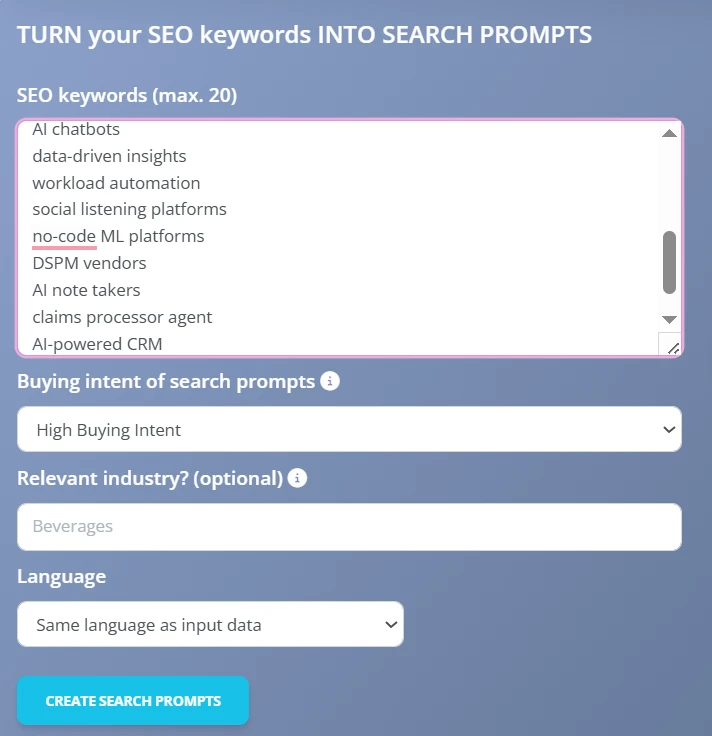
✓ Shows how a brand appears across AI-generated content.
✓ Offers weekly updates on your visibility.
✓ Supports Looker Studio reporting across major AI search surfaces, including Google AI Mode.
Limitation(s)
✕ A key limitation is that the prompt suggestions often target keywords with no existing organic search traffic. This may reduce their value for driving visibility.
✕ No tracking of exact URLs where you’re mentioned.
✕ No sentiment analysis.
ZipTie
ZipTie is known for broad geographic tracking. It monitors how a brand appears in AI responses across 10+ countries.
Summary of our experience:
In our experience, ZipTie’s keyword suggestions feel loosely connected to the name of the actual domain and tend to be of poor quality. Although it allows for update frequency settings and language selection, the overall performance and insight depth left us disappointed.
Strength(s)
✓ Tracks mentions on search engines such as ChatGPT, Google AI Overviews, Perplexity, and others.
✓ Shows competitor appearances in the same results.
✓ Offers a prompt success score, helping you focus on prompts that work best.
✓ Supports country and language-specific user queries.
Limitation(s)
✕ Prompts aren’t always well-aligned with your domain’s content.
✕ Data refresh speed depends on pricing tier.
Cognizo
Cognizo offers in-depth analytics for those who know the questions they want to track.
Summary of our experience:
We appreciated Cognizo’s detailed analytics, especially the ability to see how often our keywords appear in specific questions and how we compare to competitors.
Strength(s)
✓ Focuses on large language model platforms.
✓ Tracks brand mentions by specific question, keyword, or topic.
✓ Highlights competitors on a per-question basis.
✓ Lets agencies create reports for multiple clients.
Limitation(s)
✕ Analysis might take time.
Peec AI
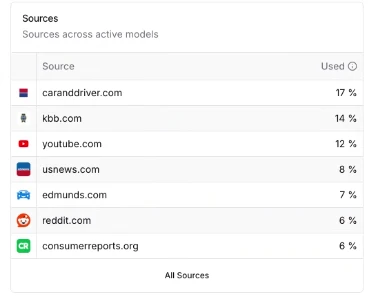
Peec AI Peec AI tracks how often and where a brand appears in AI-generated answers, and which sources the AI systems rely on when they mention it.
Strength(s)
✓ Tracks how often and where the brand is mentioned.
✓ Breaks down the sources AI tools rely on (e.g., Twitter vs. Wikipedia).
✓ Sends alerts when brands’ visibility changes.
✓ Shows actual result pages that mention the given domain.
✓ Updates ranking daily.
✓ Actions, introduced in February 2026, turn visibility data into a prioritized list of next steps. It groups similar sources, shows where competitors are cited and the brand is not, and gives each opportunity a low, medium or high score based on how often AI models cite that source type.1
✓ Brand perception, introduced in September 2026, shows which attributes AI models associate with a brand, recurring objections to it, and the sources behind them. It can also check AI claims against facts the user defines.2
Limitation(s)
✕ Actions suggest what to create or where to get mentioned, but they do not write the content. Drafting and outreach happen outside the tool.
GetCito (AI Monitor)
GetCito, previously known as AI Monitor, works more like a consulting service. It’s less about dashboards and more about insight-packed reports.
Summary of our experience:
When we tried AI Monitor, their focus seemed to be on selling insight-driven reports, and the prompts were clearly generated based more on the domain name than the actual content.
Strength(s)
✓ Offers brand benchmarking and platform comparisons.
✓ Monitors how AI crawlers interact with the content.
✓ Identifies technical issues like blocked crawlers or indexing problems.
✓ Focused on organic traffic and conversion insights from AI sources.
Limitation(s)
✕ No self-service interface or prompt generation.
✕ Brand visibility is not always presented in real time.
✕ Appears to use brand name more than site content for prompt suggestions.
RankScale
RankScale focuses on measuring how often a brand appears in AI-generated answers. The tool tracks brand mentions and rankings across several AI platforms.
Strength(s)
✓ Tracks brand mentions across 17+ AI platforms.
✓ Shows how often a brand appears compared to competitors.
✓ Provides a simple visibility score to summarize performance.
Limitation(s)
✕ Limited insights into the sources or content behind AI answers.
Nightwatch
Nightwatch offers a feature for tracking how brands appear in AI-generated answers. The platform focuses on monitoring brand mentions and basic visibility signals across AI systems.
Summary of our experience:
When testing Nightwatch, we found that the platform does not generate prompts based on a website’s domain or content. Instead, it includes a chatbot-style interface that can provide general information about a brand. However, the tool mainly returns descriptive information rather than deeper insights about AI search visibility or performance.
Strength(s)
✓ Includes a chatbot-style interface for exploring brand-related information.
✓ Allows basic monitoring of brand presence in AI-generated responses.
Limitation(s)
✕ Does not generate prompts based on domain content.
✕ Limited analytics compared to tools focused specifically on AI search tracking.
RankPrompt
RankPrompt focuses on AI visibility through prompt-based research. Instead of keywords, it explores how AI engines respond to different queries related to your brand, product, or topic.
Summary of our experience:
When testing RankPrompt, we found that the platform initially generates around 100 prompts across three broad categories. These categories felt quite general at first, but the resulting prompts were surprisingly well-fitted to the domain context.
Strength(s)
✓ Provides domain-based prompt generation in broad but relevant topic areas.
✓ Offers well-matched prompts that reflect brand or content context.
✓ Designed specifically for AEO-style visibility tracking through prompt evaluation.
Limitation(s)
✕ Visibility results and detailed analytics are locked behind paid credits.
✕ Limited to prompt-based tracking, no keyword or traffic visibility metrics.
Profound
Profound helps brands understand tone and content of AI answers, not solely visibility.
Strength(s)
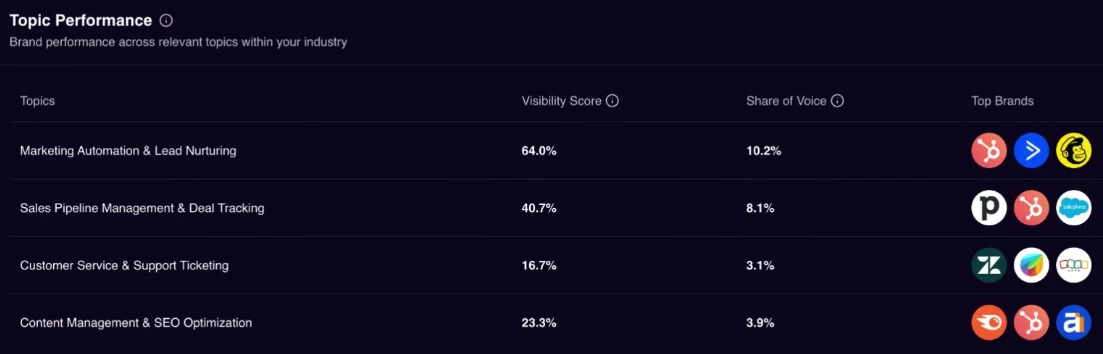
✓ Assigns a visibility score and tracks share of voice for AI search results.
✓ Shows tone, keywords, and phrases AI-generated responses use to describe given brand.
✓ Maps which sources AIs rely on for information.
✓ Allows prompt testing using both custom and real-world search queries.
Limitation(s)
✕ Does not generate automated prompts.
Scrunchai
ScrunchAI offers a wide feature set for monitoring and optimization.
Strength(s)
✓ Simulates different user intents to see how AI answers change.
✓ Tracks citations and source credibility.
✓ Identifies misinformation, outdated content, and content gaps.
✓ Runs technical diagnostics, like checking if the given pages are even visible to AI crawlers.
✓ Links mentions to actual site visits.
Limitation(s)
✕ No automated prompt generation based on domain content.
Athenahq
Athenahq helps brands monitor how they appear in AI-generated content.
Strength(s)
✓ Pinpoints content gaps by showing when AI tools miss key facts about your business.
✓ Offers a built-in Action Center provides some “next steps”, based on the insights from analysis.
Limitation(s)
✕ From our experience, we can see that automated prompt generation also appears to be influenced by the website’s name, in addition to its content. This can result in prompts with keywords that are weakly related to the actual brand.
✕ Relies on ChatGPT
AirOps
AirOps is a generative answer optimization (AEO) and SEO analysis tool. Instead of showing AI search visibility, AirOps analyzes how existing pages perform across key quality signals that matter for AI systems. These include freshness, structure, authority, brand alignment, and the ease with which AI can extract short answers.
Summary of our experience:
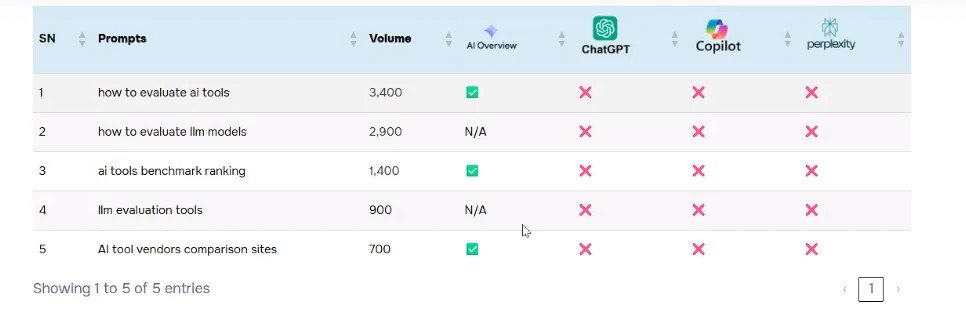
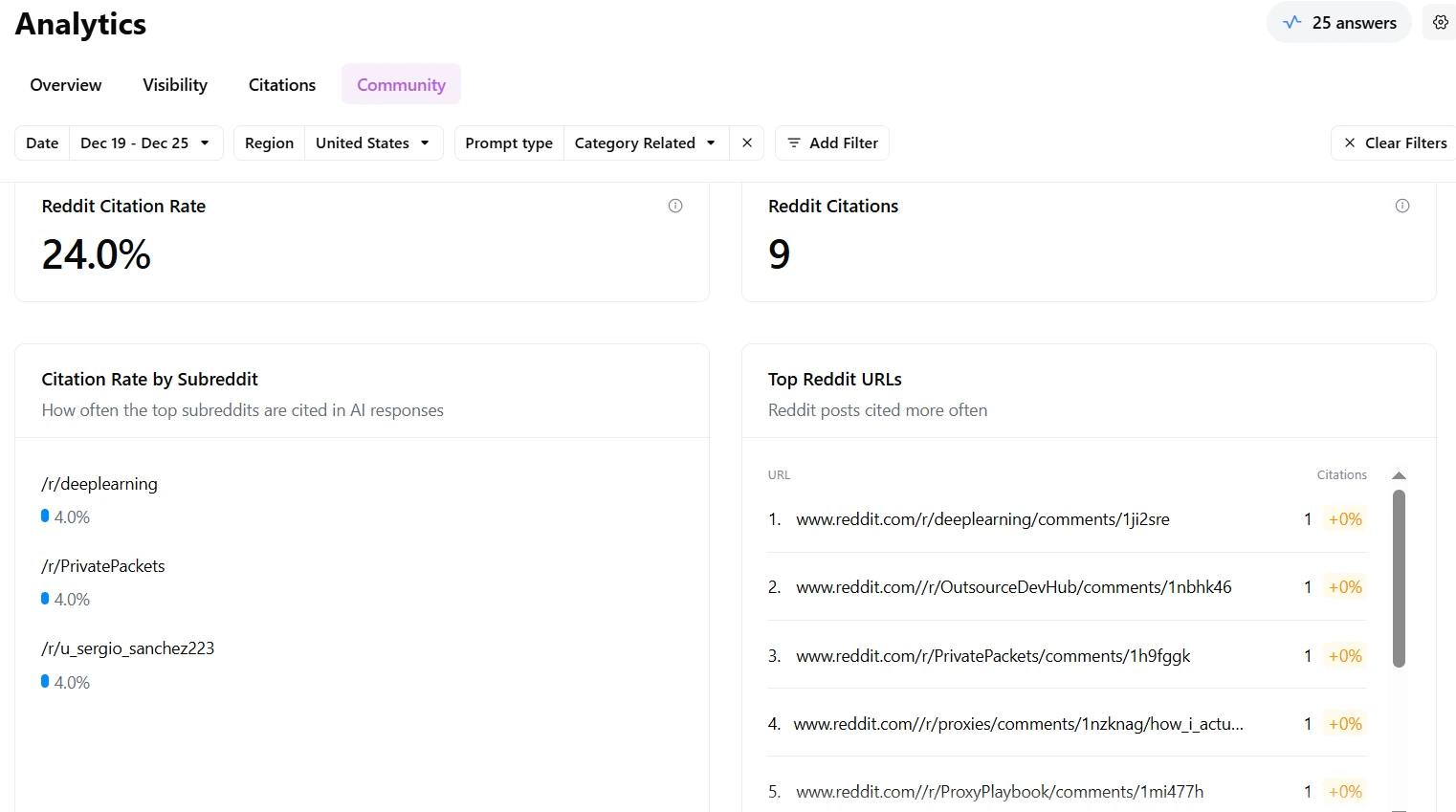
When we tested AirOps, it generated prompts based on the selected domain and provided detailed page-level SEO and AEO analysis. One notable feature was its visibility into off-site signals, such as Reddit citation rates and specific Reddit comment URLs where the domain was mentioned. The tool also produced clear, structured recommendations for improving a selected page.
Strength(s)
✓ Provides domain-level and sample URL-level insights.
✓ Shows external signals, such as Reddit mentions and citation patterns.
✓ Combines SEO and AEO analysis in a single audit.
✓ Provides insights on where to invest.
Limitation(s)
✕ Less focused on real-time prompt testing.
✕ More analytical than exploratory, which may feel heavy for quick checks.
Ahrefs
is mainly known as an SEO platform. Its AI monitoring tool, Brand Radar, tracks how a brand appears in Google AI Overviews, AI Mode, ChatGPT, Perplexity, Gemini and Copilot. Claude is available for custom prompts.3
Summary of our experience:
We tested Ahrefs Brand Radar by entering our brand name, keywords, and competitors manually. The platform does not automatically scan the site or generate queries. The resulting insights were limited in depth and felt more like repackaged SEO data than genuine AI search tracking. Sentiment detection was available but often vague.
Strength(s)
✓ Uses AI to expand keyword lists and group them by difficulty, intent, and CPC.
✓ Tracks keyword trends and search volumes.
✓ Helps with identifying long-tail keywords and ad planning.
Limitation(s)
✕ User must input all keywords and competitor info manually.
✕ Results can feel less actionable for AI-focused use cases.
Semrush
Semrush offers AI-enhanced keyword research tools. It focuses on discovering keyword opportunities, search trends, and intent for both paid and organic search strategies. Compared to others, it starts in the traditional SEO space. However, Semrush added an AI Visibility feature to track GEO visibility.
Strength(s)
✓ Analyzes keyword difficulty, trend, CPC, and intent.
✓ Helps identify low-competition long-tail keywords.
Limitation(s)
✕ Shows which of your own pages AI platforms cite (Cited Pages), but not every third-party URL where the brand is mentioned.4
✕ The AI Visibility Toolkit is a paid add-on with no free trial, and the base plan includes 25 tracked prompts.
DemandSphere
DemandSphere measures visibility primarily through keyword tracking rather than prompts. The tool operates similar to an SEO analytics platform but integrates AI search behavior, focusing on how target keywords perform across both Google and AI-enhanced results.
Summary of our experience:
We found that DemandSphere relies on user-defined keyword lists rather than automatically generating them. Once keywords are added, the platform provides related “People also ask” questions and visibility insights tied to Google Search Console data. It’s effective for keyword-based visibility but feels closer to traditional SEO tracking than full AEO monitoring.
Strength(s)
✓ Let users define and track their own keywords.
✓ Surfaces “People also ask” questions for contextual keyword expansion.
✓ Integrates well with Google Search Console data for performance analysis.
Limitation(s)
✕ Does not track prompt-based visibility or AI-generated query responses.
✕ Heavily SEO-oriented, offering limited insight into LLM-based or AI engine visibility.
Key features of answer engine optimization tools
Automated query generation
Most AEO tools aim to automatically create search queries by scanning a domain or using its name. However, we’ve found that these queries sometimes lack relevance or don’t reflect actual user search behavior. This reduces their value for conducting keyword research or optimizing for user intent.
Sentiment analysis
A few tools attempt to show user sentiment linked to mentions of a brand or topic. While potentially helpful for digital marketing or enhancing user experience, this feature is often underdeveloped and lacks depth.
Learn more on sentiment analysis with AI-based tools, read
- Sentiment Analysis Benchmark Testing: ChatGPT, Claude & DeepSeek
- Methods for Audio Sentiment Analysis
- Open Source Sentiment Analysis Tools
Mention URLs
We’ve seen tools that identify where and how a brand or keyword is mentioned, often linking to specific URLs. This can help analyze referral traffic, audit backlink quality, and understand where AI-generated answers may be pulling from.
Why these features matter
- Optimizing for answer engines means creating precise answers that align with user queries and AI-generated responses.
- Using structured data markup like FAQ pages and schema markup helps AI engines extract relevant answers.
- Understanding user behavior and intent allows for better content structuring, internal linking, and targeting for voice search and AI assistants.
- By integrating these insights, marketing teams can go beyond traditional SEO strategies and improve online visibility in natural language-driven search environments.
How the tools changed in 2026
Three shifts stand out this year.
From tracking to guidance. Several tools moved past visibility scores into recommendations. Peec AI introduced Actions in February 2026. It groups the sources AI models cite and suggests where a brand should publish, optimize or get mentioned.1 AthenaHQ has a similar Action Center.
From guidance to execution. Profound launched Workflows in public beta on December 11, 2025, and renamed the product Agents on February 3, 2026. Agents use Profound’s visibility data to draft content briefs, manage approvals and publish to a CMS.5 The market is moving from “show the score” to “suggest the fix” and, in some tools, “carry out the fix.”
SEO suites added AI tracking. Semrush sells an AI Visibility Toolkit that reports brand performance across Google AI Overviews, AI Mode, ChatGPT, Perplexity and Gemini, and lists the pages on a site that AI platforms cite.4 Ahrefs Brand Radar runs search-backed prompts through AI Overviews, AI Mode, ChatGPT, Perplexity, Gemini and Copilot. Its help center says chatbot data refreshes monthly, while Google AI Overviews and AI Mode data update continuously.3 This gives buyers one tool for search and AI tracking, though in our tests the depth often lagged purpose-built tools.
Paid placements arrived. OpenAI began testing ads in ChatGPT in early 2026 for logged-in adult users on the Free and Go tiers in the U.S. OpenAI says ads appear separately from the answer and do not influence it.6
Agentic commerce: the next test for AEO
AI assistants have started to play a role in shopping, not just in research, but the setup is still changing.
OpenAI launched Instant Checkout in ChatGPT in September 2025. In March 2026, it changed course. An OpenAI spokesperson said Instant Checkout “is moving to Apps,” and OpenAI said it would let merchants use their own checkout while it focuses on product discovery. Target, Sephora, Nordstrom, Lowe’s, Best Buy, The Home Depot and Wayfair have integrated OpenAI’s Agentic Commerce Protocol for discovery.7
Google took the opposite route. In January 2026 it announced the Universal Commerce Protocol (UCP), an open standard built with Shopify, Etsy, Wayfair, Target and Walmart. UCP powers a checkout option for eligible U.S. retailers inside AI Mode in Search and the Gemini app, with the retailer remaining the merchant of record.8
Either way, the AI reads structured product data, reviews, and terms such as shipping and returns before it recommends a product. A missing specification or an outdated price can keep a product off the shortlist.
For e-commerce, AEO now goes beyond text. It covers accurate product feeds, clear policies, and clean structured data that an agent can read and act on.
FAQs
Prompts for answer or generative engine optimization (AEO or GEO) include “What is answer engine optimization?”, while SEO focus on keywords like “answer engine optimization”
Yes. Tools that rely on official LLM APIs often return shorter answers, fewer sources, and different brand mentions than what users actually see in AI interfaces like ChatGPT or Perplexity. Scraping answers directly from the interface provides a more accurate view of AI visibility, which is crucial for monitoring brand presence and optimizing content for real-world AI search results.9
Confirm AI can read the page. On July 1, 2025, Cloudflare changed its default so that known AI crawlers are blocked unless the site owner allows them.10 Check the CDN and robots.txt settings. A page hidden behind JavaScript, a login, or a dropdown is also hard for an AI crawler to read.
Add evidence, not keywords. In the GEO study from Princeton and partners (KDD 2024), which tested nine content changes on a 10,000-query benchmark, adding quotations, statistics and source citations improved visibility in AI answers by roughly 30–40%. Keyword stuffing did not help and sometimes performed worse than leaving the text unchanged.11Keep content fresh. An Ahrefs analysis of 17 million citations across seven AI platforms found that the URLs AI assistants cite are on average 25.7% newer than the URLs in Google’s organic results. ChatGPT showed the strongest preference for newer pages; Google AI Overviews the weakest.12 This is a correlation and does not prove that updating a page causes more citations.
Earn mentions off the site. AI systems learn about a brand from the wider web. Tools such as Peec AI and Ahrefs Brand Radar show that Reddit threads, review sites and editorial listicles are frequently cited sources.
 Add as preferred source
Cite this research
Pick the format that matches where you're publishing. Pasting the link version into your CMS preserves the backlink.
@misc{arslan2026,
  author = {Arslan, Ezgi},
  title  = {{Top 15 Answer Engine Optimization Tools}},
  year   = {2026},
  month  = jul,
  howpublished    = {\url{https://aimultiple.com/answer-engine-optimization-tools}},
  note   = {AIMultiple. Retrieved July 1, 2026}
}Results and timestamps of 15 data points. Download the summary data shown in this article's charts and tables as a ZIP file containing one CSV file.
Want the granular data behind it? Join Premium
Changelog
6 updatesAdded sections on 2026 AEO tool trends and agentic commerce.
Added a Gartner prediction to the Answer/generative engine optimization tools section.
Reference Links




Be the first to comment
Your email address will not be published. All fields are required. Comments are left in their original language.