


Compare 20+ Cloud Orchestrators

Picking the correct cloud orchestration tool is a challenge since there are more than 20 cloud orchestrators and various tool types.
Follow the links below to screen these orchestrators’ features, benefits and case studies:
- Service orchestration and automation: Stonebranch & RunMyJobs
- Container orchestration: Kubernetes
- DevOps automation: Chef & Microsoft Azure Data Factory
- Infrastructure provision & orchestration: AWS CloudFormation, OpenStack, Red Hat Ansible & Terraform
- Monitoring and management: New Relic
Leading cloud orchestration tools
* IT orchestration tools cover all orchestration requirements while others are more focused on specific domains. More info on each orchestration approach is provided under its section below.
Sorting is in alphabetical order within each tool category, with the exception of subscribers (i.e. products with links to their websites), that are placed at the top of the list.
Selection criteria contains:
- Employee count: 10+ employees on LinkedIn.
- Presence on B2B review sites: 1+ reviews on B2B user review sites.
Service orchestration and automation
Check out the full list of service orchestration platforms, also known as IT orchestration tools.
1. Stonebranch
Stonebranch UAC can manage IT workflows across hybrid and multi-cloud environments. Stonebranch capabilities include:
- Multi-cloud orchestration to automate workloads and transfer data across AWS, GCP, Azure, SaaS apps, and on-prem tools.
- Cloud infrastructure orchestration to centrally manage server provisioning and integrate with tools.
- Hybrid cloud data transfer between local servers, cloud providers, and storage platforms.
- Schedule and manage containerized microservices with integration into platforms like OpenShift.
2. RunMyJobs
RunMyJobs by Redwood is a Cloud Security Alliance STAR Level 1 certified cloud orchestration tool. It supports hybrid cloud deployment, manage jobs across distributed cloud environments and integrate to various systems, such as: SAP, Oracle, Amazon S3 and Azure. Some of the capabilities of RunMyJobs are:
- Single-tenant cloud architecture ensures dedicated resources for each user and includes maintenance and uptime, providing reliability and minimal downtime.
- Flexible load balancing and process prioritization allows easy adjustments across applications to prevent delays and slowdowns, enhancing performance and efficiency.
- Self-updating lightweight agents enable virtual machine setup and script execution on multiple operating systems (e.g. Windows, Linux, AIX, HPUX, macOS, OpenVMS, and Solaris) with minimal resource use and no need for local hardware, ensuring seamless and quick system upgrades. With these agents, RunMyJobs upgrades are completed with a single click in minutes, unlike manual upgrades that take months and require significant resources.
- Entire cloud platform redundancy that duplicates critical parts, so if one fails, another takes over seamlessly, ensuring continuous operation without downtime.
- RangerAI which is an integrated AI agent framework to autonomously orchestrate full automation lifecycle (e.g. design, execution, monitoring, and optimization).
Explore Pros & Cons of RunMyJobs.
3. ActiveBatch
ActiveBatch offers a flexible and scalable hybrid cloud management platform to monitor, manage and optimize virtual machines, and private and public-cloud resources and environments while minimizing cloud costs.
ActiveBatch offers:
- Low-code/no-code drag-and-drop visual interface to design, execute, and monitor workflows.
- Managed smart queues feature to automatically allocate temporary cloud virtual machines to handle high-volume workloads.
- Out-of-the-box integrations to connect with major cloud providers, including Informatica Cloud, VMware, Amazon EC2 and Microsoft Azure.
- Low-code REST API adapter to build integrations and connectors to any application or service without the need for custom scripting.
4. JAMS Scheduler
JAMS provides cross-platform scheduling across Windows, Linux, UNIX, and cloud environments. JAMS transitioned into an independent company backed by PSG and 2ndWave, allowing for a renewed focus on its core automation mission.
- Pre-built connectors for applications like Microsoft SQL Server, Oracle, SAP, and cloud platforms such as AWS and Azure.
- Centralized job scheduling capability to schedule, monitor, and manage jobs across cloud, on-premises, and hybrid environments.
- Cross-platform automation via native support for Windows, Linux, UNIX, and cloud platforms.
- Advanced job dependencies and triggers to optimize execution order and reduce processing delays.
Container orchestration
Explore other container orchestration tools to manage containerized applications across cloud environments.
5. Kubernetes
Kubernetes coordinates microservices, resource utilization, and dynamic scaling based on demand. Kubernetes offers features like self-healing capabilities, service discovery, and multi-cloud portability.
DevOps automation
Check out more DevOps automation tools to automate software development and deployment processes in the DevOps lifecycle.
6. Chef
Chef automates the configuration, deployment, and management of infrastructure and applications in cloud environments. Its key features include infrastructure-as-code practices, role-based access control, and a large library of pre-built cookbooks. Chef Software recommends migrating to Chef 360, a SaaS-based platform as the on-premises Chef Infra Server will reach end-of-life after October 2026.
7. Microsoft Azure Data Factory
Microsoft Azure Data Factory is a Platform as a Service (PaaS) solution that orchestrates data workflows and pipelines across various data sources without handling underlying hardware. The legacy tool Azure Data Factory is expected to complete its transition to Microsoft Fabric Data Factory service by the end of this year.
Infrastructure provision & orchestration
8. AWS CloudFormation
AWS CloudFormation streamlines cloud orchestration by enabling the provisioning and management of cloud resources through templated configurations. It facilitates the automation of infrastructure deployment, updates, and version control, ensuring consistency and scalability. AWS CloudFormation integrates with AWS services, allowing users to leverage multiple tools from the same cloud service provider.
Three steps to deploy AWS CloudFormation:
- Drift-aware change sets: Features a three-way diff between the new template, the last-deployed version, and the actual live state.
- Stack refactoring: Allows users to move or rename resources across stacks without disrupting live services.
- Developer tools: Includes a CloudFormation Language Server (LSP) for better IDE integration and template validation at the change-set creation stage to catch errors early.
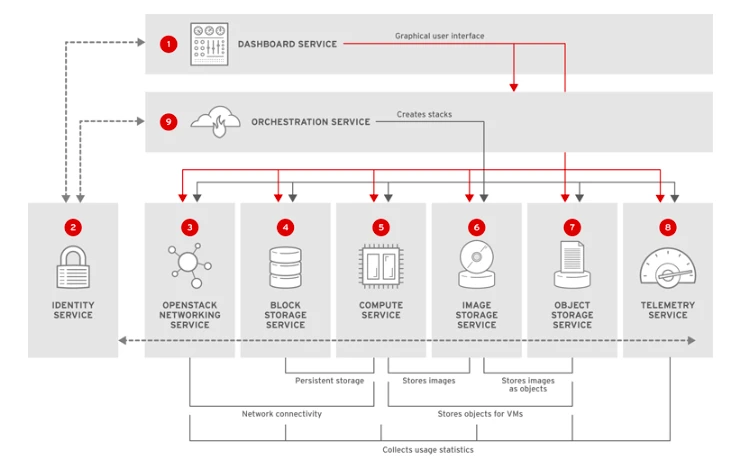
9. OpenStack
OpenStack orchestrates, compute, store and network cloud resources. It offers multi-tenancy support, self-service provisioning, and integration with various cloud technologies.
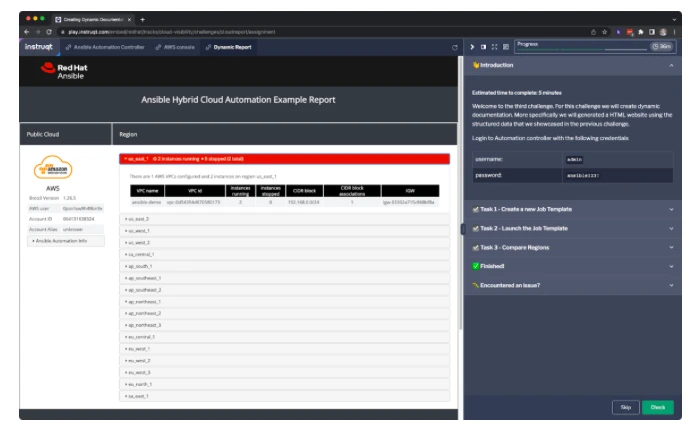
10. Red Hat Ansible
Red Hat Ansible offers agentless architecture, simplifying orchestration tasks, and ensuring consistent configurations. Ansible’s features include integration capabilities and support for heterogeneous environments.
11. Terraform
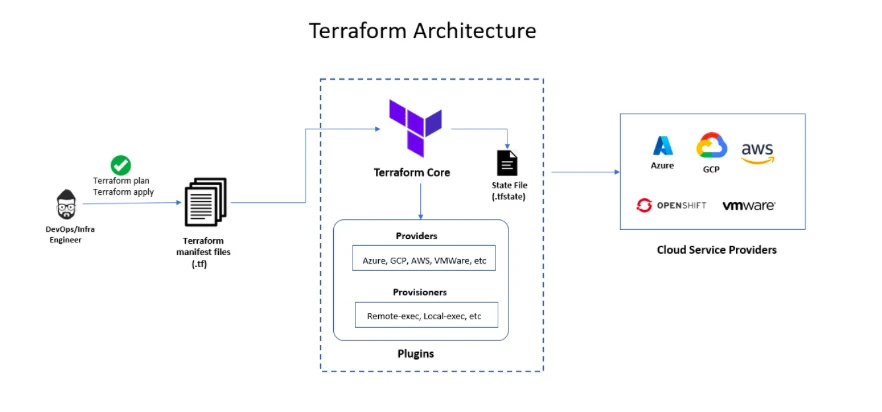
Terraform facilitates cloud orchestration by provisioning and managing infrastructure across multiple cloud providers using declarative configuration files. Some of its features include dependency graph visualization and immutable infrastructure.
Monitoring and management
12. New Relic
New Relic provides visibility into application performance across cloud infrastructure. It helps optimize resource utilization, troubleshoot performance issues, and scaling. Its key features include real-time monitoring, distributed tracing, and AI-driven insights for proactive optimization. Latest integrations include:
- SRE Agent: A specialized AI assistant designed to help teams manage and resolve incidents faster.
- New Relic Lens: Allows users to query external data sources directly within the observability UI, breaking down silos between different data platforms.
 Add as preferred source
Other orchestration tools
Discover other orchestration tools, such as:
Why use cloud orchestrators?
88% of businesses operate in a hybrid cloud environment, while 5% rely solely on-premises infrastructure. 4 However, cloud infrastructure can be complex, requiring coordination and integration of diverse systems. To overcome this challenge:
- 78% of organizations to plan to replace legacy automation tools or add new platforms to achieve effective orchestration.
- 64% of companies target cloud automation for optimizing resource utilization, improving service delivery, and maintaining competitive advantage.
Further reading
Explore more on orchestration tools through our comprehensive and data-driven benchmarks, such as:
- Analyze Best Container Orchestration Tools Based on 2000+ Reviews
- Compare Data Orchestration Tools Based on 800+ Reviews
Cite this research
Pick the format that matches where you're publishing. Pasting the link version into your CMS preserves the backlink.
@misc{simsek2026,
  author = {Şimşek, Hazal},
  title  = {{Compare 20+ Cloud Orchestrators}},
  year   = {2026},
  month  = oct,
  howpublished    = {\url{https://aimultiple.com/cloud-orchestrators}},
  note   = {AIMultiple. Retrieved October 1, 2026}
}Results and timestamps of 23 data points. Download the summary data shown in this article's charts and tables as a ZIP file containing one CSV file.
Want the granular data behind it? Join Premium
Changelog
7 updatesExpanded AWS CloudFormation with new deployment steps and developer tools.
Replaced ActiveBatch with Stonebranch in the Service orchestration and automation section.
Reference Links










Be the first to comment
Your email address will not be published. All fields are required. Comments are left in their original language.