


LLM Pricing: Top 15+ Providers Compared

We track the launch prices of more than 160 LLMs, from GPT-3.5 Turbo in March 2023 to the latest releases, grouped by size class. We also compare current models’ API prices with their benchmark results and review the subscription plans of the major providers.
LLM launch price trends
- Claude Opus launch prices fell from $30.00 (Opus 4.1, August 2025) to $8.00 (Opus 5.5, September 2026).
- Claude Fable 5 launched at $20.00 in June 2026, twice the price of Claude Opus 4.8 two weeks earlier. OpenAI’s GPT-6 Astra followed at $20.00 in September.
- GPT-6 Sol launched at $4.00 in September 2026, 64% below GPT-5.6 Sol’s $11.25 in July. GPT-6 Luna launched at $0.20, against $2.25 for GPT-5.6 Luna.
- The median launch price of small closed models rose from $0.53 in 2024 to $0.85 in 2025. In 2026, Gemini 3.5 to 3.8 Flash launched at $3.00 to $3.38.
- In 2025, the median launch price of large open-weights models was under a quarter of the median for closed mid-tier models. Moonshot’s Kimi K3 launched at $6.00 in July 2026, above Claude Sonnet 5’s $4.00.
Prices are per million tokens, blended three parts input to one part output, and exclude time-limited promotions. Open-weights models have publicly released weights; for those without a first-party API, the price is a hosting provider’s rate from around launch. New launches can still change the current quarter’s averages.
LLM API price evaluation
There are two ways to pay for an LLM: subscription plans with flat-rate LLM pricing from the major providers, or a pay-as-you-go API model billed by token usage.
Click on model names to view their benchmark results, real-world latency, and pricing, to assess each model’s efficiency and cost-effectiveness.
Ranking: Models are ranked by their average position across all benchmarks.
You can check the hallucination rates and reasoning performance of top LLMs in our benchmarks.
Comparing LLM subscription plans
Non-technical users may prefer to use the UI rather than the API. In 2026, most provider subscriptions bundle far more than a chat interface. Coding agents like Claude Code, Codex, Kimi Code, and Mistral Vibe ship inside Pro-tier plans. For developers and heavy users, the right $10–$200 subscription often replaces what would otherwise be a separate coding IDE subscription, a per-token API budget, and a video or research tool combined.
OpenAI
Free plan includes unlimited everyday text chats with GPT-5.6 Luna, standard voice mode, limited uploads, and basic image generation. Contextual ads reach about 40 markets as of August 2026, including the U.S. and most of Europe, and appear only on the Free and Go plans.
- ChatGPT Go ($8/month) is a low-cost plan that may include ads. Text chats are unlimited, as on Free; the upgrade buys higher limits on file uploads, image creation, voice, and memory, all on GPT-5.6 Luna.
- ChatGPT Plus ($20/month) includes extended usage limits, access to GPT-5.6 Sol, Terra, and Luna, advanced voice mode, Codex agent, image generation, and early-access features.
Pro plan has two tiers as of April 2026:
- ChatGPT Pro ($100/month) provides the same model lineup as the $200 tier (including GPT-5.6 Sol) at roughly 5x Plus usage limits.
- ChatGPT Pro ($200/month) provides the highest individual usage limits (about 20x Plus), maximum Deep Research allowance, advanced voice with video and screensharing, Codex with maximum usage boost, and Sora.
Both Pro tiers include priority access during peak hours. Codex pricing on Plus, Pro, and Business shifted from per-message to API-token-aligned usage in April 2026.
ChatGPT Work, OpenAI’s agent for long-running multi-step projects (launched July 9, 2026), is included on paid plans, and the desktop app bundling Chat, Work, and Codex is available on every plan, including Free.
- Business plan ($20/user/month annual or $25/user/month monthly) is OpenAI’s plan for small and mid-sized teams (formerly ChatGPT Team, renamed in August 2025). It adds higher message limits, admin console, SSO, training-excluded team data, and shared credit pools for advanced features. Bundled apps: Codex with shared workspace credits. Codex-only seats closed to new workspaces on June 24, 2026; OpenAI has announced Premium seats at $100/user/month annual ($125 monthly) with 5x Standard usage. The plan requires at least 2 seats.
- The Enterprise plan (custom pricing) provides high-speed model access, expanded context windows, enterprise-grade data controls, domain verification, analytics, and audit logs. Bundled apps: Codex with shared credit pool and optional Codex-only seats.
Anthropic (Claude)
Free plan includes web and mobile access, basic analysis, access to Claude Sonnet 5 and Haiku, and document uploading. Daily usage is capped, and Opus and Fable models are not available.
- Pro plan ($20/month, or $17/month billed annually) provides access to Opus 5, Sonnet 5, and Haiku, roughly 5x more usage than Free, project organization, and priority access during peak hours. Fable 5 is not part of the Pro usage limits; it is billed at API rates through pay-as-you-go usage credits. Bundled apps: Claude Code (Anthropic’s coding agent in the terminal and IDE), Cowork, Claude Design, and Claude for Microsoft 365, all sharing the same usage pool as the chat.
- Max 5x plan ($100/month) provides about 5x more usage than Pro, priority access to the newest features and models, and full Claude Code access at the higher Max usage tier.
- Max 20x plan ($200/month) provides about 20x more usage than Pro, maximum priority access, and full Claude Code access. Designed for daily power users running Claude Code workloads. Both Max tiers include Fable 5, Anthropic’s highest-priced model; its use can take up to half of the plan’s weekly usage limit.
Team plan offers two seat types and supports 2 to 150 members:
- Standard seat: $20/user/month annual ($25/user/month monthly). Includes base features, standard usage limits, and Claude Code access.
- Premium seat: $100/user/month annual ($125/user/month monthly). Everything in Standard, plus higher usage limits for power users running heavier Claude Code workloads.
Bundled apps: Claude Code and Cowork are included with every Team seat (Standard and Premium); the difference lies in the usage allowance, not access. Both seat types include central billing, collaboration tools, and admin controls.
- Enterprise plan ($20/seat/month plus usage at API rates on the self-serve tier; custom pricing with sales) provides expanded context windows, SSO, domain capture, role-based access, SCIM, audit logs, and data integrations. Bundled apps: on new and self-serve Enterprise plans, Claude Code and Cowork are included with every seat; older Enterprise contracts may distinguish between Chat-only seats and Chat + Claude Code seats with usage-based billing.
Google (Gemini)
The free plan provides access to Gemini 3.6 Flash and varying access to Gemini 3.1 Pro, basic image generation, Deep Research, Gemini Live, Canvas, and Gems. Bundled apps: Gemini Notebook (formerly NotebookLM) and Flow with limited Nano Banana Pro access.
Google uses regional pricing, so pricing can vary by region.
- Google AI Plus ($4.99/month, U.S.) is the entry paid tier with 2x Free usage limits. Bundled apps: more Gemini 3.1 Pro access in the chat, image generation with Nano Banana Pro, video generation with Gemini Omni Flash, 200 Flow credits, Gemini Notebook with more Audio Overviews, Gemini in Gmail, Docs and Vids, and early-access Gemini in Chrome. Includes 400 GB of storage.
- Google AI Pro ($19.99/month, U.S.) provides 4x Free usage limits and 5 TB of storage. Bundled apps: Jules (asynchronous coding agent), Google Antigravity (agentic development platform), expanded AI Studio limits, $40/month in Google Cloud credits, Gemini Notebook with 5x Audio Overviews, Deep Research, 1,000 Flow credits, YouTube Premium Lite, and Google Home Premium (Standard plan).
- Google AI Ultra (U.S.) costs $99.99/month for 5x AI Pro usage limits or $199.99/month for 20x. Bundled apps: Deep Think reasoning, Gemini Agent (U.S. only), Gemini Spark, Project Genie (interactive world model), Jules at the highest limits, top-tier Antigravity, 10,000 or 25,000 Flow credits, Google Home Premium (Advanced plan), and a YouTube Premium individual subscription. Storage starts at 20 TB.
Microsoft Copilot
The free plan (Copilot Chat) is available at no additional cost for all Microsoft Entra users with an eligible Microsoft 365 subscription. It includes basic Copilot chat across Microsoft apps without the deeper in-document features.
- Microsoft 365 Premium ($19.99/month or $199.99/year) is now the consumer Copilot plan. It bundles the Office apps, up to 6 TB of storage (1 TB each for up to six people), and the highest consumer Copilot limits; the AI features apply only to the subscription owner. The former Copilot Pro ($20/month) is closed to new purchases, and existing subscribers can keep it or switch to Premium.
- Microsoft 365 Copilot Business ($21/user/month annual; $18/user/month first-year rate for purchases through September 30, 2026; $25.20/user/month monthly) adds Copilot across Microsoft 365 apps, Teams integration, and admin controls. Bundled apps: Copilot Studio Lite for building lightweight agents, Copilot in SharePoint, and Copilot Pages for collaborative drafts. Limited to organizations with up to 300 users.
- Microsoft 365 Copilot Enterprise ($30/user/month annual, or $31.50/user/month billed monthly; requires a qualifying Microsoft 365 license) provides advanced security, compliance, and analytics on top of Business features. Bundled apps: agent building with Copilot Studio (work-data and prebuilt agents can be metered; standalone Copilot Studio is sold separately), Copilot in Microsoft Purview and Intune for IT and security workflows, and governance over deployed agents.
xAI (Grok)
The free plan offers limited access to Grok.
- SuperGrok Lite ($10/month) is the entry paid tier. It includes 2x longer conversations, increased rate limits, and AI image and video creation. Bundled apps: Grok Build (xAI’s app-building agent, also free on the web since August 2026) and Grok Imagine for image and video generation.
- SuperGrok ($30/month, or $300/year) includes enhanced reasoning with Grok 4.6, 5x longer conversations, longer file uploads, Voice mode for spoken chat, and 20x more Grok Imagine image and video generations including HD 720p 30-second video.
- SuperGrok Plus ($100/month) adds Grok Bot access, 1080p video generation, higher usage limits, faster replies, and priority access.
- SuperGrok Heavy ($300/month) provides everything in Plus, an agent team for parallel work, maximum rate limits, early previews of upcoming xAI features, and an X Premium+ subscription. In July 2026 xAI also shipped Excel, Outlook, and Google Workspace add-ins plus scheduled Automations; most are free, with the Outlook add-in and email-triggered Automations reserved for paid users.
Grok is also bundled into X subscriptions: X Premium ($8/month) is the cheapest paid path to Grok inside the X app and includes verified status and reduced ads. X Premium+ ($40/month) removes ads across X and carries the highest Grok usage limits, alongside full creator monetization.
Moonshot AI (Kimi)
Kimi’s consumer plans are named after musical tempo markings, from slowest to fastest. International pricing is in USD; Chinese users pay in CNY at lower rates. As of August 2026, new purchases are waitlisted. The pricing page announces upcoming plans that separate Kimi and Kimi Code benefits, and Moonshot’s July 20 notice cites computing capacity constraints for their delayed launch, four days after the K3 release. Existing subscribers keep their plans and can renew.
- Adagio (Free) provides unlimited basic conversations with 6 agent uses, capped Deep Research queries, and basic OK Computer agent tasks.
- Moderato ($19/month) adds Kimi K3 in chat and agent tasks plus expanded Deep Research sessions. Bundled apps: Kimi Code (terminal-first AI coding agent; an estimated 300 to 1,200 requests per 5-hour window, billed from the shared credit pool), plus Slides and Websites authoring tools.
- Allegretto ($39/month) provides higher usage on everything in Moderato. Bundled apps: Agent Swarm (parallel subagent orchestration, up to 4 parallel subtasks on this tier), Kimi Claw cloud deployment for heterogeneous agent groups with persistent memory, and 2x Moderato’s agent credits.
- Allegro ($99/month) provides 5x agent credits, Agent Swarm with up to 8 parallel subtasks, and K3 chat with up to 1M tokens of context.
- Vivace ($199/month) provides 10x agent credits, 4 concurrent tasks, Agent Swarm with up to 8 parallel subtasks, and K3 chat with up to 1M tokens of context, targeted at heavy research and agentic workloads.
Membership includes Kimi Code API keys for use in third-party coding tools; the separate Kimi Open Platform API is billed per token.
MiniMax
MiniMax sells one unified Token Plan on top of its M3 and M2.7 models. It replaced the earlier separate Agent credit plans and Coding Plan in mid-2026.
MiniMax Token Plan (one quota for agents, coding, and multimodal work):
- Plus ($20/month): 5-hour rolling and weekly quota windows, enough for 3 to 4 coding agents running in parallel; for personal projects and prototyping.
- Max ($50/month): the same windows for 4 to 5 parallel agents; for daily coding with agents and multimodal work.
- Ultra ($120/month): 6 to 7 parallel agents; for heavy agent workflows and extended sessions.
- Credit packs: $5 for 5,000 credits, $25 for 25,000, $100 for 100,000 (1,000 credits = $1, valid 365 days), usable on top of any plan.
The Token Plan covers the full model lineup (M3, M2.7, image, and speech) in a single quota, making it one of the cheapest paths to a frontier coding model when paired with a CLI like Cline or Kilo Code.
Mistral AI
Free plan of Mistral Vibe (formerly Le Chat) includes web browsing, basic file analysis, image generation, limited coding sessions, 100+ connectors, and $10/month in API credits.
- Pro plan ($14.99/user/month) includes more messages and web searches, more extended thinking and Deep Research reports, 15 GB of document storage, up to 1,000 projects, image generation, and $30/month in API credits. Bundled apps: Mistral Vibe’s Code mode in the CLI, IDE, or web, with pay-as-you-go beyond the included quota. Verified students get Pro for $5.99/month.
- Team plan ($24.99/user/month) includes everything in Pro with up to 30 GB of storage per user, central billing, role-based access control, domain name verification, and data export. Bundled apps: Mistral Vibe at the team usage tier with shared admin controls.
- Enterprise plan (custom pricing) provides secure deployment options, including self-hosted and private cloud, SAML SSO, audit logs, premium support, and detailed analytics. Bundled apps: Mistral Vibe with on-premise deployment options for regulated workloads.
DeepSeek
DeepSeek does not offer traditional subscription plans. Web and mobile chat access to the latest models (currently DeepSeek V4-Flash and V4-Pro) is free for all users, with fair-use throttling.
API access is pay-per-token with peak and off-peak rates since August 16, 2026. Off-peak, V4-Flash costs $0.22 per million input tokens (cache miss) and $0.66 per million output tokens; peak rates are double ($0.44 and $1.32). V4-Pro costs $0.66 and $1.98 off-peak. Cache hits cost about 3% of the miss rate, and peak hours are 01:00-04:00 and 06:00-10:00 UTC on weekdays.
DeepSeek has also entered agent tooling. DeepSeek Harness, an open-source, plugin-based toolkit for building and running AI agents, is in developer preview with public source code. It carries no price of its own and is model-agnostic; usage is billed by whichever model API the agent calls.
Meta (Muse Spark)
Meta AI remains free inside WhatsApp, Instagram, Facebook, Messenger, the Meta AI app, and Ray-Ban Meta glasses, powered by Muse Spark (launched April 8, 2026, now at version 1.2). Meta has begun limited testing of paid Meta One subscriptions. The Plus and Premium plans raise the monthly AI usage allowance and Thinking-mode access, reported at $7.99 and $19.99 per month.1
The Meta Model API is in public preview, self-serve and OpenAI-SDK-compatible. Muse Spark 1.2 pay-as-you-go pricing starts at $1.25 per million input tokens and $4.25 per million output tokens with a 1M-token context window. Muse Code, a terminal coding agent, shipped in beta on August 5, 2026.
Understanding LLM pricing
Tokens: The Fundamental Unit of Pricing
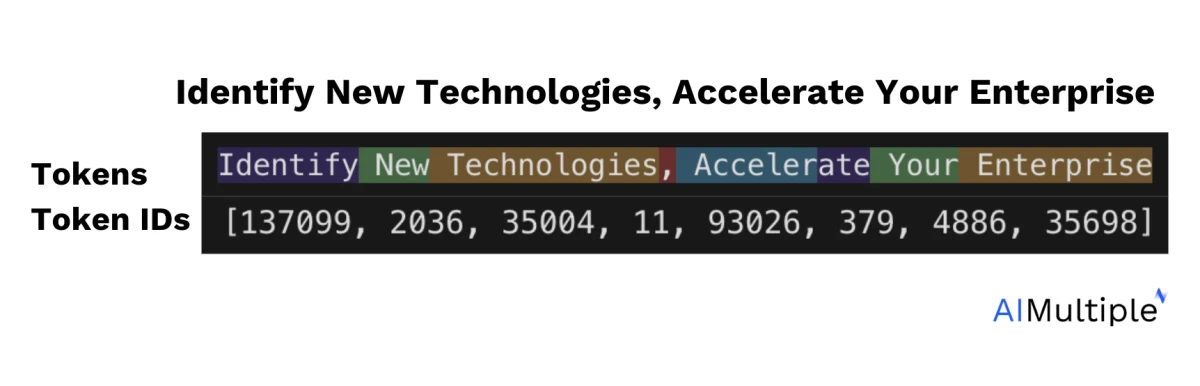
Figure 1: Example of tokenization using the GPT-4o & GPT-4o mini tokenizer for the sentence “Identify New Technologies, Accelerate Your Enterprise.”2
While providers offer a variety of pricing structures, per-token pricing is the most common. Tokenization methods differ across models; examples include:
- Byte-Pair Encoding (BPE): Splits words into frequent subword units, balancing vocabulary size and efficiency.3
- Example: “unbelievable” → [“un”, “believ”, “able”]
- WordPiece: Similar to BPE but optimizes for language model likelihood, used in BERT.4
- Example: “tokenization” → [“token”, “##ization”]. “token” is a standalone word; “##ization” is a suffix.
- SentencePiece: Tokenizes text without relying on spaces, effective for multilingual models like T5.5
- Example: “natural language” → [” natural”, ” lan”, “guage”] or [” natu”, “ral”, ” language”].
Please note that the exact subwords depend on the training data and BPE/WordPiece process. To better understand these tokenization methods, watch the video below:
After grasping tokenization, an average price can be estimated based on the project token length. Table 2 outlines token ranges by content type, including UI prompts, email snippets, marketing blogs, detailed reports, and research papers, and notes that token counts vary across models. Once a model is chosen, its tokenizer can be used to estimate the average token count for the content.
Table 2: Typical content types, their size ranges, and enterprise considerations (ranges are estimates and may vary).
Context window implications
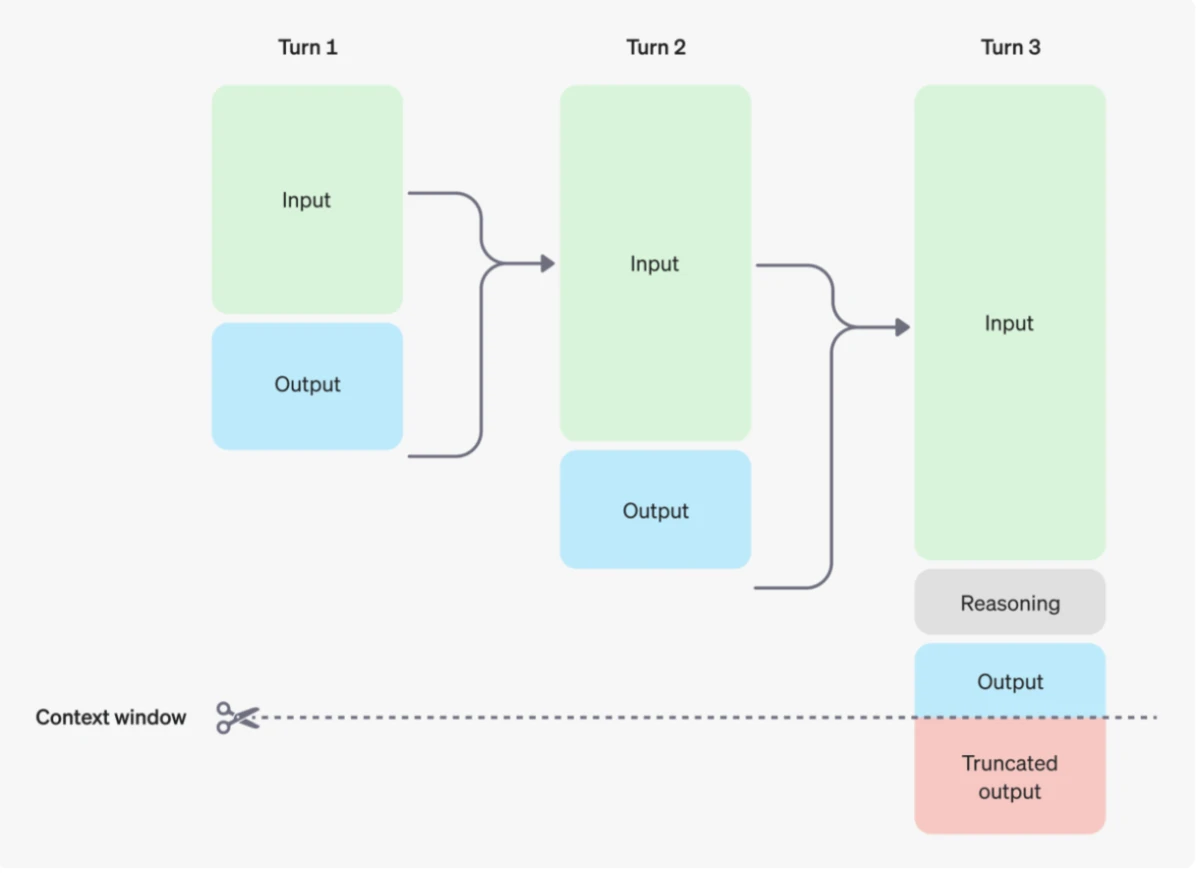
The context window sets a hard limit on the number of input and output tokens per call, including any tokens used by reasoning models for chain-of-thought reasoning. If the total exceeds this limit, the response is truncated, or the request fails outright.
Figure 2: Illustration of context window limitations leading to output truncation in a multi-turn conversation.6
For applications that maintain long conversations, every additional turn pushes more history into the input. Without intervention, input tokens grow linearly with conversation length, and so does the bill. API users typically address this in one of three ways:
- Prompt caching. OpenAI, Anthropic, Google, and DeepSeek all cache repeated prompt prefixes server-side and bill cache hits at a fraction of the standard input rate, typically 3 to 10 percent of the cache-miss price. For applications that reuse a long system prompt or conversation prefix, caching can cut input cost by an order of magnitude.
- Rolling window or retrieval-augmented generation (RAG). Drop the oldest turns once a threshold is hit, or retrieve only relevant past messages from a vector store on each call.
- Summarization. Periodically condense older turns into a summary instead of resending them verbatim.
For agentic workloads such as coding sessions or deep research, modern coding agents handle this automatically in session. Claude Code, for example, ships with context compaction: when the conversation approaches the limit, it summarizes older messages into a condensed version while keeping recent turns intact. Subsequent turns send only the summary plus recent context back to the model.
The pricing impact is direct. On per-token APIs, compaction caps how large each call’s input grows and caching cuts the price of the repeated prefix, so cost-per-turn stays predictable across long sessions. On flat-rate subscriptions like Claude Pro, ChatGPT Plus, or Kimi Moderato, compaction stretches daily and weekly usage limits because each call carries less context. A coding session that would otherwise burn through a 5-hour rate limit can run longer when older turns get compressed.
The trade-off is that any form of summarization is lossy. The summary may drop details that turn out to matter later, forcing the user to re-supply them
Max output tokens
Max output tokens caps the length of a model’s response. While many documentations mention that it can be adjusted using the max_tokens parameter, it is crucial to review the documentation of the specific API being used to identify the correct parameter. It should be adjusted according to the specific needs:
If set too low, it may result in incomplete outputs, causing the model to cut off responses before delivering the full answer.
If set too high, depending on the temperature (a parameter that controls response creativity), it can lead to unnecessarily verbose outputs, longer response times, and increased cost.
Therefore, it is a parameter that requires careful consideration to optimize resource usage while balancing output quality, cost, and performance.
Table 3: Example input prompts and estimated token counts per content type.
*This assumes that each model produces responses with an equal number of output tokens, although the token count for both input and output may vary depending on each model’s tokenization; the number has been kept constant here for each model.
Combining the token ranges in Table 2 with a model’s per-token rates gives the expected cost per content type; Table 3’s sample prompts show the input and output sizes behind those estimates.
Using multiple language models
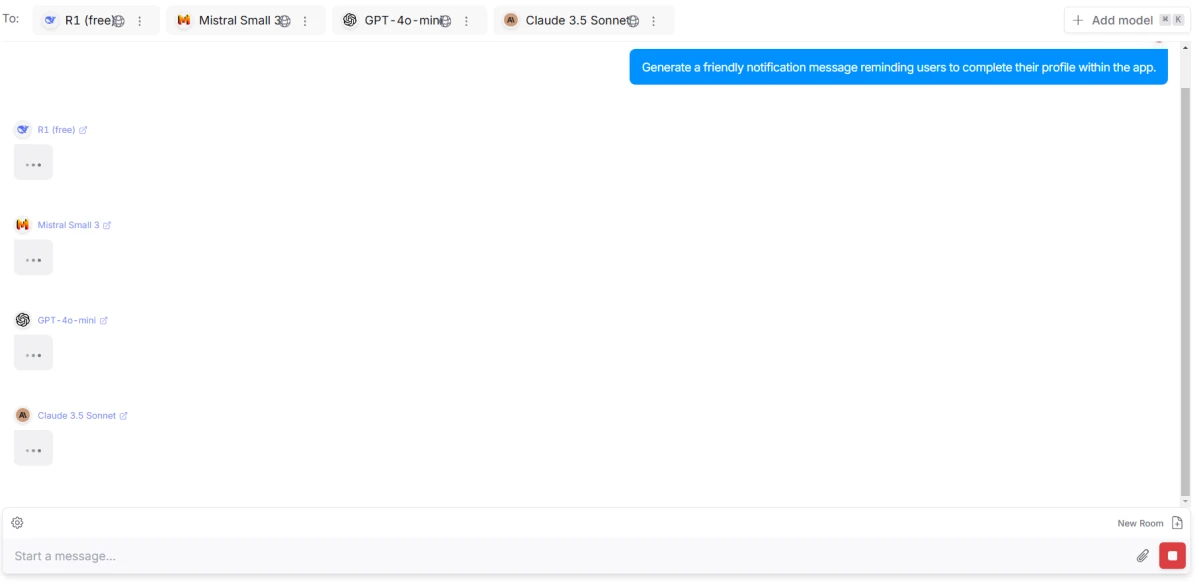
An AI gateway such as OpenRouter allows the same prompt to be sent to multiple models simultaneously. The responses, token consumption, response time, and pricing can then be compared to determine which model is most suitable for the task.
Figure 3: Interface showcasing a prompt sent to multiple Large Language Models via OpenRouter.7
Benefits and challenges
- Increased adaptability and efficiency: Orchestration enhances responsiveness, enabling real-time assessment of model efficiency and identifying a cost-effective model and potential savings.
- Prompt sensitivity and optimization: Identical prompts can elicit vastly different outputs across models, necessitating prompt engineering tailored to each model to achieve desired results, adding to development and maintenance complexity.
Pricing mechanics & hidden costs
Reasoning tokens vs. output tokens
A growing number of providers have introduced reasoning models that spend additional compute to perform chain-of-thought reasoning internally. OpenAI, Anthropic, and Google bill those reasoning tokens as output tokens at the model’s standard output rate, so the cost increase comes from volume, not from a higher per-token price.
Models like GPT-5.5 Pro, Claude Opus 5 with extended thinking, or Gemini 3.1 Pro Deep Think generate internal reasoning traces
even when you do not explicitly request them. These internal tokens count toward your bill and can substantially increase cost, especially in long analytical tasks such as legal review, data analysis, or multi-step reasoning.
This makes it essential to:
- Choose a reasoning model only when accuracy substantially outweighs cost.
- Disable the chain-of-thought or set a shorter max output token count when possible.
- Test the same task on non-reasoning models to see if performance is comparable at a fraction of the price.
Since a reasoning model can emit 10 to 30 times as many output tokens as the same prompt would produce without reasoning, it is critical to understand this distinction for cost planning.
Architecture-driven pricing differences
LLM architectures directly influence model efficiency and, therefore, API pricing. For example:
- Mixture-of-Experts (MoE) models activate only a subset of parameters per request, reducing compute cost and allowing providers to offer lower per-token rates.
- Speculative decoding pairs a smaller draft model with a larger one, improving throughput and lowering cost for deterministic tasks.
- Quantized variants (e.g., 4-bit or 8-bit) can perform inference at lower precision, enabling lower pricing for locally deployed or cloud-hosted versions.
Understanding these architectural choices helps users predict not only pricing differences but also latency, quality, and how a model scales under production workloads.
Operational costs beyond API fees
While per-token pricing is the primary cost driver, many production deployments incur additional costs beyond API usage:
- Embeddings and vector databases: Storing and retrieving vectors (e.g., Pinecone, Weaviate, ChromaDB) adds cost per query and per GB of storage.
- Reranking and post-processing models: Many applications use smaller models for summarization, filtering, or classification before sending a final request to a bigger model.
- Caching layers: Providers like OpenAI now offer prompt-level caching, but local caching infrastructure may require additional compute.
- Logging, monitoring, and auditing: Enterprises often incur costs for token-level monitoring, latency tracking, and security audits.
These hidden costs often account for 20–40% of total LLM operational expenses and should be considered when evaluating pricing structures.
 Add as preferred source
Enterprise-specific pricing considerations
Many LLM vendors charge additional fees for enterprise-grade security and compliance features, such as:
- Single-tenant deployments
- Dedicated GPU clusters
- Enhanced SLAs (e.g., uptime, latency guarantees)
- Data residency and regional controls
- SOC2, HIPAA, or GDPR compliance modes
These offerings can increase costs significantly but are essential for regulated industries such as healthcare, finance, legal services, and public institutions.
Future trends in LLM pricing
Three things defined 2025 LLM pricing: commodity models got cheap, almost every major provider launched a chat subscription, and reasoning models stayed expensive. The gap is structural and likely to widen: a million output tokens costs $0.66 on DeepSeek V4-Flash (off-peak) and $180 on GPT-5.5 Pro. The interesting questions for 2026 onward are about what shifts on top of that base.
Per-token billing gives way to per-task pricing
Agents now drive most heavy LLM usage. A single coding task with Claude Code, a research run with Cowork, or an autonomous browsing session with Operator can make hundreds of sequential model calls. Token billing becomes unpredictable for both buyer and seller.
In response, providers are switching from token meters to task and session quotas. Moonshot estimates 300 to 1,200 Kimi Code requests per 5-hour window from a shared credit pool. Claude Code caps usage per 5-hour session rather than per message. MiniMax sets its Token Plan quotas as 5-hour rolling and weekly windows sized by the number of parallel coding agents. Kimi sets tier-specific limits on parallel Agent Swarm subagents.
Cross-provider agent harnesses such as OpenClaw and MaxHermes push this further. They sit between users and multiple model APIs, and their pricing increasingly tracks per-task throughput rather than per-million-tokens. Expect more providers to publish per-task or per-session SKUs over the next year.
Small reasoning models move to the device
Apple Intelligence runs inference on-device for routine queries, falling back to Private Cloud Compute only for complex requests. Microsoft Copilot+ PCs ship with a local model. Pixel devices run Gemini Nano. Recent small models such as Microsoft’s Phi-4 and Google’s Gemma 3 are reasoning-capable at sizes that fit on a phone or laptop’s neural processing unit.
The pricing implication is a two-tier consumer market. Routine work runs free at the marginal token on-device. Cloud subscriptions compete on what local cannot do: frontier reasoning, large context, multimodal generation, and agent orchestration. The free-local floor pushes chat-only subscriptions toward zero, leaving bundled apps as the real reason to pay.
Long context and memory decide who wins agentic work
Long-horizon agentic tasks fail when models lose track of earlier instructions or hallucinate facts they should remember. Sustained agentic work depends on three things: a large context window, persistent memory, and a low hallucination rate.
In one year, three frontier capabilities have collapsed toward baseline. Claude Opus 5, Gemini 3.1 Pro, GPT-5.6, and Kimi K3 offer 1M-token context windows. On OpenAI, Anthropic, Google, and DeepSeek, cache hits cost 3 to 10 percent of cache misses. ChatGPT and Claude now include persistent memory on their free tiers.
Specialist agentic models are emerging at the top of this market. In June 2026, Anthropic shipped Claude Fable 5, a generally available Mythos-class model8, priced at $10 input and $50 output per million tokens, double the Opus 5 rate. Fable 5 targets agentic coding, computer use, and long-horizon research; Claude Mythos 5, the same model with safeguards lifted in some areas, remains limited to approved partners at the same price.
The competitive question shifts from “how big is the context window” to “how cheaply and reliably can the model sustain a long agentic task?” Providers that solve this well will command premiums. Those that do not will lose agentic workloads regardless of the headline token price.
FAQs
Accessing Large Language Models (LLMs) via an Application Programming Interface (API) grants you remote access to AI models. This access is subject to a fee, often called an “API fee,” charged by the service provider. This fee is a critical consideration when integrating LLMs into your applications.
It represents the cost associated with each query, request, or task performed through the provider’s API. Because pricing structures can vary widely (based on factors like token usage, API call volume, feature utilization, or subscription models), understanding how providers calculate these costs is essential.
LLM API pricing can be complex due to factors like token consumption, context length, and model choice. Tokenization procedures vary across models, with some using Byte-Pair Encoding (BPE), WordPiece, or SentencePiece, each influencing how text is split into tokens and impacting cost efficiency. Understanding these differences helps optimize API usage and pricing.
LLM costs are primarily determined by token usage (both input and output), API call volume, and the pricing model (e.g., per-token or subscription).
Compare input and output token prices, context window limits, and any additional fees. Tools like OpenRouter allow you to send the same prompt to multiple models and directly compare their results, token usage, speed, and pricing. Consider your typical content length and usage patterns to estimate overall costs.
Input tokens are the tokens in the prompt you send to the LLM, while output tokens are the tokens in the generated response. For reasoning models, tokens generated during the reasoning process itself are also counted as output tokens, impacting the final cost. Both input and output contribute to the overall cost.
Larger text requests require more processing, increasing response time and costs. Optimize input sizes and use an LLM API pricing calculator to estimate token counts and manage your budget effectively.
The LLM community has developed various tools and benchmarks to help users understand and optimize LLM pricing. These resources often include calculators and comparison charts that offer insights into the power and efficiency of different models.
Platforms like Hugging Face and GitHub host tools and code developed by the community to analyze model performance and costs. Many services offer community support through forums or chat features.
Cite this research
Pick the format that matches where you're publishing. Pasting the link version into your CMS preserves the backlink.
@misc{dilmegani2026,
  author = {Dilmegani, Cem},
  title  = {{LLM Pricing: Top 15+ Providers Compared}},
  year   = {2026},
  month  = aug,
  howpublished    = {\url{https://aimultiple.com/llm-pricing}},
  note   = {AIMultiple. Retrieved August 26, 2026}
}Results and timestamps of 285 data points. Download the summary data shown in this article's charts and tables as a ZIP file containing 6 CSV files and a README.
Want the granular data behind it? Join Premium
Changelog
8 updatesUpdated the chart description in the introduction.
Added a chart to the LLM pricing types section.
Removed the 'Understanding LLM pricing' section.
Expanded the "Context window implications" section with strategies for managing token usage in long conversations.
Added ChatGPT Go to the OpenAI section.
Reference Links
Cem's work at AIMultiple has been cited by leading global publications including Business Insider, Forbes, Morning Brew, and Washington Post, global firms like Deloitte and HPE, NGOs like World Economic Forum, and supranational organizations like European Commission. [1], [2], [3], [4], [5]
Throughout his career, Cem served as a tech consultant, tech buyer and tech entrepreneur. He advised enterprises on their technology decisions at McKinsey & Company and Altman Solon for more than a decade. He also published a McKinsey report on digitalization.
He led technology strategy and procurement of a telco while reporting to the CEO. He has also led commercial growth of deep tech company Hypatos that reached a 7 digit annual recurring revenue and a 9 digit valuation from 0 within 2 years. Cem's work in Hypatos was covered by leading technology publications like TechCrunch and Business Insider.
Cem regularly speaks at international technology conferences. He graduated from Bogazici University as a computer engineer and holds an MBA from Columbia Business School.




Comments 1
Share Your Thoughts
Your email address will not be published. All fields are required. Comments are left in their original language.
"Really well-written and timely article! Your analysis of how different large language model (LLM) providers compare - based on token pricing, context window, and performance - really helps demystify an often opaque cost structure. I found the detailed breakdown of token-based billing (input vs output tokens), context-window implications, and the built-in “price calculator” particularly useful for anyone trying to realistically estimate LLM usage