


WLA Migration: Best Practices & Vendor Approaches

69% of organizations are transitioning to more functional workload automation tools, as the right choice can improve customer service by 53% and reduce costs by 47% according to the State of IT Automation Report.1
Explore workload automation (WLA) migration, best practices, what to pay attention to, and the differing approaches from different vendors.
What is WLA migration?
WLA (Workload Automation) migration is the process of moving an organization’s job scheduling and automation workflows from one workload automation solution to another. Companies do this to replace legacy tools with modern platforms that can better support current business needs or to save costs. There are three primary migration approaches:
- Leverage automated conversion tools
- Depend on consultants with a focus on services
- Combine the two approaches.
Why organizations migrate to new WLA tools?
Legacy job schedulers often struggle to orchestrate processes in modern IT environments. For example, they may not run jobs across both on-premises infrastructure and multiple cloud platforms. Other common drivers for migration include:
- Digital transformation initiatives: Companies undergoing digital transformation often find that their existing automation tools lack the agility and integration capabilities needed for new projects.
- Cloud adoption and hybrid environments: Many older schedulers were not built for hybrid cloud orchestration, prompting a switch to tools that are cloud-ready. See hybrid cloud job schedulers.
- Scalability and performance: Businesses today handle larger volumes of data and processes. Modern workload automation tools are designed to scale horizontally and vertically to handle thousands of concurrent jobs, whereas a legacy scheduler might struggle or become a bottleneck.
- Maintenance costs and support risks: Legacy automation software can carry high licensing and maintenance costs. In some cases, vendors may have ended active development or support for older versions.
- Enhanced features and analytics: Newer WLA solutions often come with out-of-the-box features to provide better insights into operations, such as: visual workflow designers, centralized monitoring dashboards, granular auditing, and ML-based optimizations.
Stonebranch (Universal Automation Center)
Stonebranch’s Universal Automation Center (UAC) offers a structured migration service move organizations from legacy workload automation tools to its modern platform. The service combines automation tools with expert support and covers systems such as CA 7, SAP Job Scheduler, Tidal, Windows Task Scheduler, and cron.
Stonebranch uses the Xpress Conversion Tool (XCT) to automate job translation into UAC formats. XCT converts definitions, triggers, dependencies, and resource mappings directly, allowing SAP background jobs and batch workflows to transition with minimal manual effort.
For environments with embedded file transfers, Stonebranch pairs migration with Universal Data Mover Gateway (UDMG) to replace legacy B2B file movements alongside job schedules.
The migration follows a 7-step approach:
- Initiation: Define scope and set up the migration environment.
- Analysis: Inventory and assess the current job landscape.
- Pilot migration: Test conversion accuracy and gain approvals.
- Full transition: Automate the conversion of all workloads.
- Validation: Conduct quality checks and user reviews.
- Cut-over: Replace the legacy system with UAC in production.
- Closure: Finalize documentation and knowledge transfer.
Compare Stonebranch against its top alternatives.
Redwood RunMyJobs
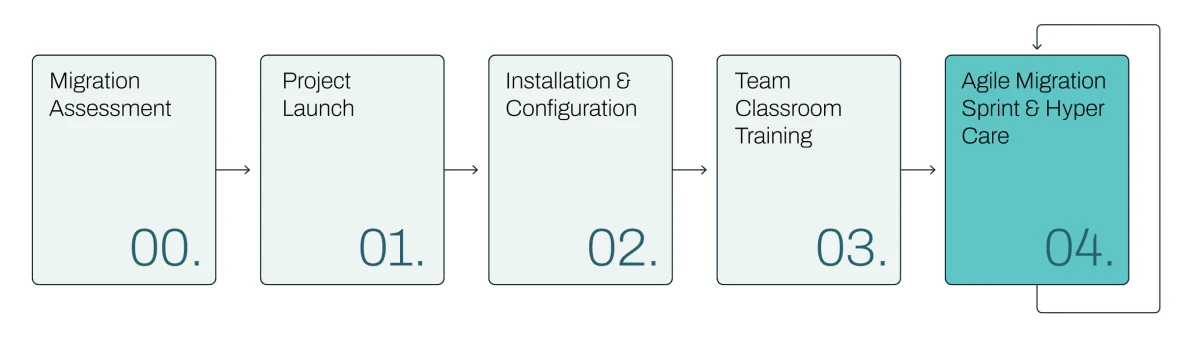
RunMyJobs includes a guided migration service known as a migration factory. Under this service, Redwood experts use proprietary tools to transfer workloads from major workload automation (WLA) platforms to RunMyJobs. The process begins with a detailed assessment of the existing job inventory, followed by phased migrations that prioritize low-risk workloads.
RunMyJobs migration process often involves running the old and new systems in parallel and training the client’s team throughout the project.
RunMyJobs migration strategy
1. Project launch
The migration begins with low-risk, simple jobs and gradually moves to more complex ones. It’s organized into agile sprints, grouping jobs by application, business unit, or job type to minimize disruption.
2. Installation and configuration
RunMyJobs environments are set up, user authentication is configured, and security protocols are defined. Integration with all systems and databases ensures smooth workflow execution across the enterprise.
3. Team training
Key stakeholders undergo training through Redwood University’s on-demand platform and instructor-led sessions, ensuring hands-on experience and continuous learning throughout the migration.
4. Agile migration sprint & hypercare
Migration happens in stages with both legacy and RunMyJobs systems running in parallel. After data conversion and testing, workflows are moved to production. Hypercare ensures the system is monitored and issues are resolved post-migration.
ActiveBatch
ActiveBatch offers a guided migration service to move organizations from legacy schedulers to its modern workload automation platform. The migration follows a phased and risk-aware approach.
ActiveBatch also provides automated migration tools that convert legacy scheduler objects into ActiveBatch-compatible formats, simplifying the transition.
Training and testing are key parts of the migration. The client’s team is trained on ActiveBatch’s features, and parallel runs of the old and new systems are used to verify the migration before full deployment.
ActiveBatch has a specifically streamlined process for migration from these schedulers:
- BMC Control-M
- CA AutoSys
- CA Workload Manager
- IBM Tivoli
- Unix cron
- Windows Task Scheduler
- SQL Server Agent
For example, ActiveBatch can convert these schedulers’ jobs (including complex scheduling rules and alerts) into ActiveBatch workflows automatically. It similarly imports CA AutoSys job definitions by exporting the AutoSys JIL files and converting them into ActiveBatch objects.
These conversion tools retain job attributes as well as calendars, event triggers, resource allocations, and dependencies. The approach emphasizes GUI-based conversion migration to minimize risk and downtime.
CA Workload Automation (Broadcom)
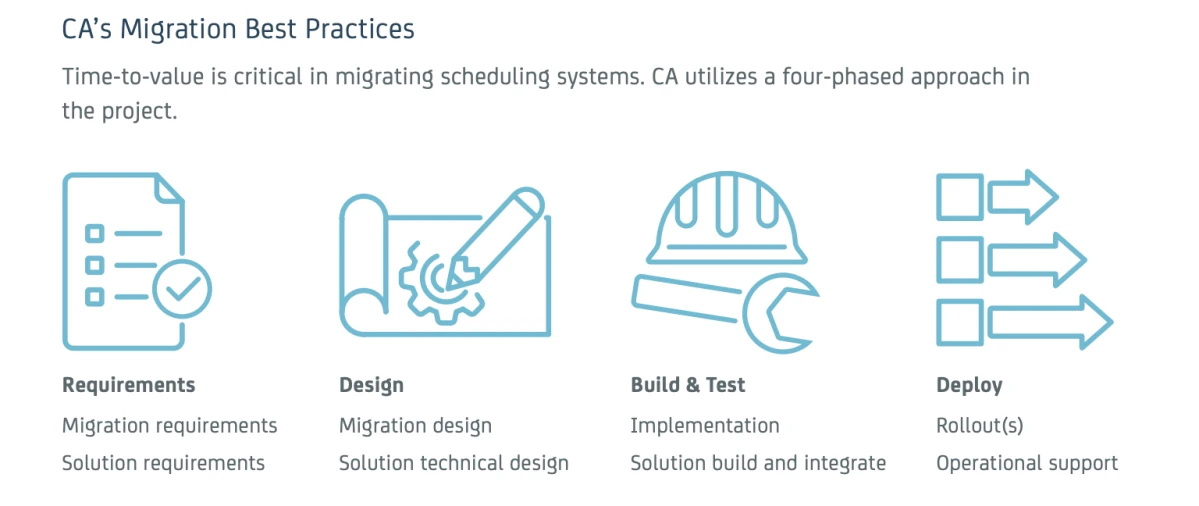
CA Workload Automation provides a structured, tool-driven migration service supported by dedicated experts. The migration includes parallel runs during testing to minimize disruptions.
CA also provides operational support, training, and knowledge transfer to ensure the client’s team can manage the platform effectively. Migration tools support transitions from the following products:
- BMC: Control-M
- ASG: Zeke, Zena
- IBM® Tivoli®: TWS for z/OS, DJC, TWS for DS (formerly Maestro)
- Cisco: Tidal
- Native Schedulers: cron, Microsoft® SQL Server®, Windows Batch Scheduler
- Redwood: Cronacle
HONICO (BatchMan for SAP)
Specializes in SAP-focused workload automation and offers a tailored migration service for customers switching from other WLA providers to their BatchMan solution. Stonebranch acquired HONICO on Sept 10, 2025, integrating HONICO’s SAP tool BatchMan into its UAC platform for unified hybrid IT orchestration, while keeping BatchMan available as a standalone product.
HONICO performs an automated bulk migration of job objects into a test environment for validation. When it comes to cutover, HONICO is flexible: they can do a step-by-step side-by-side migration or a “Big Bang” switch, depending on what the tests indicate is safest. A HyperCare period is provided post-go-live, wherein HONICO’s team closely supports the customer’s operations to ensure stability. Their expertise in SAP scheduling means they focus on preserving SAP-specific job parameters and improving integration with SAP systems.
Real-life examples for WLA migration
SWM
SWM, a major municipal utility provider in Germany, migrated from BMC Control-M to RunMyJobs to streamline its workload automation and reduce operational overhead.
SWM needed to move beyond BMC Control-M to support its expanding SAP-centric operations. The SAP Basis team sought a platform with deep SAP integration and the flexibility to manage diverse enterprise systems. A key requirement was automating the complex meter-to-cash process within SAP IS-U, which involved high-volume, multi-step job orchestration and required reliable execution across varied data sources.4
Results SWM achieved:
- Eliminated 1+ hour of manual effort per SAP process
- Reduced SAP HANA loads to 6–7 hours, calculations to 1.5–2 hours
- Enabled full nightly orchestration across systems
- Added auto-recovery: failed jobs restart in 30 minutes
- Improved billing accuracy and customer data availability
BSH Hausgeräte GmbH
BSH, one of the world’s leading home appliance manufacturers, replaced several outdated scheduling tools with RunMyJobs to harmonize automation across its global IT environment. The transition resulted in improved SAP job scheduling, consolidated monitoring, and significant gains in efficiency. Additionally, the unified platform helped BSH comply with internal governance standards.5
BSH’s reliance on Broadcom AutoSys limited its ability to scale and automate complex financial and supply chain processes. The need for frequent custom development led to instability, high maintenance costs, and disruptions. With a sprawling IT environment, including five core SAP ERP systems, 30+ additional systems, and 2,000+ servers, BSH required a more reliable and scalable automation platform to support its global operations.
Results BSH obtained:
- Built resilience through exception handling and dynamic process flows
- Replaced AutoSys with real-time, event-driven orchestration
- Improved data accuracy and decision-making across the supply chain
- Gained full process visibility via dashboards and alerts
- Standardized supply chain automation and reduced manual work
Whitbread PLC
Whitbread, the UK’s largest hospitality company, adopted RunMyJobs to support its SAP landscape. The organization sought to minimize manual interventions and improve scheduling reliability across finance and retail operations. The migration enabled Whitbread to enhance system resilience and manage workload peaks more effectively, particularly during busy retail periods.6
Whitbread faced the dual challenge of replacing two legacy systems, SAP RemoteWare for file transfers and Broadcom AutoSys for job scheduling, both managed by third parties. With RemoteWare nearing end-of-life, the team needed a phased, non-disruptive migration that complied with strict IT governance and security standards. Their goal was to consolidate operations under a single, reliable automation platform capable of handling complex, enterprise-wide workloads across retail and hospitality divisions.
Whitbread PLC’s results:
- Migrated 1,900 jobs in 6 months with zero post-migration issues
- Consolidated 1,200 AutoSys jobs down to 100 using Redwood
- Gained full visibility into 800+ enterprise outlets
- Automated process documentation and improved cross-team alignment
- Integrated incident management with ServiceNow
UBS
Global financial services firm UBS transitioned to RunMyJobs to gain better control over its distributed batch job operations. The new system offered UBS a single, central view of job execution and enabled quicker responses to incidents. The bank benefited from enhanced compliance, reduced operational risk, and improved reporting across teams.7
UBS struggled with a fragmented and labor-intensive financial reporting environment, relying on nearly 100 staff to manually coordinate disconnected systems. With 10 million postings per hour and the need to report on 500 million account balances, legacy tools couldn’t meet performance or compliance demands. Rising regulatory requirements (e.g., US GAAP, IAS) and a sprawling IT landscape were driving up TCO, with no single system capable of managing the scale, until Redwood was introduced.
Results UBS reached:
- Replaced 16 legacy applications with a unified automation platform
- Improved total cost of ownership (TCO) by 30%
- Cut external reporting time from 9 days to 5 days post-close
- Automated processing of 15+ billion transactions in 9 months
- Centralized financial data for faster insights and risk response
- Gained a strategic 5-year advantage, according to UBS leadership
Further reading on WLA
 Add as preferred source
Cite this research
Pick the format that matches where you're publishing. Pasting the link version into your CMS preserves the backlink.
@misc{dilmegani2026,
  author = {Dilmegani, Cem and Şimşek, Hazal},
  title  = {{WLA Migration: Best Practices & Vendor Approaches}},
  year   = {2026},
  month  = sep,
  howpublished    = {\url{https://aimultiple.com/wla-migration}},
  note   = {AIMultiple. Retrieved September 30, 2026}
}Results and timestamps of 4 data points. Download the summary data shown in this article's charts and tables as a ZIP file containing one CSV file.
Want the granular data behind it? Join Premium
Changelog
4 updatesAdded Stonebranch (Universal Automation Center) to the vendor approaches section.
Added HONICO (BatchMan for SAP) to the list of vendors in the "Migration Approaches by Leading WLA Vendors" section.
Reference Links
Cem's work at AIMultiple has been cited by leading global publications including Business Insider, Forbes, Morning Brew, and Washington Post, global firms like Deloitte and HPE, NGOs like World Economic Forum, and supranational organizations like European Commission. [1], [2], [3], [4], [5]
Throughout his career, Cem served as a tech consultant, tech buyer and tech entrepreneur. He advised enterprises on their technology decisions at McKinsey & Company and Altman Solon for more than a decade. He also published a McKinsey report on digitalization.
He led technology strategy and procurement of a telco while reporting to the CEO. He has also led commercial growth of deep tech company Hypatos that reached a 7 digit annual recurring revenue and a 9 digit valuation from 0 within 2 years. Cem's work in Hypatos was covered by leading technology publications like TechCrunch and Business Insider.
Cem regularly speaks at international technology conferences. He graduated from Bogazici University as a computer engineer and holds an MBA from Columbia Business School.







Be the first to comment
Your email address will not be published. All fields are required. Comments are left in their original language.