


7 Useful AI Transformation Strategies

Before choosing how to transform AI, leaders need to know where to start. We analyzed the Anthropic Economic Index (March 2026 release)1, mapping over 1 million real-world Claude interactions across 3,260 occupational tasks to the standard APQC Process Classification Framework (PCF).2
Check out high, mid, and granular-level processes by real-world AI exposure and human verification times, backed by real-life AI transformation use cases:
The chart above provides a prioritization matrix across all 13 top-level enterprise categories.
- Bubble size: The number of underlying L4/L5 tasks.
- AI exposure (Y axis): The share of Claude conversations targeting that task. A higher position means AI is actively being used for this kind of work in the wild.
- Verification time (X axis): The minutes a qualified human needs to validate the AI’s output. A lower time means the cost of human oversight is low, making AI deployment cheaper and faster to scale.
- The Golden quadrant: Top-left show high level of AI integration and low verification costs while bottom-right shows low AI usage and slow verification.
The graph above displays the high-leverage process groups within each category. The data reveals that even within a high-priority function like IT or Marketing, specific workflows present vastly different implementation profiles.
The graph above breaks down these process groups into individual underlying tasks and activities across each enterprise function. This micro-granular view clearly identifies which specific workflows to prioritize during automation deployment.
Which processes to choose for AI transformation?
- Information Technology (IT): The clearest priority, featuring high AI usage and a manageable ~60-minute verification cycle.
- At level 2: Application development and code refactoring lead because automated testing keeps human review under 30 minutes.
- At the level 3: Syntax debugging and unit test generation sit in the golden quadrant with near-zero verification overhead.
- Marketing, sales & customer service: Highly scalable targets with under 45-minute verification times.
- At the level 2: Content generation and market research synthesis offer rapid deployment due to their low verification overhead.
- At the level 3: Granular task analysis reveals that SEO meta-tagging and initial draft copy generation require the least human oversight.
- Vision & Strategy: A high-exposure bottleneck where AI is used heavily, but humans still take the longest amount of time to double-check the work.
- At level 2: LLMs frequently draft models for strategic business planning. However, human verification requires several hours (180+ minutes) to validate critical assumptions before execution.
- At level 3: Competitive landscape modeling as a primary driver of this verification bottleneck.
- Risk, compliance, external relations & asset management: Deprioritized workflows due to low AI exposure and long verification tails.
- At level 2: Regulatory audit tracking should rely on targeted point solutions rather than broad autonomous rollouts due to high error costs.
- At level 3: Tasks involving legal contract risk-parsing flatten out at the bottom of the matrix due to the high-stakes human review required.
Learn more on methodology.
What is AI Transformation?
AI transformation is the next step after digital transformation. After a company adopts digital processes, the next step is to improve its intelligence. This would increase the level of automation and effectiveness of those processes.
Transformative artificial intelligence touches all aspects of the modern enterprise, including both commercial and operational activities. Tech giants are integrating AI into their processes and products. For example, Google is calling itself an “AI-first” organization. Besides tech giants, IDC estimates that at least 90% of new organizations will insert AI technology into their processes and products.
Feel free to read our digital sustainability solutions if you believe that your company has not yet progressed on its digital transformation journey.
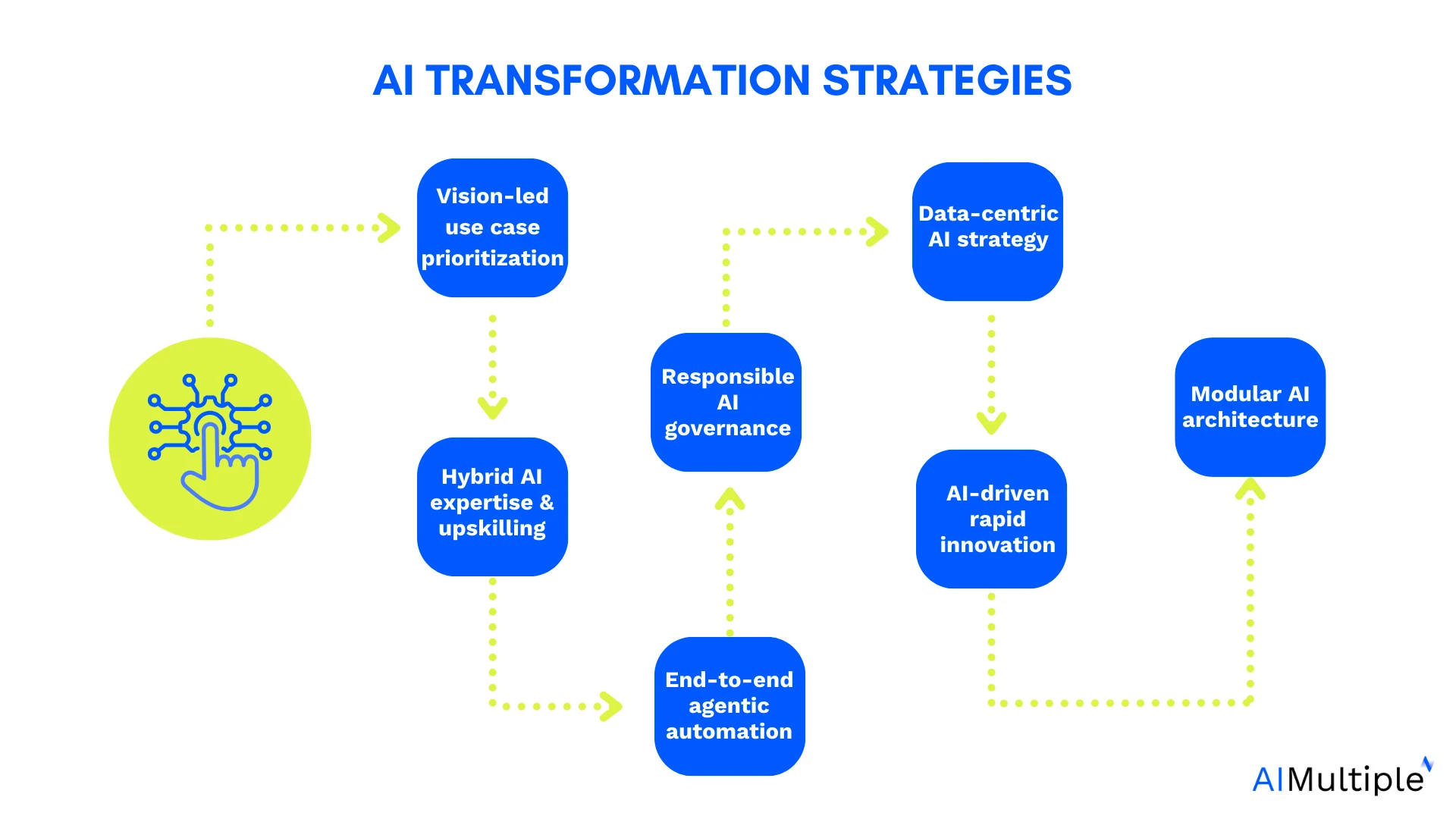
What are the steps to AI transformation?
We have listed below the top steps for Fortune 500 firms. Smaller firms could skip in-house teams and adopt less risky, less investment-heavy approaches, such as relying on consultants for targeted projects.
Here is a brief summary of each strategy with the relevant real-life example details:
1. Defining a clear vision and strategic roadmap for AI adoption
A successful AI transformation begins with identifying and prioritizing the use cases where generative AI (GenAI), large language models (LLMs) and agentic AI can most significantly impact business outcomes. Organizations should begin by assessing which operational workflows are most suitable for automation and where human expertise can be effectively enhanced through AI.
This could include automating repetitive tasks, streamlining data analysis, or synthesizing insights from vast, unstructured data sets. The key is to align these use cases with overall strategic objectives so that every AI initiative drives tangible results and contributes to a higher return on investment.
Case study: JPMorgan Chase’s DocLLM demonstrates leveraging GenAI to transform contract analysis. By automating the review process, the bank has reportedly reduced manual review time by up to 85% and significantly minimized errors. Such high-impact initiatives free up critical resources, allowing experts to focus on strategic decisions rather than getting bogged down in routine tasks. 3
2. Build a hybrid AI expertise network
Organizations looking to drive AI transformation in 2025 must ensure they have access to cutting-edge technical talent and domain-specific knowledge. Building a hybrid AI network means combining the expertise of external AI labs and vendors, such as OpenAI, with the upskilling of internal teams. This combination is essential because it infuses the organization with state-of-the-art AI capabilities and fosters a deep understanding of how these technologies can be tailored to unique business challenges.
Case study: Airbus invested in training approximately 10,000 engineers in tools like GitHub. This effort accelerated their aircraft design simulations by an impressive 40%, demonstrating that internal upskilling and external partnerships can yield significant efficiency gains.4
Companies can foster a culture of continuous learning and innovation by investing in comprehensive training programs tailored to roles ranging from executives to junior engineers.
Also, implementing process mining is one of those easy-to-achieve and impactful projects. With a process mining tool, your business can identify existing inefficiencies and automate or improve processes to achieve savings or improve the customer experience. Some process mining tools generate a digital twin of an organization (DTO), providing an end-to-end overview of the company’s processes and enabling simulation to compare actual and hypothetical scenarios.
3. Deploy agentic AI for end-to-end automation
The concept of agentic AI revolves around deploying autonomous systems that can handle multi-step workflows without constant human intervention. By integrating AI agents into business processes, companies can automate complex decision-making and execution chains. This strategy optimizes operational efficiency, enabling employees to redirect their focus to higher-level tasks that require creative and strategic thinking.
Case study: Unilever’s deployment of an AI procurement agent illustrates how autonomous systems can revolutionize supply chain management. The AI agent can negotiate with suppliers, leading to annual savings of up to $250 million. This case study underscores the immense potential of AI agents to streamline operations and optimize cost efficiencies across various functions. 5
4. Embed responsible AI safeguards
With AI’s increasing integration into every facet of business operations, ensuring ethical use and preventing bias have never been more important. Embedding responsible AI means establishing robust oversight frameworks that monitor AI outputs for accuracy, fairness, and regulatory compliance. This proactive approach is vital to maintaining public trust and ensuring that AI systems operate transparently and ethically.
A case study in responsible AI implementation is CVS Health’s use of AWS’s Guardrails for Amazon Bedrock. By integrating critical models and auditing mechanisms, CVS Health ensures that its pharmacy chatbots consistently adhere to strict FDA guidelines while mitigating the risks of biased outcomes. Such practices are critical in healthcare and other sensitive industries where the stakes are high, and any deviation can have serious repercussions. 6
5. Master data-centric AI
The success of AI initiatives is rooted in the quality and management of data. A master data-centric strategy involves investing in superior data lifecycle management practices to ensure that AI models are trained on high-quality, relevant, and well-curated datasets. Without such a foundation, even the most advanced AI systems can underperform and produce unreliable outputs.
Case study: Mayo Clinic’s Medical-GPT is an exemplary example of data-centric AI. By training on anonymized patient interactions and domain-specific data, the Medical-GPT system has outperformed general-purpose models, delivering more accurate, contextually relevant insights in the medical field. This success highlights the importance of mastering data curation and management to fully leverage AI’s potential. 7
6. AI-driven innovation
Innovation in AI is not a one-time effort but a continuous process that benefits from iterative testing and rapid prototyping. AI-driven innovation sprints offer a strategic approach to quickly test and validate new ideas before scaling them across the organization. These sprints enable companies to experiment with GenAI applications across marketing content generation, predictive maintenance, and customer service enhancements.
Case study: L’Oréal provides a compelling example of this strategy. By conducting targeted AI innovation sprints, L’Oréal could reduce product development cycles from 18 months to 4 weeks using tools like ChatGPT-4 for trend analysis and product ideation. This approach accelerates the innovation process and drives faster time-to-market for new products and services. 8
7. Scale with modular AI
A modular AI architecture allows organizations to integrate multiple AI models, ranging from OpenAI’s suite of tools to open-source solutions, into a scalable system. This ensures that businesses are not dependent on a single vendor and are well positioned to adopt new advancements as they become available.
Case study: Samsung’s Gauss LLM demonstrates a modular architecture in action. By integrating a variety of AI models, Samsung has optimized tasks ranging from code generation to customer support. This integrated approach not enhances the system’s overall performance but also ensures the organization can swiftly pivot to new models or technologies without significant rework. 9
What are the obstacles to AI transformation?
The top obstacles facing AI transformation are:
- Insufficient AI talent and experience in the organization.
- Data quality issues and inadequate data.
- Difficulties in identifying applicable business use cases.
- Company culture often fails to recognize the value of AI.
What are the best practices?
Based on our review of existing research and interviews:
- Define clear objectives: Identify specific business challenges that AI can solve and ensure these initiatives align with your strategic goals.
- Build a robust integration framework: Set clear guidelines for data governance, model training, IT integration, performance monitoring, and regulatory compliance.
- Start with pilot projects: Launch small-scale pilots to evaluate AI effectiveness, gather insights, and minimize risks before scaling.
- Implement continuous iteration: Regularly assess AI performance, collect user feedback, and refine models to adapt to evolving business needs.
- Partner with experts & develop internal skills: Collaborate with experienced LLM vendors while investing in upskilling your team to ensure sustainable transformation.
- Prioritize security & ethical practices: Address biases, ensure transparency, and enforce strong data privacy measures throughout the AI lifecycle.
- Foster cross-functional collaboration: Encourage communication and teamwork across departments to align AI initiatives with broader business strategies.
- Focus on user experience: Design intuitive tools that easily integrate with existing workflows and actively promote user adoption.
- Adopt a future-proof strategy: Build flexible architectures that enable continuous learning, adapt to new technologies, and reduce reliance on a single vendor.
 Add as preferred source
AI process transformation methodology
We combined three public datasets to build this view.
The three datasets are:
- Anthropic Economic Index (AEI): Anthropic’s research dataset measuring how Claude is used in the real world. The March 2026 release covers over a million conversations, tagged by task type. It tells us which tasks AI is being applied to today.
- O*NET: the U.S. Department of Labor’s database of occupations. For every job, it lists the specific tasks involved (for example, “analyze financial records to prepare reports” for an accountant). It tells us what work people actually do.
- APQC Process Classification Framework (PCF): the standard taxonomy of enterprise business processes, organized in five hierarchy levels (L1 to L5), from broad categories like “Manage Financial Resources” down to individual activities like “Process accounts payable.” It tells us how businesses organize work.
The challenge: AEI is organized by occupational tasks, while businesses think in process taxonomies. We needed to bridge the two.
Step 1: Connect AEI to occupational tasks
We took the March 24, 2026 AEI release and used the global sample. For each task, we pulled the metrics relevant to prioritization: how often AI is used, how people collaborate with it (delegate, iterate, validate, or learn), how autonomously the AI operates, the typical education level required, whether humans report the task as something they can do, and how often the AI succeeds.
Because AEI labels each task using the exact wording from O*NET task statements, the link is direct. About 7% of tasks appear in multiple occupations. In those cases we used the first listed.
Step 2: Connect occupational tasks to enterprise processes
This step is harder because the same task can appear in multiple business processes, and the wording rarely matches exactly between O*NET and PCF. We solved it in two layers:
- Filter the candidate pool. For each of the 13 PCF top-level categories, we kept the occupations that plausibly do that kind of work. For example, “Develop Vision and Strategy” was restricted to top executives, management analysts, and market research analysts. We built this filter manually for all 13 categories using the standard U.S. occupational coding system.
- Find the best match inside that pool. We used a sentence similarity model (a widely used open-source model called MiniLM) to score how closely each O*NET task description matched each PCF process description. The highest-scoring match was selected for each PCF process.
Match confidence
Every match received a similarity score between 0 and 1:
- High confidence (score 0.65 or higher): 306 matches (20%)
- Medium confidence (0.50 to 0.65): 1,037 matches (66%)
- Low confidence (0.35 to 0.50): 220 matches (14%)
- No reliable match (below 0.35): 5 matches
All 1,568 detailed PCF rows (L4 activities and L5 tasks) received a match. The higher levels (L1 to L3) are too abstract for direct matching and are used for hierarchy and grouping.
Here is the data we plotted above:
Note that the table shows the complete dataset, whereas the charts exclude tasks with zero AI exposure for better readability.
What we excluded and why
- AEI reports usage data for tasks that appeared in enough conversations during the sample week to draw reliable conclusions.
- For 57% of matched processes, the corresponding O*NET task fell below that threshold, so we cannot determine the exact level of AI adoption.
- We excluded these from the charts rather than guess. They are not necessarily low-priority, we lack the evidence to place them.
- The charts show the 327 processes where we have a measurable signal in both AI exposure and verification time.
For more on AI
Feel free to check our other AI articles to learn more about how AI can transform your business:
Cite this research
Pick the format that matches where you're publishing. Pasting the link version into your CMS preserves the backlink.
@misc{dilmegani2026,
  author = {Dilmegani, Cem and Şimşek, Hazal},
  title  = {{7 Useful AI Transformation Strategies}},
  year   = {2026},
  month  = jun,
  howpublished    = {\url{https://aimultiple.com/ai-transformation}},
  note   = {AIMultiple. Retrieved June 12, 2026}
}Results and timestamps of 990 data points. Download the summary data shown in this article's charts and tables as a ZIP file containing 4 CSV files and a README.
Want the granular data behind it? Join Premium
Changelog
4 updatesAdded an opening section mapping Anthropic Economic Index data to APQC process categories, with AI exposure and verification-time charts.
Added an AI process transformation methodology section detailing the AEI, O*NET, and APQC PCF dataset matching approach.
Reference Links
Cem's work at AIMultiple has been cited by leading global publications including Business Insider, Forbes, Morning Brew, and Washington Post, global firms like Deloitte and HPE, NGOs like World Economic Forum, and supranational organizations like European Commission. [1], [2], [3], [4], [5]
Throughout his career, Cem served as a tech consultant, tech buyer and tech entrepreneur. He advised enterprises on their technology decisions at McKinsey & Company and Altman Solon for more than a decade. He also published a McKinsey report on digitalization.
He led technology strategy and procurement of a telco while reporting to the CEO. He has also led commercial growth of deep tech company Hypatos that reached a 7 digit annual recurring revenue and a 9 digit valuation from 0 within 2 years. Cem's work in Hypatos was covered by leading technology publications like TechCrunch and Business Insider.
Cem regularly speaks at international technology conferences. He graduated from Bogazici University as a computer engineer and holds an MBA from Columbia Business School.







Comments 1
Share Your Thoughts
Your email address will not be published. All fields are required. Comments are left in their original language.
Great insight on AI and the transformation progression. I found the industries currently impacted interesting also.