


Compare 15 Agent Swarm Frameworks: OpenAI, Google, Microsoft

Anthropic split its research assistant into a lead agent and a team of parallel subagents, reporting 90.2% better results on its internal evaluations. Yet, the system used about 15 times as many tokens.1 How much of that overhead one pays depends partly on the framework.
In our orchestration benchmark, we ran the same five-agent workflow with the same model and tools on four frameworks, and LangGraph finished 2.2 times faster than CrewAI because the frameworks handle tool calls and context differently.
Compare eleven frameworks based on their features and prices, and learn how the market has changed in a year:
Product | Maintainer | License | Languages | Pricing |
|---|---|---|---|---|
Agency Swarm | VRSEN | MIT | Python 3.12+ | Free; no hosted offering |
Agent Squad | 2FastLabs (originally AWS Labs) | Apache 2.0 | Python, TypeScript, Swift | Free; Bedrock usage billed by AWS |
AgentScope | Alibaba | Apache 2.0 | Python, Java | Free; optional deployment on Alibaba Cloud billed by usage |
CAMEL | CAMEL-AI.org | Apache 2.0 | Python | Free; no hosted offering |
CrewAI | CrewAI Inc. | MIT | Python | Free; AMP: free tier (50 runs/mo), Professional: $25/mo |
Google ADK | Google | Apache 2.0 | Python, TypeScript, Go, Java, Kotlin | Free; Agent Engine hosting usage-based |
LangGraph | LangChain Inc. | MIT | Python, JS/TS | Free; hosting via LangSmith Plus: $39/seat/mo |
Mastra | Mastra (Kepler Software) | Apache 2.0 (except ee/ code) | TypeScript | Free; platform: free tier, Teams: $250/mo |
MetaGPT | FoundationAgents | MIT | Python | Free; hosted product Atoms (formerly MGX) priced separately |
Microsoft Agent Framework | Microsoft | MIT | Python, .NET (Go in preview) | Free; Foundry hosting usage-based |
What is an agent swarm?
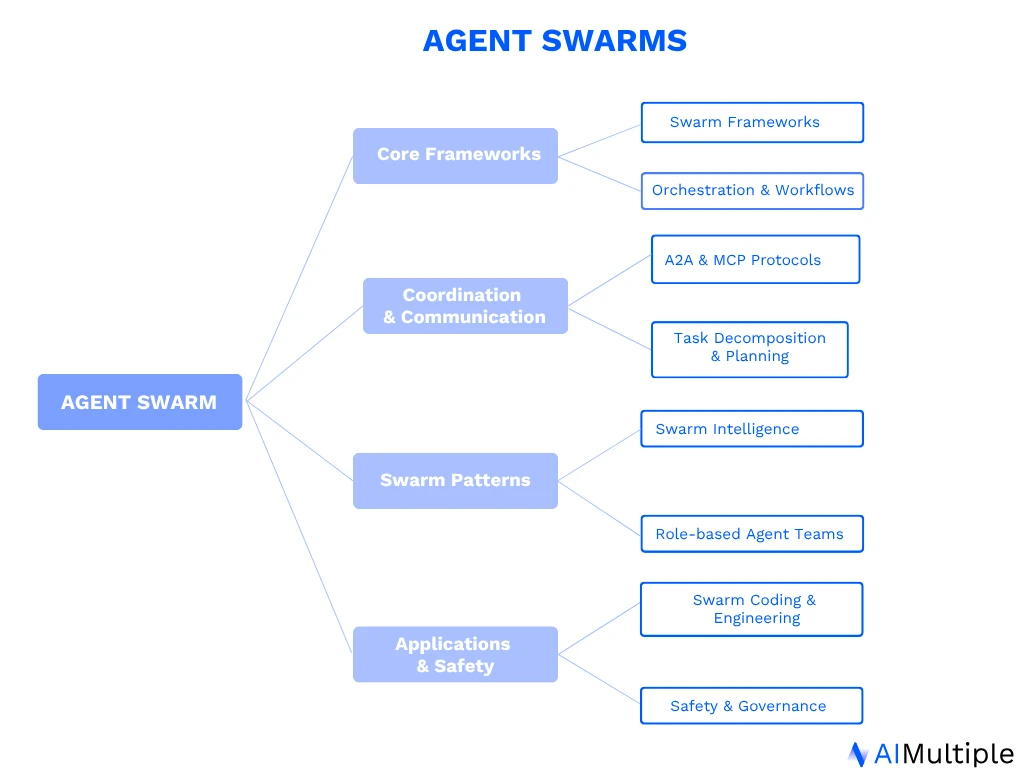
An agent swarm is a setup where several AI agents work on one shared task, instead of a single agent doing everything (a “monolithic” design). The agents coordinate in one of three ways:
- Handoffs: one agent passes control of the conversation to another, more specialized agent.
- Message passing: agents send each other messages or results.
- Shared state graph: agents are nodes in a graph that read and write a common state.
Agent swarm features
Agent swarm frameworks share four core features:
- Tool and function calling: agents can call APIs and other functions, and the framework generates the schemas for those calls.
- Multi-agent orchestration: done through explicit graphs, handoffs, hierarchical crews, or a central router that sends each task to the best-suited agent.
- Memory and state: conversation history or task state carries over between turns, kept in memory or in a pluggable store such as SQLite, Redis, or a vector database.
- Open source: every framework’s code is on GitHub under a permissive license, except Mastra.
Agent swarm frameworks and platforms
Agency Swarm
Built on top of the OpenAI Agents SDK. You define agents by role (for example CEO, developer or assistant) and declare which agents may contact which; agents then talk through a send_message tool. Tools are typed with Pydantic, and you save conversation history yourself through callback functions.
Pros:
- Converts OpenAPI schemas directly into agent tools.
- Runs on macOS, Linux and Windows.
Cons:
- Models other than OpenAI’s (Anthropic, Gemini, Grok, Azure, OpenRouter) go through LiteLLM rather than a native integration.
- Version 1.x is built on the OpenAI Agents SDK and Responses API, so changes there affect it.2
AgentScope
Alibaba’s Python framework, now at version 2.0, built from building blocks such as a ReAct loop, toolkit, memory and middleware. It requires Python 3.11 or higher and includes Agent Team, where a leader agent coordinates worker agents. Its permission system gives fine-grained control over tools and resources, including confirmation steps.
Pros:
- Tools and code run in isolated workspaces on backends ranging from local and Docker to E2B, Daytona and Kubernetes.
- Its agent service ships SQL and NoSQL persistence for agent state and sessions, plus scheduled tasks.3
Cons:
- The quickstart example uses Alibaba’s DashScope model.3
Agent Squad
A classifier sends each request to the most suitable agent, using Amazon Bedrock by default.4 SupervisorAgent coordinates sub-agents that share one conversation context. GroundedAgent keeps data gathering separate from writing the answer, to reduce made-up content.
Pros:
- The Swift version runs entirely on the device (iOS 16+, macOS 14+), including MCP tools, voice, and locally stored chat history.
- Python and TypeScript have feature parity.
- Ready-made agents cover Bedrock, Anthropic, OpenAI, Lex and Lambda.
Cons:
- Routing adds a classifier call to each request; the faster JevClassifier option relies on a paid third-party service, TypeSafe AI.
- GroundedAgent uses two LLM calls on turns that use tools.5
CAMEL
A Python framework from CAMEL-AI.org focused on finding the scaling laws of agents.Its Workforce module assembles, manages and scales teams of agents for tasks beyond a single agent, and it starts recovery steps when a task fails.
Pros:
- Its design covers data generation, task automation and world simulation.
- Agents can be given a HumanToolkit to ask a person for clarification or approval mid-task.
Cons:
- It has no paid tier and no hosted service from CAMEL-AI.6
- Tool sets such as web search are installed separately as extras (camel-ai[web_tools]).7
CrewAI
Agents are organized into “crews,” where each agent has a role, a goal, and tools. A second layer called Flows handles step-by-step, event-driven execution with conditional branches.
Memory is stored in a hierarchy, searchable with fast vector search or deeper LLM-assisted recall, and saves happen in the background. The hosted platform, AMP, adds a visual editor; AMP Factory runs the same platform on your own servers or private cloud.
Pros:
- Standalone, with no LangChain dependency.
- Supports MCP and A2A.
- Memory and models can run locally through Ollama, so content doesn’t go to an outside API.8
- Passes every earlier agent’s full output to the next one; in our orchestration benchmark, its final agent produced the most detailed result (5,339 tokens).
Cons:
- Agents call the OpenAI API by default unless you configure another provider.
- Anonymous usage telemetry is on by default (disable it with the
OTEL_SDK_DISABLEDenvironment variable). - Agents deliberate before calling a tool, which can’t be switched off; in our benchmark this took about 5 seconds, most of one agent’s 9-second run.
Google Agent Development Kit (ADK)
ADK 2.0 added a graph-based workflow engine that mixes fixed code steps with agent decisions, with support for routing, fan-out and fan-in, loops, retries and human-in-the-loop. The adk web interface includes a drag-and-drop Visual Builder, which is experimental and Python-only. Agents deploy to Vertex AI Agent Engine, Cloud Run or GKE.9
Pros:
- Evaluation is built in through
adk eval, rather than requiring a separate tool. - The Task API handles structured delegation between agents.
Cons:
- The language versions don’t move together: 2.0 is released for Python, Go and TypeScript, but not yet for Java or Kotlin.
LangGraph
Workflows are defined as directed graphs that can loop and branch on conditions. An interrupt API lets a human inspect or change a run’s state at any point. LangSmith Studio is a visual debugger for graphs written in code. LangSmith Agent Builder configures agents through a form rather than a drag-and-drop canvas.10 LangSmith Deployment is LangChain’s optional managed hosting.
Pros:
- Can be used without LangChain or any paid service.
- Durable execution saves checkpoints, so a failed run resumes exactly where it stopped.
- Passes only state changes between agents, not full outputs; in our orchestration benchmark, its final agent produced 2,589 tokens, the fewest of the frameworks tested.
Cons:
- It describes itself as a low-level framework, and for building agents quickly its own README points users to Deep Agents, a higher-level package built on top of it.11
Mastra
Combines agents, graph-based workflows, memory, evaluations and observability in one framework. Workflows can pause indefinitely for human approval and resume from saved state. Studio is an interface for testing agents written in code, and it can be shared with a team through Mastra Cloud.12
Pros:
- Connects to 40+ model providers through one interface.
- Can publish its agents and tools as MCP servers.
- Embeds in existing React, Next.js or Node.js apps.13
Cons:
- Features in
ee/directories require a commercial license for production use.13
MetaGPT
A Python framework built on the idea that code is the result of applying standard operating procedures to a team of LLM agents. It assigns roles such as product manager, architect, project manager and engineer to separate agents.
Pros:
- It runs as a CLI or a Python library, and the config accepts providers such as OpenAI, Azure, Ollama and Groq.
- It includes a Data Interpreter role for writing code for data tasks.14
Cons:
- The latest README news is from March 2025 and promotes mgx.dev, the team’s commercial product.14
Microsoft Agent Framework
An open, multi-language framework for building production-grade AI agents and multi-agent workflows. It is fully supported in both Python and C#/.NET with consistent APIs, and the README links migration guides from Semantic Kernel and from AutoGen.15
Pros:
- Every orchestration supports human-in-the-loop, so a workflow can pause and wait for a person at set points.16
- Agents can be deployed to Foundry-hosted infrastructure with two extra lines of code, and OpenTelemetry tracing is built in.15
Cons:
- The Go version is a public preview that does not yet have declarative agents, RAG, CodeAct or functional workflows.
- Some provider packages are still early. The Gemini integration is marked as Alpha.17
Microsoft AutoGen
Agents coordinate through a group chat rather than a defined execution graph. AutoGen Studio is a no-code visual builder, and UserProxyAgent provides human-in-the-loop input.18 Microsoft points new projects to Microsoft Agent Framework, and a community fork, AG2, continues separately.19
Pros:
- A layered design offers both a high-level API for common patterns and a low-level core for custom ones, with Python and .NET interoperability.
- Group chat suits multi-turn tasks such as brainstorming and iterative review.20
Cons:
- The project is now community-managed, so support responses may be slow.
- AutoGen Studio is meant for prototyping and, by its own README, is not a production-ready app.21
Microsoft Semantic Kernel
An SDK built around plugins, with connectors to existing enterprise systems and a Process Framework for structured business workflows. Microsoft provides migration guides that carry existing plugins over to Microsoft Agent Framework.22
Pros:
- Model-agnostic, with MCP support for plugins.
- Runs local models through Ollama, LM Studio or ONNX.
Cons:
- Its README now states that Semantic Kernel “is now Microsoft Agent Framework,” and new features go there.
OpenAI Agents SDK
Built around agents, handoffs, guardrails, sessions and tracing. Sandbox agents work inside a container on long tasks and keep workspace state between steps, and realtime agents handle voice. It replaces OpenAI’s retired Swarm library.
Pros:
- Human-in-the-loop is built in, and input and output guardrails can run in parallel and stop a run early.23
- Works with over 100 models beyond OpenAI’s own.24
Cons:
- The default local sandbox runs only on macOS and Linux; Windows needs Docker or a hosted sandbox.
- Handoffs are the only coordination primitive, so a rule like “two agents must both finish before a third starts” has to be built outside the SDK.20
PraisonAI
Agents and multi-agent setups can be defined in YAML without code, built in the Flow drag-and-drop editor (based on Langflow), or written in Python or JavaScript. It ships with over 100 built-in tools and supports over 100 models.
Pros:
- The Claw dashboard connects agents to Telegram, Discord, Slack and WhatsApp.
- Doom-loop detection, human approval and guardrails help prevent runaway agents.
Cons:
- Claw requires both OpenAI and Tavily API keys.
- The project lives on its creator’s personal GitHub account.25
Spring AI Alibaba
The agent framework is a Java framework built on Spring AI with two layers. It includes built-in context engineering and human-in-the-loop support, along with workflow agents such as SequentialAgent, ParallelAgent, RoutingAgent and LoopAgent. The Graph runtime underneath provides persistence, orchestration and streaming for long-running stateful agents.26
Pros:
- Agent-to-agent communication works through Nacos, so agents can coordinate across services.26
- The Admin platform lets you build agents visually, deploy them without code or export them as a Java project, and it can migrate Dify DSL.26
- It exclusively uses Java and is tightly integrated with Alibaba Cloud services such as Bailian, ARMS and Nacos.
Swarms
Through a SwarmRouter interface, you choose from ready-made coordination patterns such as sequential, concurrent, hierarchical, graph and mixture-of-agents. AutoSwarmBuilder generates an agent team from a task description, and consensus and debate patterns let agents vote. Swarms Cloud is a hosted API billed by usage.
Pros:
- Documents ten architectures in its README and links to 60+ more.
- GraphWorkflow runs independent branches in parallel automatically.
- Claims compatibility with agents built in LangChain, AutoGen and CrewAI.
Cons:
- The recommended “auto” mode has no fixed iteration cap, and the README itself advises a fixed cap for cost-sensitive work.27
Agent swarm orchestration patterns and trends
1. Major vendors replaced their first agent frameworks
Between March 2025 and April 2026, OpenAI, Microsoft and Google each replaced or rebuilt their agent frameworks.
- OpenAI: Swarm was replaced by the Agents SDK in March 2025. The SDK keeps Swarm’s handoff model and adds AI guardrails, tracing and sessions.28
- Microsoft: AutoGen and Semantic Kernel merged into Microsoft Agent Framework, which reached version 1.0 in April 2026. Both older frameworks are now in maintenance mode.29
- Google: ADK 2.0 replaced its hierarchical agent executor with a graph-based workflow engine.30
- AWS: Agent Squad left AWS Labs when its original authors took it to their own company, 2FastLabs.31
2. Graph-based workflow engines became standard
In 2026, ADK, Microsoft Agent Framework, LangGraph and Mastra all let developers build multi-agent workflows as graphs. Agents and functions are the nodes, and the edges set the order, branches and loops. 20 A graph can express any of the three common coordination patterns and most production systems combine more than one.
Centralized (orchestrator-worker)
A supervisor agent splits the task, sends subtasks to worker agents, and combines their results. Some examples are:
- Amazon Bedrock: Multi-agent collaboration uses this model and has been generally available since March 10, 2025.32
- Anthropic: Its research system uses a lead agent with parallel subagents. 1
Hierarchical
Supervisors delegate to lower-level supervisors, which helps with tasks too large for one agent’s context window.
- ADK 2.0: The Workflow Runtime supports nested workflows, fan-out and fan-in, loops and retries.33
- ADK templates: SequentialAgent, ParallelAgent and LoopAgent cover common pipelines without building a graph by hand.34
Decentralized (peer-to-peer handoffs)
Agents pass control directly to one another while the task runs, with no supervisor.
For example, LangGraph’s swarm library implements this and remembers the last active agent, so a follow-up message returns to it.35
Whichever pattern a framework uses, the handoff itself is rarely the bottleneck. In our orchestration benchmark, passing work from one agent to the next took milliseconds on every framework; the differences came from how each framework handles tool calls and context.
3. The two main agent protocols moved to the Linux Foundation in 2025
An agent can use both:
- Model Context Protocol (MCP) connects an agent to its tools and data. Anthropic created it in 2024 and donated it to the Linux Foundation’s Agentic AI Foundation in December 2025.36
- Agent2Agent (A2A) connects separate agents to each other, even across frameworks and vendors. Google created it in April 2025 and moved it to the Linux Foundation that June.37
Further reading
- Major Agentic AI Design Patterns & Real-World Examples
- LLM Orchestration: Top Frameworks and Gateways
- Top AI Agent Builders
 Add as preferred source
Cite this research
Pick the format that matches where you're publishing. Pasting the link version into your CMS preserves the backlink.
@misc{simsek2026,
  author = {Şimşek, Hazal},
  title  = {{Compare 15 Agent Swarm Frameworks: OpenAI, Google, Microsoft}},
  year   = {2026},
  month  = nov,
  howpublished    = {\url{https://aimultiple.com/agent-swarm}},
  note   = {AIMultiple. Retrieved November 5, 2026}
}Results and timestamps of 475 data points. Download the summary data shown in this article's charts and tables as a ZIP file containing 3 CSV files.
Want the granular data behind it? Join Premium
Reference Links





Be the first to comment
Your email address will not be published. All fields are required. Comments are left in their original language.