


5 Agentic AI Design Patterns & Real-World Examples

Agentic AI design patterns enhance the autonomy of large language smodels (LLMs) like Llama, Claude, or GPT by leveraging tool-use, decision-making, and problem-solving. This brings a structured approach for creating and managing autonomous agents in several use cases.
What are agentic workflows?
An agent is considered more intelligent if it consistently chooses actions that lead to outcomes more closely aligned with its objective function.
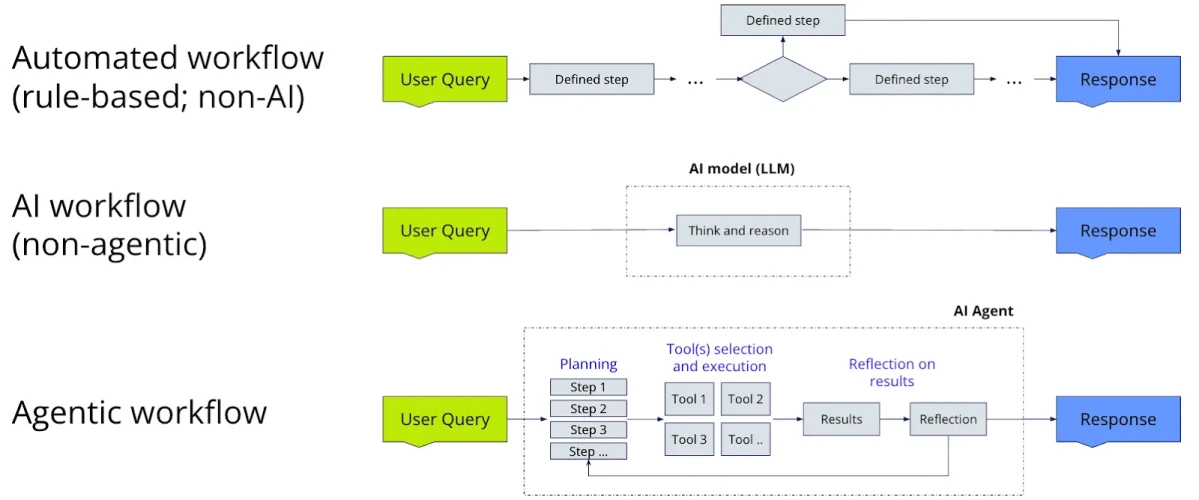
Automated workflows (rule-based, non-Al)
Follow predefined rules and processes, typically based on fixed instructions. They are designed to handle repetitive tasks efficiently, often through systems like robotic process automation (RPA), where little to no decision-making is required.
AI workflows (non-agentic)
Systems where LLMs and tools are orchestrated through predefined code paths, with minimal thinking involved. In a non-agentic workflow, an LLM generates an output from a prompt, like generating a list of recommendations based on input.
Agentic workflows
AI-driven processes where autonomous agents make decisions, take actions, and coordinate tasks with minimal human input. These workflows use key components like reasoning, planning, and tool utilization to handle complex tasks.
Compared to traditional automation, like RPA, which follows fixed rules and designs, agentic workflows are more “dynamic and flexible”, adapting to real-time data and unexpected conditions.
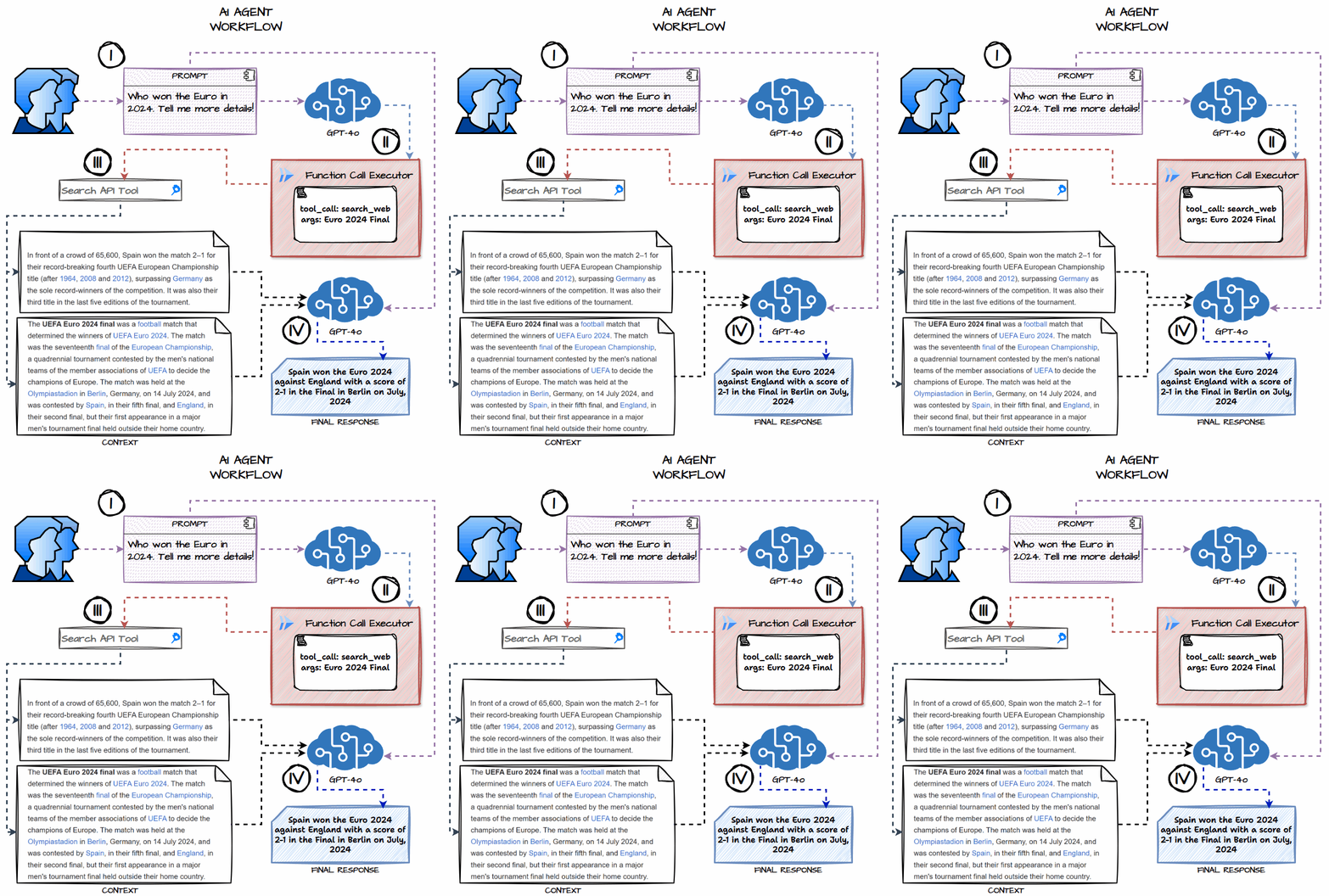
In this workflow, the AI agent is answering the user query (Example: “Who won the Euro in 2024?”)
- User query: The user asks a question.
- LLM analysis: The LLM interprets it and determines if external data is needed.
- External tool activation: A search tool retrieves real-time info.
- Response creation: The LLM combines the data and replies:
“Spain won the Euro 2024 against England with a score of 2–1 in the Final in Berlin in July 2024.”
5 types of agentic AI design patterns
Reflection pattern
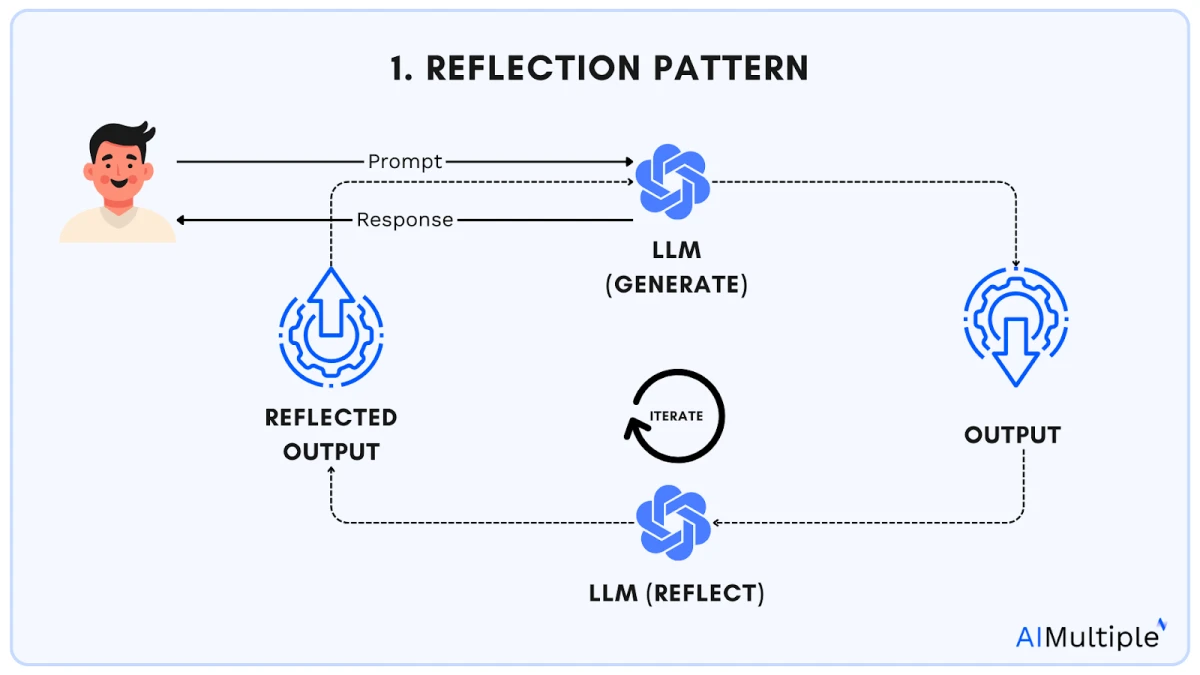
The reflection pattern enhances agentic workflows with continuous self-improvement.
→ This pattern involves a self-feedback mechanism where an AI agent evaluates its outputs or decisions before finalizing its response or taking further action.
→ It allows the agent to analyze its own work, identify errors or gaps, and refine its approach, leading to better results. This process is not limited to a single iteration, agents can adjust their answers in subsequent interactions.
Real-world example:
AI agents such as GitHub Copilot can refine the code through self-reflection by examining and modifying its own structure and behavior at runtime, for example:
- Initial response: GitHub Copilot generates a code snippet based on a prompt.
- Reflection process: Reviews the generated code for errors, inefficiencies, or improvements. It may use a feedback loop, such as running the code in a sandbox environment, to identify bugs.
- Self-iteration: Evaluates whether the generated code functions as expected, refines its logic, and suggests optimizations.
Tool use pattern
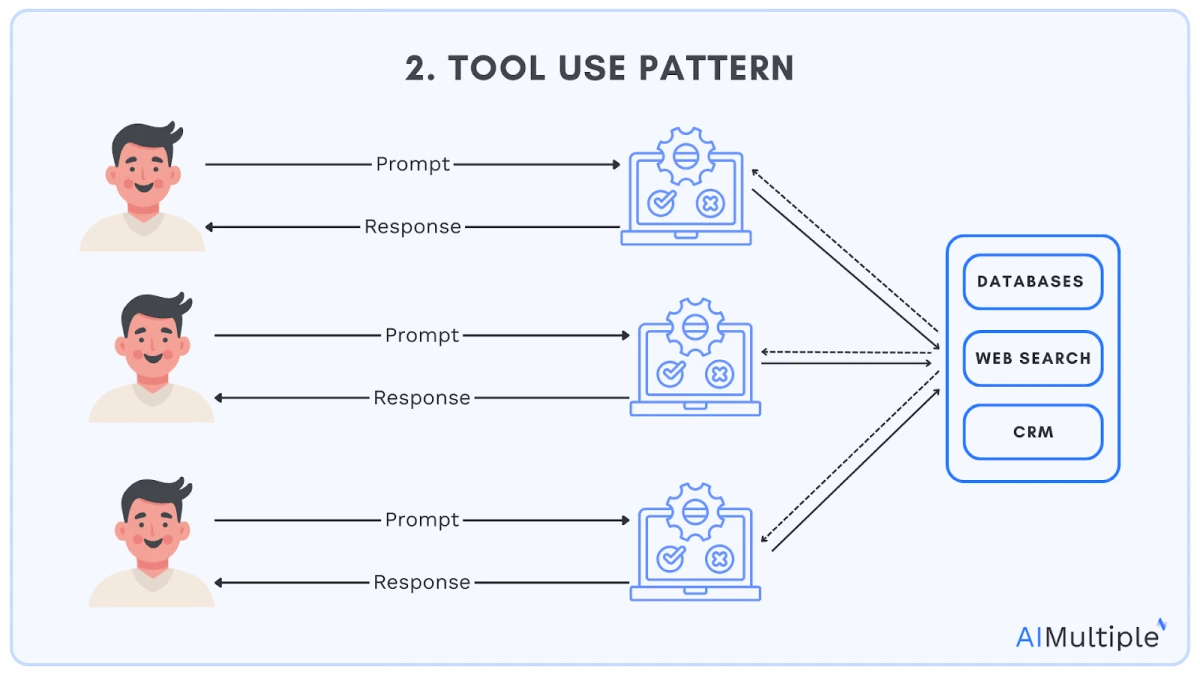
The tool use pattern in agentic AI enhances the capabilities of large language models (LLMs) by enabling them to interact dynamically with external tools and resources.
Protocols like the Model Context Protocol (MCP) help standardize the tool use process.2
Standardizing tool use through MCP moves agentic design from custom API integrations to a unified context layer. Rather than managing individual connectors, agents utilize MCP to maintain a secure data stream between the model and the local or enterprise environment. With tool use protocols and agentic models, agents can:
- access real-time information (via APIs), search the web
- interact with APIs to process and generate responses
- interact with information retrieval systems
- retrieve specific datasets
- run scripts for data analysis
- leverage machine learning models to run specialized algorithms
We tested popular AI agents’ tool use capabilities.
Real-world example:
MM-REACT, a Microsoft Azure AI system, pairs ChatGPT with a pool of vision expert models, such as image captioning, object detection and OCR. ChatGPT works through a thought–action–observation loop: it reasons about the request, calls the vision expert it needs, reads the result, and repeats until it can answer.
For example, given several uploaded receipts, it can extract the amounts from each and calculate total travel cost, without any additional multimodal training.3
Planning pattern
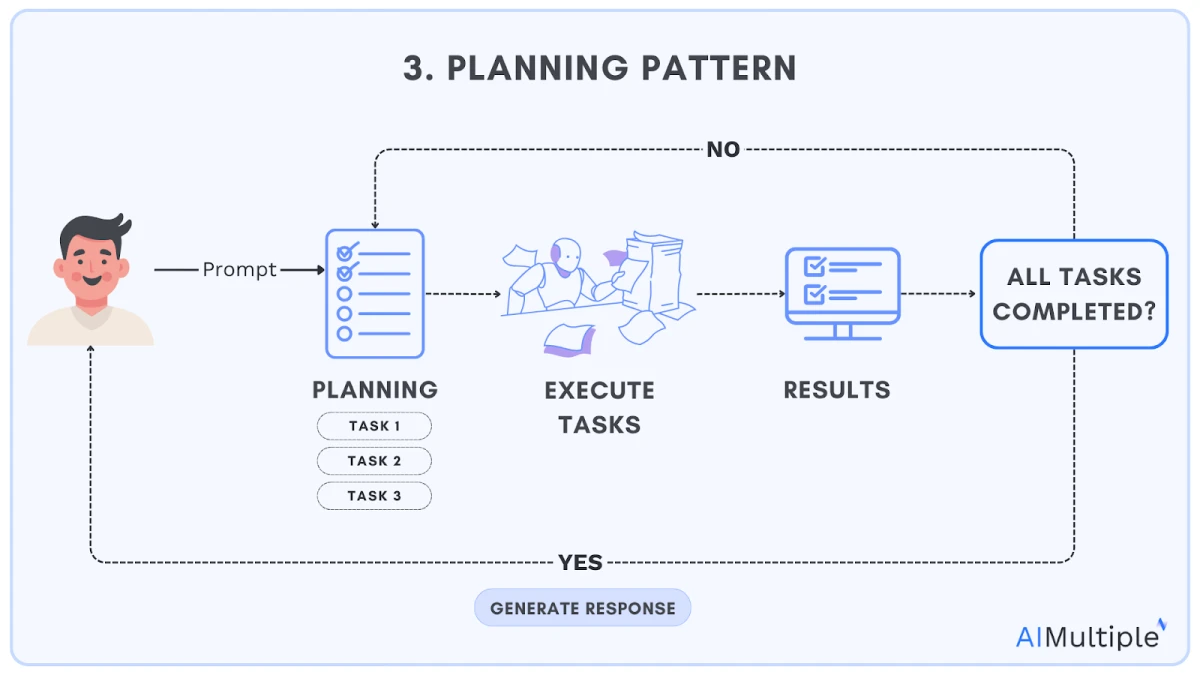
The planning pattern enables LLMs to break down large tasks into subtasks.
An LLM using the planning pattern will organize the sub-goals into a logical sequence. Depending on the complexity, the agent may plan actions in a linear order or create branches for parallel execution.
Real-world example:
A group of researchers demonstrated how LLM agents collaborate with models from platforms like Hugging Face to handle complex, larger tasks.
The approach was called HuggingGPT, an LLM-powered agent that leverages LLMs (e.g., ChatGPT) to connect various AI models in machine learning communities (e.g., Hugging Face) to solve AI tasks.4
In current workflows, the planning pattern is increasingly integrated with model-level reasoning. While frameworks handle high-level task delegation, reasoning models perform internal processing to validate plans before execution. This internal deliberation:
- reduces logic errors during task decomposition
- minimizes the need for multi-step prompt engineering
- allows the agent to self-correct before initiating an action
Multi-agent pattern
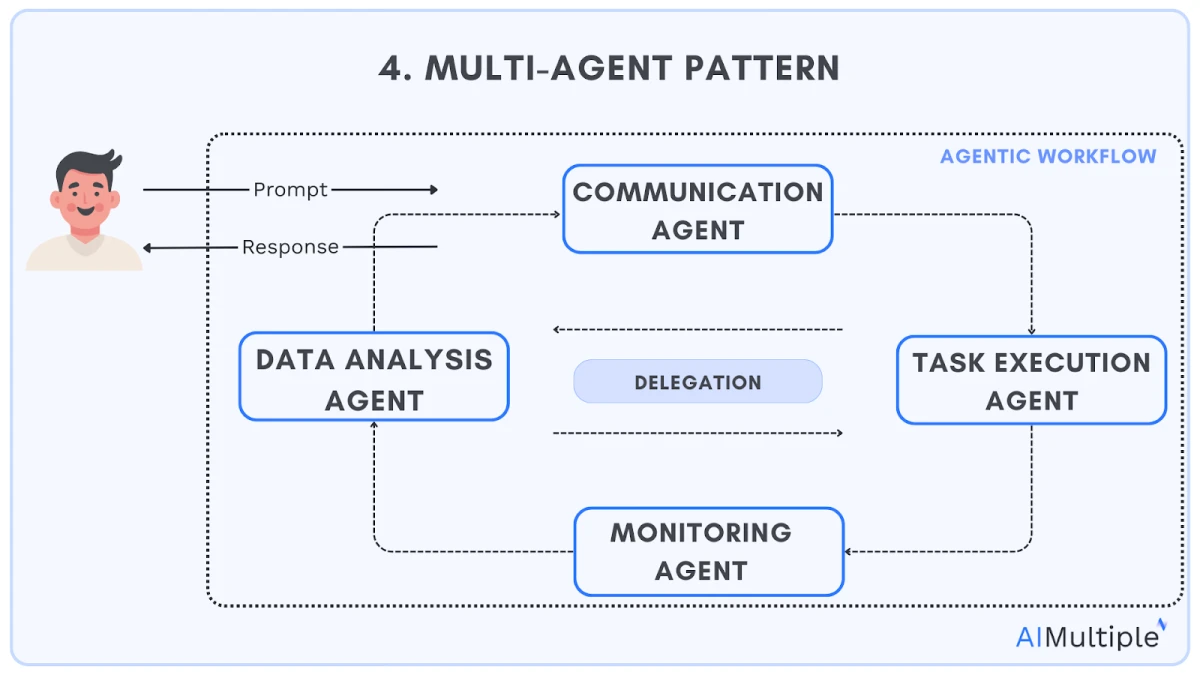
The multi-agent patterns focus on task delegation, which involves assigning different agents to different tasks that can be created by prompting a single LLM (or multiple LLMs) to handle distinct responsibilities.
For example, to create a software developer agent, you could prompt the LLM: “You are an expert in writing efficient, clear code. Please write the code to accomplish [specific task].“
In multi-agent systems, agents communicate using Agent-to-Agent (A2A) protocols that define the flow of information between them. For instance, Google’s A2A protocol is an open framework that equips agents with structured context and tools.5
Current multi-agent frameworks:
- LangGraph: Facilitates cyclic workflows and state management for agents requiring feedback loops.
- PydanticAI: A framework focusing on type-safe, production-ready agent orchestration.
- CrewAI: Orchestrates agents by assigning specific roles and collaborative task sequences.
- OpenAI Swarm: A lightweight protocol for managing hand-offs between specialized models.
For more: Open source agentic AI builders & frameworks.
 Add as preferred source
Human-in-the-Loop (HITL) pattern
The HITL pattern incorporates human intervention at specific decision points to ensure accuracy and safety. Key implementations include:
- Approval Checkpoints: The agent pauses for human confirmation before executing high-impact actions, such as financial transactions or data deletions.
- Review Loops: A human or a secondary supervisor model evaluates the agent’s output to provide a quality control layer before the process concludes.
Agentic workflow use cases
1. Retrieval-augmented generation (RAG)
Agentic design patterns can be used in RAG systems to incorporate agents into the RAG pipeline.
For more, see:
→ Discover Top Agentic RAG Systems
→ Compare Top Retrieval-Augmented Generation Tools
2. Software development
- Code generation & completion:
- Cursor: Automatically generates code snippets and entire functions based on natural language descriptions
- Devin: Creates apps from scratch with minimal human oversight, using a browser or a command line interface.
- Automated software testing:
- Diffblue: Automatically writes unit tests for Java code, ensuring coverage and code correctness.
- Snyk: Scans dependencies for known vulnerabilities and automatically opens pull requests that upgrade them to patched versions, leaving developers to review and merge.6
3. Gaming
- Autonomous NPCs:
- Generative Agents (Stanford and Google Research): 25 LLM-powered characters in a Sims-style town remember, reflect and plan their days. From one prompt, they organized a Valentine’s Day party on their own.7
- AI Dungeon (Latitude): An LLM acts as game master, narrating the outcome of any player action without a fixed script.8
- Autonomous exploration:
- Voyager (NVIDIA, Caltech and others): A GPT-4 agent explores Minecraft, writes code to learn new skills, and saves working skills to a reusable library without human intervention.9
- Game-inspired agent training:
- AgentRefine: Trains LLM agents on Dungeons & Dragons-style scenarios so they learn to correct their own mistakes.10
- Pathfinding (classic game AI):
- NavMesh: Game engines like Unity use navigation meshes so characters can find paths around obstacles in real time.11
4. Multimedia creation
- Turning GenAI search results into Wikipedia pages
- Perplexity Pages: When a user enters a search query, Perplexity Pages aggregates relevant information from multiple sources to turn search results into Wikipedia pages.
- Automated video production
- Pictory autonomously turns text-based content into video.
5. Research & data analysis
- ChemCrow: Running simulations and making autonomous recommendations for drug discovery.
- AI2: Provides data warehouse management through autonomous systems.
6. Computer use
Modern agents can interact with Graphical User Interfaces (GUIs) similarly to human users. Through computer-use capabilities, agents interpret screen pixels, move cursors, and input text across various applications. These agents can:
- search the web and interact with desktop software interfaces
- navigate internal ERP systems that lack structured APIs
- execute cross-platform administrative workflows
- fill out online forms and book travel arrangements.
7. Customer service
AI agents for customer service respond to customer queries in natural language, interpret context, and generate human-like responses. These agents are commonly used for contact center automation. Some examples include:
- Zendesk AI
- Intercom’s Fim
- Kore.AI Agent
8. Healthcare automation
Agentic AI for healthcare aims to leverage healthcare systems to automate workflows in clinical operations. Tool examples include:
General-purpose healthcare automation:
- Sully.ai
- Hippocratic AI
- Innovacer
- Beam AI Healthcare agent
- Notable Health
Patient support:
- Amelia AI
- Cognigy
Further reading
Cite this research
Pick the format that matches where you're publishing. Pasting the link version into your CMS preserves the backlink.
@misc{dilmegani2026,
  author = {Dilmegani, Cem and Şimşek, Hazal},
  title  = {{5 Agentic AI Design Patterns & Real-World Examples}},
  year   = {2026},
  month  = nov,
  howpublished    = {\url{https://aimultiple.com/agentic-ai-design-patterns}},
  note   = {AIMultiple. Retrieved November 3, 2026}
}
Changelog
1 updatesAdded a Human-in-the-Loop (HITL) pattern section covering approval checkpoints and review loops.
Reference Links
Cem's work at AIMultiple has been cited by leading global publications including Business Insider, Forbes, Morning Brew, and Washington Post, global firms like Deloitte and HPE, NGOs like World Economic Forum, and supranational organizations like European Commission. [1], [2], [3], [4], [5]
Throughout his career, Cem served as a tech consultant, tech buyer and tech entrepreneur. He advised enterprises on their technology decisions at McKinsey & Company and Altman Solon for more than a decade. He also published a McKinsey report on digitalization.
He led technology strategy and procurement of a telco while reporting to the CEO. He has also led commercial growth of deep tech company Hypatos that reached a 7 digit annual recurring revenue and a 9 digit valuation from 0 within 2 years. Cem's work in Hypatos was covered by leading technology publications like TechCrunch and Business Insider.
Cem regularly speaks at international technology conferences. He graduated from Bogazici University as a computer engineer and holds an MBA from Columbia Business School.







Be the first to comment
Your email address will not be published. All fields are required. Comments are left in their original language.