

Top 10 AI Agents in Healthcare with Examples

We list AI agents for healthcare that automate clinical operations workflows. Explore AI agents in the healthcare industry, including tools used for general tasks, EHR-native, patient-facing support, and clinically assisted decision-making:
AI agents in healthcare industry
General-purpose healthcare agents
These agents automate administrative and operational tasks (e.g., scheduling, medical coding, and office operations). They do not provide diagnoses.
AI agent | Medical coding | Patient intake | Billing automation | EHR Integration |
|---|---|---|---|---|
Notable | ⚠️ NLP-based doc review | ✅ Semi autonomous – patients fill forms, AI pushes data to EHR | ✅ End-to-end billing automation | ✅ Broad integration |
Beam AI | ✅ AI agent suggests billing codes | ✅ Highly autonomous – collects info, updates EHR | ✅ End-to-end billing automation | ⚠️ API-based connection (integration-ready) |
Sully.ai | ✅ AI agent suggests billing codes | ✅ Highly autonomous – collects info, updates EHR | ⚠️ Partial billing automation (doesn’t automate tasks like claim submission) | ✅ Broad integration (17+) |
Sully.ai
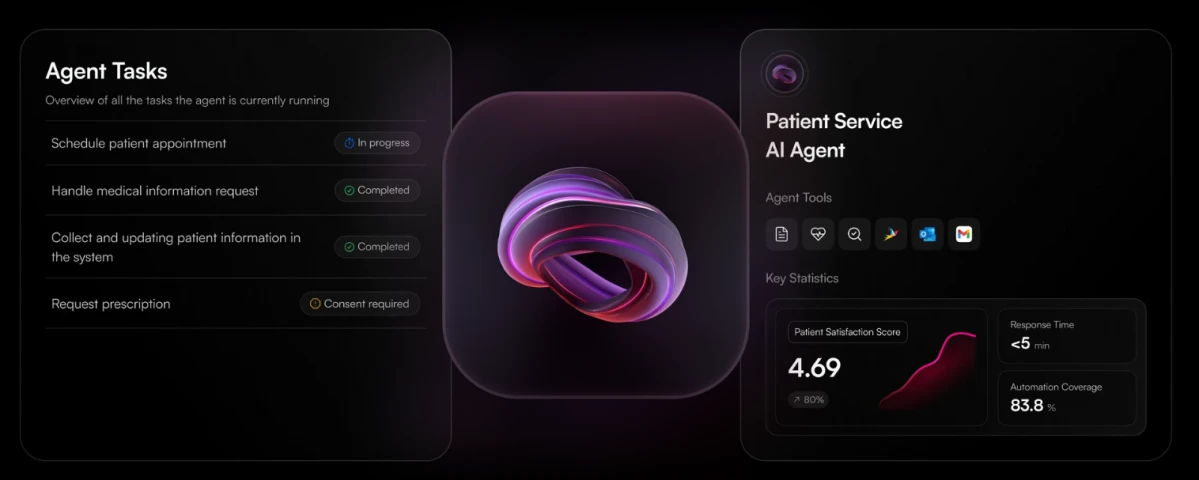
Sully.ai provides an agentic architecture across intake, coding, billing, and triage with a focus on modular AI agents. Automates documentation, intake, scheduling, and admin tasks.
Key features:
- Voice-to-action functionality: Translates physician speech into EMR actions using voice recognition.
- HIPAA compliant: Ensures that data handling and processing comply with HIPAA standards.
- Multilingual capabilities: Supports 19 languages.
Examples of Sully.ai’s AI agents:
Real life use case: CityHealth automates healthcare with Sully.ai
CityHealth integrates Sully.ai’s AI healthcare platform directly with its electronic medical records (EMRs) to reduce documentation time.
Sully.ai:
- drafted clinical documentation
- cut manual edits
- supported data entry during consultations.
Results:
- ~3 hours/day saved per clinician through reduced charting time
- 50% decrease in operations per patient2
Beam AI
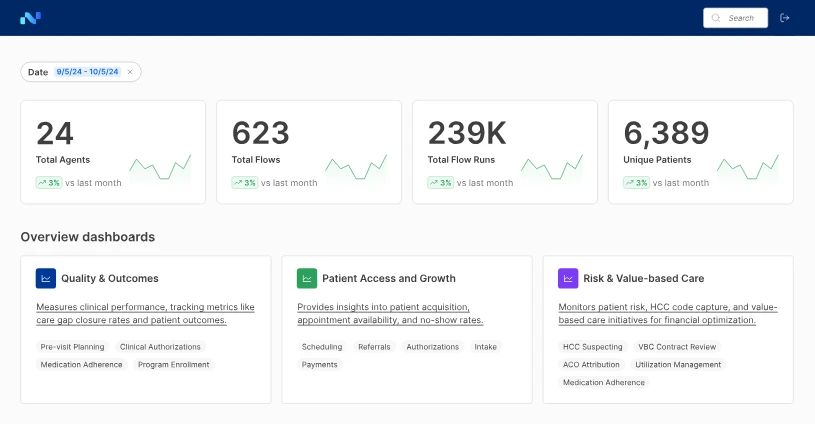
Beam AI offers a multi-agent system for healthcare management to automate medical record-keeping, healthcare billing, medical compliance, patient appointment scheduling, etc.
Examples of Beam AI healthcare agents:
Real-life use case: Avi Medical automates healthcare and customer service with Beam AI
Avi Medical partnered with Beam AI to deploy multilingual AI agents. Beam’s agents retrieved relevant data from databases to answer complex customer queries. Thanks to agents’ capability to access external data via APIs. AI agents handled high-volume, routine inquiries (70% of tickets).
Results:
- 80% of patient inquiries were automated
- 90% reduction in median response time
- 10% boost in Net Promoter Score (NPS)3
Notable Health
Notable Health uses AI agents to automate administrative tasks like patient registration, appointment scheduling, referrals, care authorization, and coding, all integrated with EHRs.
Real-life use case: North Kansas City Hospital automates patient appointments with Notable
North Kansas City Hospital (NKCH) faced inefficiencies in patient check-ins and registration. NKCH partnered with Notable to automate various administrative workflows such as vaccine scheduling.
Results:
- Over 90% reduction in patient check-in time (from 4 minutes to 10 seconds).
- 80% of patients were pre-registered, up from 40%.4
EHR-native agents
EHR-native agents are artificial intelligence systems built directly into electronic health record platforms rather than added as external tools.
Epic
Epic covers roughly 42% of the US acute care EHR market. At HIMSS26 in March 2026, Epic reported that more than 85% of its client organizations use its AI features.5
Epic ships three named agents:
- Art drafts clinical notes, hospital course summaries, and nursing care plan text. At Mercy, average end-of-shift nursing note time fell from 3.5 minutes to about 32 seconds. Notes completed on time rose 225%.
- Penny handles coding and denial appeals. Epic reports coding-related denials down more than 20% at the sites using it most heavily, and appeal letters drafted 23% faster.
- Emmie answers patient questions inside MyChart and handles scheduling. At Rush University Medical Center, billing-related service messages fell 58%.
Oracle Health
Oracle Health Clinical AI Agent listens during a visit, drafts the note, and drafts the follow-up orders.
Oracle has widened the tool on three fronts: order drafting that covers labs, imaging, prescriptions, follow-ups, and referrals; note generation for inpatient and emergency settings; and coverage across 30+ specialties, with roughly 1 million notes generated.
Oracle reports close to a 30% cut in daily physician documentation time. The tool also runs in the UK and Canada.6
Clinically augmented assistants
These systems assist clinicians with analysis and prioritization. They do not replace medical judgment.
Innovaccer
Source: Innovaccer7
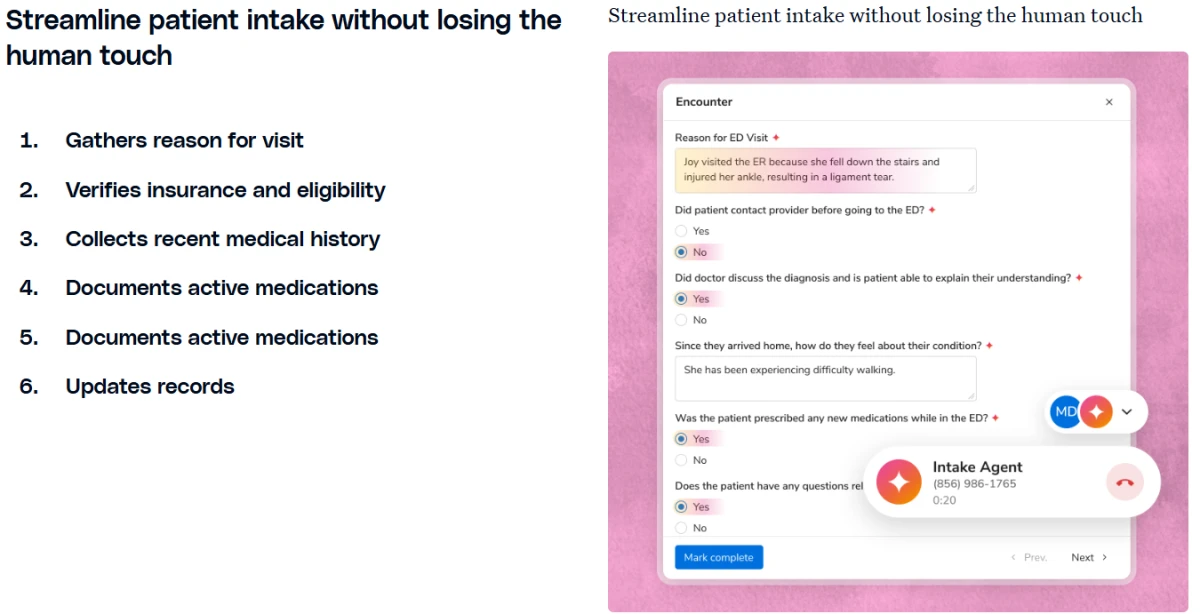
Innovaccer offers a suite of AI agents focused on value-based care and operations. Its agents support decision-making, not diagnosis.
Examples of Innovaccer healthcare agents:
Real-life use case: Franciscan Alliance streamlines coding with Innovaccer
Indiana-based multi-specialty physician network, Franciscan Alliance, uses Innovaccer’s platform to automate coding processes.
Results:
- Innovaccer’s physician engagement solution helped streamline coding processes, resulting in a ~5% improvement in coding gap closure.
- Automated protocols reduced the expected number of patient cases from ~2,600 to ~1,600.8
Patient-facing support agents
These agents specialized in interacting directly with patients, answering questions, providing instructions, scheduling, and offering emotional support.
Hippocratic AI
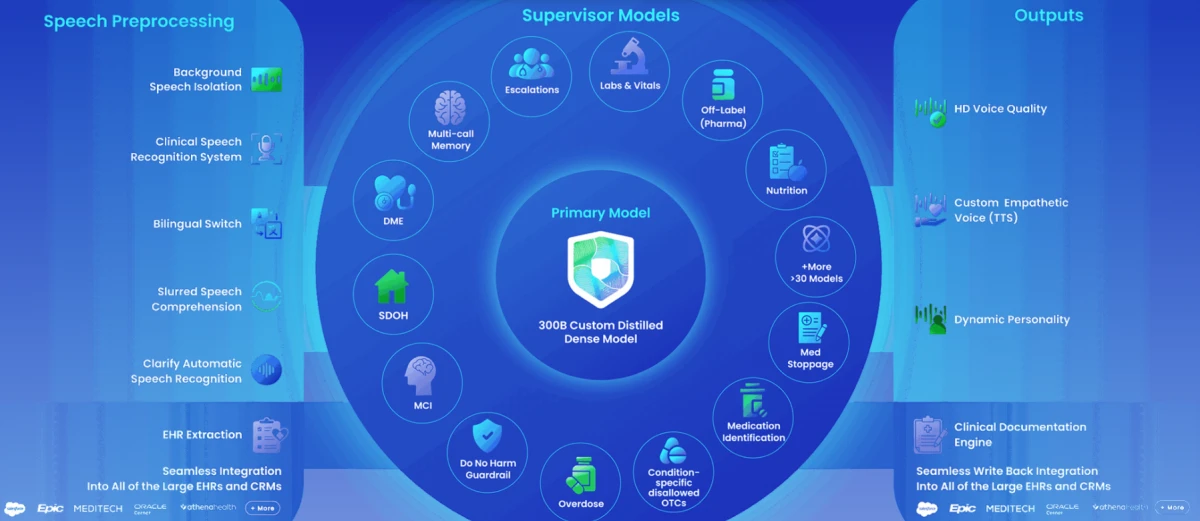
Hippocratic AI is a healthcare-focused artificial intelligence company that developed the first Large Language Model (LLM) specifically for non-diagnostic (e.g., patient engagement, follow-ups, insurance coordination) and patient-facing clinical tasks.
The company raised $126M at a $3.5B valuation, closed inNovember 2025, bringing total funding to $404M.9
Examples of Hippocratic AI’s agents:
Real-life use case: WellSpan Health and Hippocratic AI partnership
WellSpan Health partnered with Hippocratic AI to launch a GenAI healthcare agent that handles patient engagement calls. These agents can contact Spanish-speaking and English-speaking patients, address their health needs and schedule screenings.
Result:
- The system enabled WellSpan Health to contact over 100 patients, improving access to critical cancer screenings.10
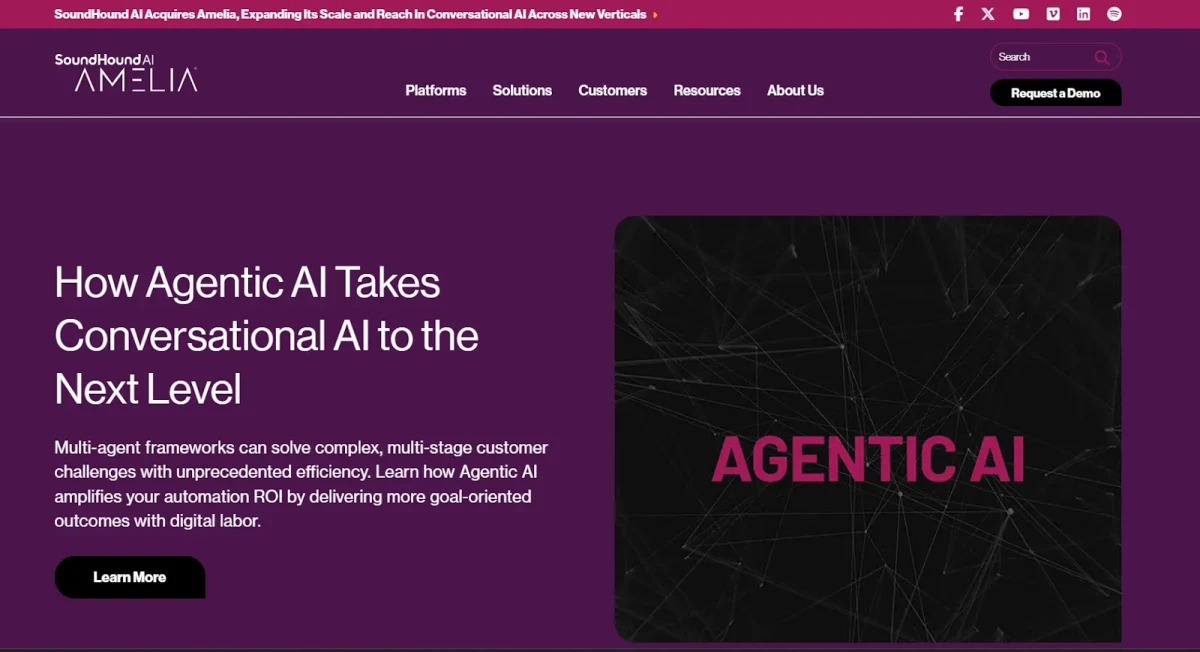
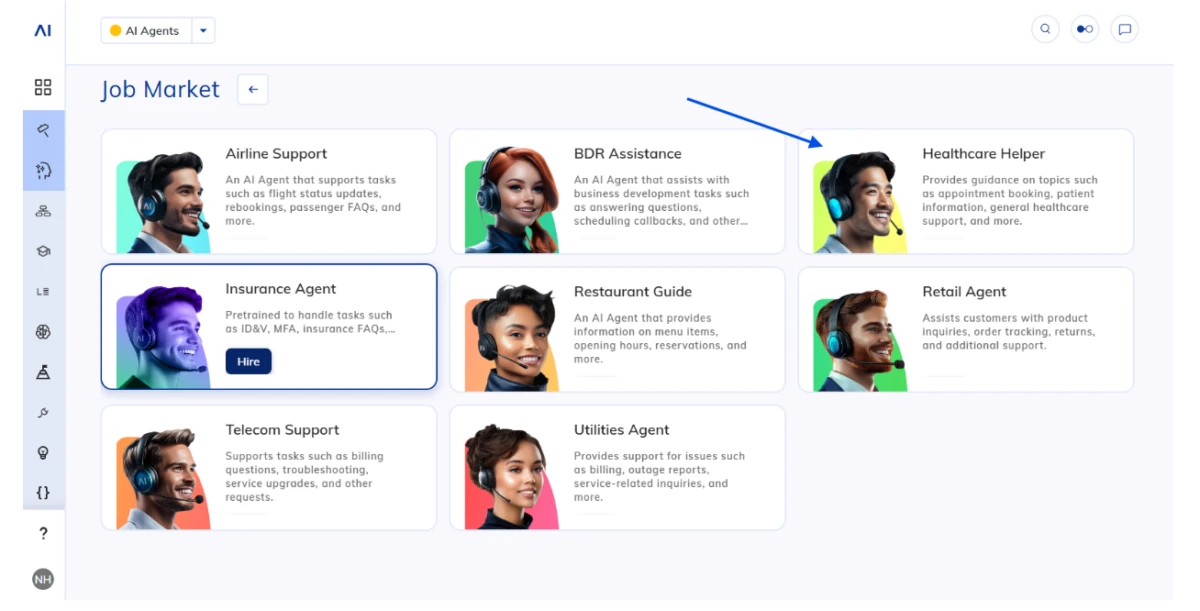
Amelia AI
Amelia AI Agents can guide patients through their care journey. They can schedule appointments, answer patient queries, and provide empathetic conversational responses.
Real-life use case: Aveanna Healthcare uses Amelia agents for customer support
Aveanna uses Amelia AI Agent to manage repetitive employee interactions via Workday and mobile apps. The agent now handles password resets, user authentication, and other HR-related tasks.
Results:
- 560+ daily employee conversations managed by the AI agent
- 95% of employee requests were resolved through the Workday chat.11
Cognigy
Cognigy’s agents are conversational AI agents for healthcare, providing support with insurance claims, prescription refills, and post-treatment care instructions.
Cognigy offers 30+ voice and digital channels out-of-the-box, from iMessage to WhatsApp and X.
Cognigy AI Agent use cases for healthcare:
- ID&V (Identity Verification)
- Make & change appointments
- Medical billing
- Update insurance
- Digital intake process (submit personal and medical information digitally)
- Refill requests
NiCE completed its $955M acquisition of Cognigy in September 2025. Cognigy now sits inside NiCE’s CXone Mpower platform.12
Real life use case: Personify Pulse maintains 40% containment rate with Cognigy
Personify Pulse implements Cognigy’s tool and integrates it with Zendesk LiveChat to handle customer inquiries.
Results:
- Containment rate: Cognigy’s AI agent handled 40% of customer inquiries without human intervention.
- Automated ticket creation: The system automatically created support tickets, streamlining the follow-up process.13
Amazon Health AI Assistant
Amazon launched an AI health assistant for Prime members in March 2026 that converses about symptoms, triages requests, schedules appointments, and connects to medical records.14
It is highly customizable and scalable within AWS ecosystem. AI health assistant requires integration and configuration.
Are healthcare AI agents truly agentic?
AI agents plan a task, call the systems they need, and act on the result. In healthcare, most stop short of acting without review
For now, healthcare agents are not fully autonomous; most still require ‘humans in the loop’ for task execution. Yet, these agents possess several agentic capabilities, including:
- Autonomous data retrieval: Retrieve patient data from the system, including personal details and medical history.
- Data validation and accuracy verification: Cross-check the data against existing records for accuracy.
- Autonomous data validation and issue flagging: Validate the verified data and flag discrepancies for resolution.
- Autonomous data updating and record management: Update the patient record with the validated information.
 Add as preferred source
Will healthcare AI agents become fully autonomous?
What we are seeing in today’s healthcare AI agents is “supervised autonomy,” where AI handles the heavy lifting of research (e.g., data extraction from lab reports) and repetitive tasks (e.g., recording patient vital signs) execution, but with human oversight at key decision points.
These agents are still far from delivering fully autonomous, production-ready results in complex medical use cases, such as patient placement and image scanning.
In the future, these systems could evolve into multi-agent networks, where different AI agents collaborate and interact, gradually improving towards more agentic solutions.
For example, tech companies like NVIDIA and GE HealthCare collaborate to build agentic robotic systems like X-ray and ultrasound, which use medical imaging to operate in the physical world.15
Further reading
Cite this research
Pick the format that matches where you're publishing. Pasting the link version into your CMS preserves the backlink.
@misc{dilmegani2026,
  author = {Dilmegani, Cem and PhD., Ezgi Arslan,},
  title  = {{Top 10 AI Agents in Healthcare with Examples}},
  year   = {2026},
  month  = jul,
  howpublished    = {\url{https://aimultiple.com/ai-agents-in-healthcare}},
  note   = {AIMultiple. Retrieved July 27, 2026}
}
Reference Links
Cem's work has been cited by leading global publications including Business Insider, Forbes, Washington Post, global firms like Deloitte, HPE and NGOs like World Economic Forum and supranational organizations like European Commission.
Throughout his career, Cem served as a tech consultant, tech buyer and tech entrepreneur. He advised enterprises on their technology decisions at McKinsey & Company and Altman Solon for more than a decade. He also published a McKinsey report on digitalization.
He led technology strategy and procurement of a telco while reporting to the CEO. He has also led commercial growth of deep tech company Hypatos that reached a 7 digit annual recurring revenue and a 9 digit valuation from 0 within 2 years. Cem's work in Hypatos was covered by leading technology publications like TechCrunch and Business Insider.
Cem regularly speaks at international technology conferences. He graduated from Bogazici University as a computer engineer and holds an MBA from Columbia Business School.






Be the first to comment
Your email address will not be published. All fields are required. Comments are left in their original language.