

We benchmarked the default API configurations of Amazon Rekognition, Google Cloud Vision, and Microsoft Azure AI Vision on 100 images across 5 object classes, and compared their pricing and feature coverage.
Image recognition tools benchmark results
Performance overview at IoU=0.5
Performance metrics for three image recognition platforms were evaluated at an Intersection over Union (IoU) threshold of 0.5, comparing mAP, F1 score, recall, and precision values.
The mAP is the primary evaluation metric to consider for object detection tasks, as it provides a comprehensive measure of detection quality across different confidence thresholds and object classes.
You can read more about our benchmark methodology.
Per-Class Average Precision (AP) at IoU=0.5
All three services detect persons reliably but lose precision on protective equipment, with helmets showing the sharpest drop.
While Amazon and Google show low precision in glove and hat detection, Microsoft Azure AI Vision achieves 0% precision for both categories. Azure AI Vision doesn’t detect objects that are small (less than 5% of the image) or arranged closely together, which could contribute to the observed low precision in detecting gloves and hats.1
None of the services can successfully detect masks (0% precision), highlighting a critical gap in their object recognition capabilities when they are used in default settings without custom labeling.
You can read more about the limitations of image recognition.
mAP at different IoU thresholds [0.5:0.05:0.95]
As IoU thresholds tighten from 0.5 to 0.95, mAP declines for all three services, but at different rates. Amazon Rekognition holds up best across the range, suggesting tighter bounding-box alignment than the other two services.
Potential factors that would affect the performance differences
Model training focus and product scope
- Amazon Rekognition includes dedicated PPE-related capabilities, which likely result in better training coverage and feature representations for objects such as helmets and gloves.
- Google Cloud Vision and Azure AI Vision prioritize general image understanding tasks (e.g., OCR, landmarks, brands, web detection), making PPE and similar objects secondary in their training objectives.
Default API configuration and precision–recall trade-offs
- All services were evaluated using default settings, which typically prioritize high precision to minimize false positives.
- This design choice leads to strong precision scores across providers but significantly lower recall, particularly for less prominent objects.
Small object detection limitations
- Objects such as gloves, hats, and helmets often occupy a small fraction of the image, making them difficult to detect reliably.
- Azure AI Vision, which is documented to underperform on small or closely spaced objects, shows the most pronounced degradation in these categories.
Label taxonomy and evaluation mapping
- Provider-specific labels had to be mapped to a unified ground-truth taxonomy.
- Valid detections using non-matching or more granular labels may have been excluded from evaluation.
Absence of mask detection
- None of the evaluated services exposes mask-related object labels in their default APIs.
- All three therefore returned 0% precision for masks.
IoU sensitivity and localization quality
- Performance differences increase at higher IoU thresholds, where stricter bounding-box alignment is required.
- Amazon Rekognition maintains relatively higher mAP at these thresholds, suggesting stronger localization accuracy.
Image recognition tools benchmark methodology
We tested these providers’ off-the-shelf (i.e., without custom labeling) performance in real-life cases.
We used 100 images. We scaled images to 512×512 pixels while preserving the essential regions containing instances, as the original dataset comprised varying dimensions.
We want to run this test again without vendors training their solutions on the dataset. Therefore, we are not disclosing the dataset that we used for this benchmark.
We processed the responses from service providers’ APIs in the following way:
- mapped service provider labels to the ground truth categories defined in the table above. Service provider labels that did not match these ground truth labels were excluded from the evaluation.
- normalized bounding box formats from different providers
- calculated IoU between predicted and ground truth boxes
- matched predictions to ground truth based on IoU threshold
- calculated metrics: precision, recall, F1, and AP per category
- computed COCO-style mAP using thresholds 0.5-0.95
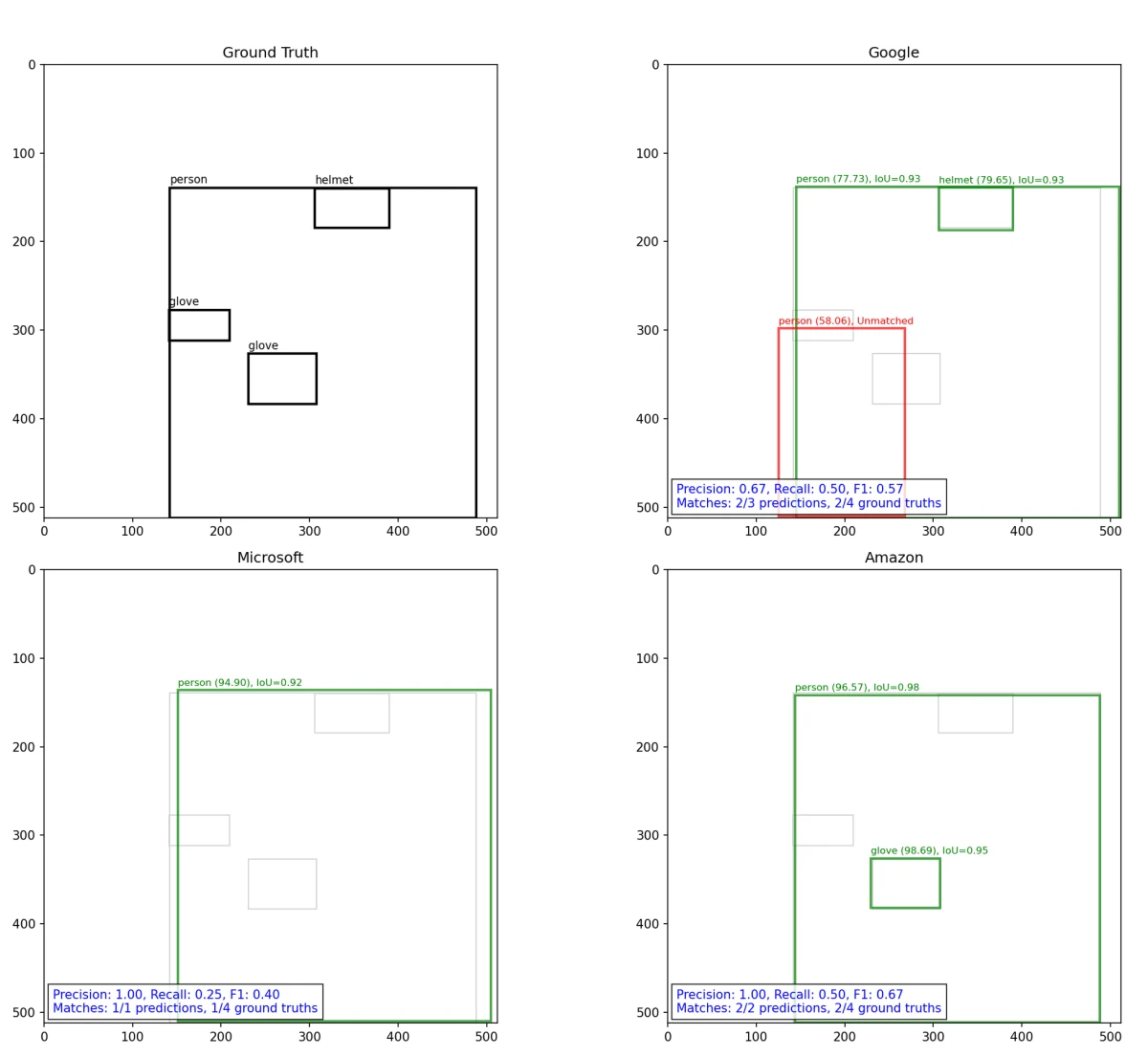
An example calculation of IoU, precision, recall, and F1 is given in the figure below:
Benchmarking metrics
Precision
Precision measures the accuracy of positive predictions made by the model. In image recognition, for a given class (e.g., “person”), it answers the question: “Of all the images the model labeled as containing a person, how many actually do?”. This is crucial in scenarios where false positives (incorrectly labeling an image as positive) are costly.
Recall
Recall measures the completeness of positive predictions, answering: “Of all the images that actually contain the class, how many did the model correctly identify?” This is vital when missing a positive (false negative) instance is critical.
F1 Score
The F1 Score is the harmonic mean of precision and recall, providing a balanced measure that is especially useful when there is an uneven distribution of classes (e.g., few helmet images compared to non-helmet images). It’s a single metric that captures both false positives and false negatives.
mAP
mAP, or mean Average Precision, is a metric primarily used in object detection tasks within image recognition. It evaluates the model’s accuracy across different classes by averaging each class’s Average Precision (AP). AP itself is the area under the precision-recall curve, which is generated by varying the confidence threshold for detections.
This interactive tool lets you compare detection results across providers using example images from the dataset. Use the top buttons to select Amazon, Google, Microsoft, or all providers. Toggle ground truth with the checkbox. Navigate between test images using the numbered buttons on the left. Color-coded boxes show each detection with confidence scores.
Best Image Recognition APIs
Amazon Rekognition
Amazon Rekognition includes dedicated PPE detection APIs alongside general object and face detection, which gives it broader label coverage on classes such as helmets and gloves than the other two services. This product scope is consistent with the per-class AP results in the benchmark.
Its image APIs are split into two groups:
- Group 1 (face identification): CompareFaces, IndexFaces, SearchFaces, used for identity verification and face search across image collections.
- Group 2 (content analysis): DetectLabels (general object detection), DetectModerationLabels, DetectText, RecognizeCelebrities, DetectPPE.
It integrates with the rest of AWS (S3 for storage, Lambda for event-driven processing, SageMaker for custom model training).
Google Cloud Vision
Google Cloud Vision exceeded 89% precision at IoU=0.5, the same precision floor as the other two services, but produced lower recall on small objects and protective equipment. Its product scope leans toward general-purpose image understanding rather than industrial detection: OCR, landmark recognition, logo and brand identification, and Web Detection (matching an image against publicly indexed images).
Core capabilities:
- Object localization and label detection
- OCR for printed and handwritten text in multiple languages
- Landmark, logo, and celebrity detection
- Web Detection for reverse-image lookup
- Custom model training via Vertex AI
It integrates with Cloud Storage, BigQuery, and Google Workspace, and accepts a wider range of file formats than Rekognition (JPEG, PNG, GIF, BMP, WEBP, RAW, ICO, PDF, TIFF).
Microsoft Azure AI Vision
Microsoft Azure AI Vision provides image analysis, OCR, image captioning, and a separate background removal service. Its documentation notes that the object detector does not handle small or closely spaced objects reliably, so it positions itself more toward general image understanding and text reading than fine-grained object detection.
Core capabilities are split into two groups:
- Group 1 (visual element detection): tagging, face, object detection, brand and landmark detection, smart cropping, OCR.
- Group 2 (language-aware output): image description, dense captions, full read (document OCR).
Differentiating features of service providers
API pricing overview
Building custom vision models
Hosted APIs such as Amazon Rekognition, Google Cloud Vision, and Microsoft Azure AI Vision return predictions from a fixed label set defined by the provider. When a required object class is missing from that set, or when accuracy on a specific domain is too low, the alternative is to train a custom model. Roboflow is an example that covers this workflow.
Roboflow
Roboflow is a computer vision platform that covers data annotation, model training, and deployment. It works on a different model than the hosted detection APIs above: users train models on their own labeled datasets and run inference on their own hardware, rather than calling a managed endpoint. This is the path teams take when default cloud APIs do not expose labels for a specific object class, such as the masks that returned 0% precision across all three benchmarked services.
Roboflow includes three main components:
- RF-DETR: a real-time transformer-based model for object detection and segmentation, intended for live camera and video inputs.2
- AutoDistill: a tool that uses large foundation models to automatically label image datasets without manual annotation.3
- Inference: a deployment package supporting multiple backends (ONNX, TensorRT, PyTorch), with execution on GPUs, CPUs, or edge devices such as NVIDIA Jetson via a Dockerized service.4
 Add as preferred source
Edge computing in image recognition
Cloud-based image recognition sends every frame to a remote data center for analysis. Edge computing runs the model on the device that captured the frame, so only the result (a label, an alert, a flag) leaves the device.
How edge computing works
In a cloud setup, cameras act as data collectors and stream raw frames upstream; the model lives in the data center. In an edge setup, the device runs the neural network locally and transmits only the relevant output: “person detected”, “inventory low”, “defect found”.
Why it matters for image recognition
- Latency: local inference removes the cloud round trip, which matters for autonomous vehicles, manufacturing robots, and any system that has to act on the prediction within milliseconds.
- Privacy: images do not leave the device, which is useful where data residency or GDPR constraints apply (medical imaging, in-store CCTV).
- Bandwidth and cost: only metadata is uploaded, not full video, which reduces network and cloud-API costs for high-volume deployments.
- Offline operation: edge devices keep working when the network fails, which is required for safety systems and remote industrial sites.
Real-world examples of edge AI in image recognition
Captur on-device SDK
On-device processing is the most common form of edge AI in mobile contexts. Captur provides an on-device image verification SDK that runs computer vision models locally on mobile devices in ~30ms, even offline.5 Logistics provider GoBolt integrated Captur’s SDK into its driver app for proof-of-delivery verification and reported a 30% drop in delivery-not-received claims in the first week.6
Ultralytics YOLO26
Ultralytics’ YOLO26 is an open-source computer vision model engineered for edge and low-power devices.7 Its fully end-to-end, NMS-free architecture removes post-processing steps such as non-maximum suppression, reducing latency and improving exportability to edge hardware while supporting object detection, segmentation, classification, and pose estimation within a single model family.8
Vision transformers in image recognition
The image recognition APIs benchmarked here use CNN-based detectors. Vision Transformers (ViTs) are an alternative architecture that splits the image into fixed-size patches (typically 16×16 pixels) and processes all patches in parallel, which lets the model relate distant regions of the image from the first layer rather than building that context up gradually through stacked convolutions.
For object detection, this matters when an object’s identity depends on the surrounding scene (a hat on a person versus a hat on a shelf). CNNs capture this through stacked convolutions; ViTs capture it through attention across all patches at once.
The three cloud services in this benchmark all run CNN-based models in production. Hybrid CNN-Transformer architectures are appearing in newer open-source models (for example, Roboflow’s RF-DETR uses a DINOv2 transformer backbone), but production cloud APIs have not yet migrated.
Vision transformer models for image recognition
- Google ViT: the original Vision Transformer, trained on ImageNet for image classification. Available on Hugging Face with pre-trained weights.
- Swin Transformer: uses a shifted-window mechanism to capture both global and local detail, used for detection and segmentation.
- DINOv2 (Meta): self-supervised model trained without manual labels, producing general-purpose image embeddings.
- Segment Anything Model (SAM): ViT-based segmenter that can isolate objects it has not been trained on.
Use cases of image recognition software
In today’s digital landscape, computer vision and image processing technologies have transformed how businesses leverage visual data. Advanced image-classification algorithms enable sophisticated image-recognition tools that are reshaping operations across industries.
These image recognition technologies combine powerful model training approaches with intuitive interfaces that enable users to automate complex visual tasks. From custom vision solutions for specific business needs to facial recognition systems for security, these tools can identify patterns, objects, and features within images.
Visual inspection
Image recognition enables automated visual inspection across multiple industries. These systems identify objects, detect features, and verify compatibility by analyzing visual data.
For example, Chamberlain Group implemented Amazon Rekognition in their myQ app, allowing users to automatically capture images of their garage door opener to check compatibility. This streamlined solution replaced a complex manual process and significantly increased user connection rates.9
Document processing
OCR technology extracts text from images and documents, automating data entry across multiple languages. Modern systems can process handwritten text and complex layouts, transforming paper-based workflows and making documents searchable.
For example, French insurance group LSA Courtage uses Google Cloud Vision API to recognize text from driving licenses and registration papers. This OCR implementation reduced document processing time by 45% per page and increased underwriter productivity by 20%, enabling them to process 1,500 documents daily.10
You can check our OCR benchmark to see the accuracy of the various OCR tools for different document types.
Agriculture monitoring
Farmers utilize drone imagery with image recognition to monitor crop health, detect diseases, and optimize irrigation. By identifying areas of crop stress before visible symptoms appear, farmers can intervene early and reduce resource usage.
For example, Microsoft’s Project FarmBeats (now Azure Data Manager for Agriculture) uses sensors, drones, and machine learning to enable data-driven farming in environments with limited power and internet connectivity. The system helps increase farm productivity and reduce costs by combining visual data with farmers’ knowledge about their land.11
Security and surveillance
Security systems use facial recognition and object detection to identify activities, control access, and locate persons. These systems monitor video feeds and alert personnel to threats. For example, Sun Finance uses Amazon Rekognition to verify customer identity by comparing selfies with ID documents, speeding up verification and preventing fraud while expanding financial inclusion.12
Content moderation
Social media platforms use image recognition to filter inappropriate content such as nudity, violence, or graphic imagery from user uploads. Caption generation can add a second layer by describing image context that pixel-level classifiers miss, for example detecting hate symbols in the background of an otherwise benign photo. According to AWS, machine filtering typically reduces the volume that human moderators need to review to 1–5% of the total.13
For example, CoStar Group uses Amazon Rekognition for content moderation and video analysis of approximately 150,000 daily image and video uploads to their commercial real estate platform. This content moderation solution scans imagery, classifies content, detects unwanted material, and leverages image captioning technology to understand context, saving time while ensuring compliance and high-quality data.14
You can read more about the applications of image recognition.
Limitations of image recognition technology
Detail reduction in small objects
When objects appear small in images, they contain fewer pixels, resulting in limited visual data. Additionally, CNNs tend to lose important fine details during processing through downsampling layers, which significantly hinders detection capabilities.
Missed detections
Image recognition systems typically favor larger objects during both the training and analysis phases, resulting in higher frequencies of missed small objects or false negatives.
Background interference
Smaller objects are more vulnerable to being obscured by visual noise, background clutter, or overlapping elements, making them harder to identify accurately. Even partial occlusion can disproportionately affect small objects, as they have less distinguishable area to begin with.
Scale variability
Objects appearing at different distances or scales pose difficulties for models not specifically designed to detect fine details across varying object sizes.
Computational demands
Techniques to improve small object detection, like multi-scale feature extraction or higher-resolution inputs, require more processing power, limiting real-time applicability.
Training bias
Datasets often underrepresent small objects or lack sufficient annotations for them, reducing model generalization to such cases in real-world scenarios.
FAQs
Image recognition software is a type of computer vision technology that uses machine learning algorithms to analyze unstructured data like digital images and video data. It goes beyond simply identifying specific objects; advanced systems aim for scene understanding, interpreting the context and relationships within an image to provide a more complete analysis. This allows computers to see and classify visual information effectively.
No single image recognition software or computer vision software is universally best. The ideal choice among image recognition technologies depends on your specific needs. Consider factors like required accuracy, the type of tasks you need to perform (like object detection or OCR, and even considering if you need to integrate with natural language processing for tasks that combine image understanding with text analysis), ease of use, scalability, budget, customization options, and your team’s technical expertise. Trying out different options is the best way to find the image recognition technologies that best provide the computer vision capabilities you need for your application.
While image recognition has improved significantly, accuracy isn’t guaranteed. Factors impacting performance include image quality (lighting, resolution), the scene’s complexity, object appearance variations, and the quality of the training data used for the deep learning algorithms. Achieving robust scene understanding and accurately detecting specific objects can be challenging in complex or noisy visual data.
Cite this benchmark
Pick the format that matches where you're publishing. Pasting the link version into your CMS preserves the backlink.
@misc{dilmegani2026,
  author = {Dilmegani, Cem},
  title  = {{Top Image Recognition Tools Compared}},
  year   = {2026},
  month  = jun,
  howpublished    = {\url{https://aimultiple.com/image-recognition-software}},
  note   = {AIMultiple. Retrieved June 17, 2026}
}
Reference Links

Cem's work has been cited by leading global publications including Business Insider, Forbes, Washington Post, global firms like Deloitte, HPE and NGOs like World Economic Forum and supranational organizations like European Commission. You can see more reputable companies and resources that referenced AIMultiple.
Throughout his career, Cem served as a tech consultant, tech buyer and tech entrepreneur. He advised enterprises on their technology decisions at McKinsey & Company and Altman Solon for more than a decade. He also published a McKinsey report on digitalization.
He led technology strategy and procurement of a telco while reporting to the CEO. He has also led commercial growth of deep tech company Hypatos that reached a 7 digit annual recurring revenue and a 9 digit valuation from 0 within 2 years. Cem's work in Hypatos was covered by leading technology publications like TechCrunch and Business Insider.
Cem regularly speaks at international technology conferences. He graduated from Bogazici University as a computer engineer and holds an MBA from Columbia Business School.





Be the first to comment
Your email address will not be published. All fields are required. Comments are left in their original language.