


Compare Google Dialogflow and Its Competitors

Tech giants such as Google, IBM, Microsoft, Amazon, and Facebook are investing in conversational AI to enable developers to build chatbots easily. These AI-powered chatbots can automate various routine tasks such as sending emails, searching for information on search engines, etc.
We have collected essential information about Google Dialogflow and compared it to its main competitors. See the graph below for their search market share breakdown:
What is Google Dialogflow?
Google Dialogflow is a platform designed for chatbot development, enabling businesses to create conversational AI applications. Since being acquired by Google in 2016, the platform has expanded into a suite of tools that utilize machine learning and natural language processing capabilities.
Dialogflow functions as two separate products, each designed for a specific use case. Dialogflow CX (Customer Experience) manages large-scale, enterprise-grade implementations, whereas Dialogflow ES (Essentials) caters to applications with simple to medium complexity.
Advanced features, including a visual flow builder, state-based routing, and improved intent-based frameworks designed for intricate conversational scenarios, were introduced with Dialogflow CX in 2019.
Advanced AI integration in Dialogflow XC
Dialogflow CX now includes Gemini-2.5 foundation models. This integration enables a prebuilt generative playbook, along with no-code sequences that can dynamically produce responses, access external APIs, and adjust based on conversational context.
By incorporating Google’s AI infrastructure, the platform’s natural language processing capabilities have significantly increased. This allows for conversational agents to be deployed globally, offering advanced entity recognition, enhanced intent matching, and extensive multilingual support.
Additionally, teams can refine proprietary big language models or implement custom models for improved intent recognition and domain-specific response generation through the platform’s direct interaction with Google Cloud’s Generative AI Studio. This capability is especially useful for businesses in regulated industries like healthcare and finance that require stringent data stewardship.
Multi-platform deployment
Dialogflow ensures that your AI agents are widely accessible by supporting deployment across major conversational platforms such as:
- Google Assistant
- Amazon Alexa
- Facebook Messenger
- Slack
- Microsoft Teams
- Telegram
- Skype
- Twilio
Due to its all-encompassing platform strategy, Dialogflow can be utilized by companies of all sizes.
Integrations for enterprises
Integrating Dialogflow with Google’s cloud ecosystem provides significant benefits for contemporary solutions. Key integrations include Google Cloud Functions for serverless backend processes, BigQuery Analytics for comprehensive conversation analysis and customized reporting, and Vertex AI for machine learning workflows. These integrations enable end-to-end model training, evaluation, deployment, and performance monitoring.
To help organizations modify their conversational agents as customer needs evolve, the platform’s enhanced entity and intent management now utilizes generative AI to automatically suggest new intents or entities based on previous conversation data.
How does Google Dialogflow work?
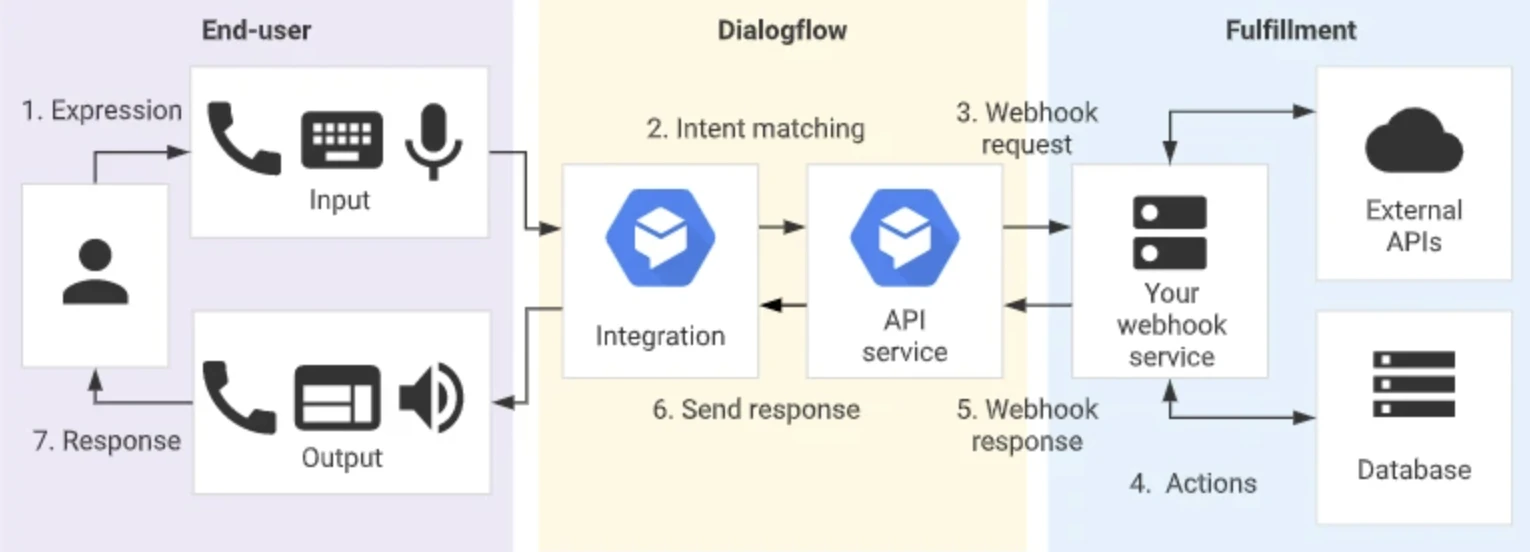
Figure 1. Working principle schema of Google Dialogflow.1
Google Dialogflow’s general architecture
On a high level, the Dialogflow system works as described below:
- Users send text or voice messages through any supported device or platform, which are immediately routed to Dialogflow.
- The incoming message is categorized by Dialogflow and matched with the intents defined by the chatbot developer. A chatbot developer can use training phrases to train the system in intent identification.
- A request is sent to the webhook service to initiate an advanced scan and determine the appropriate action to take for this entry. The responses of the bot can be written directly by the developer or can be selected by Dialogflow. The dialogue system can be externally fed and developed through a webhook and external APIs.
- Webhooks are structures that are automatically triggered according to defined actions and return an HTTP response.
- Difference between an Application Programming Interface (API) and a webhook: An API needs to be triggered. A webhook is triggered automatically when a certain action takes place.
- The most appropriate action is reported to Dialogflow again as a result of the external API and scanning in the database.
- Dialogflow processes the information and generates a suitable response for the integrated platform.
- Formatting is done in order to give the correct action in the application or device.
- The end-user receives the message.
Dialogflow CX generative playbooks
Dialogflow CX offers generative playbooks that handle complex conversational flows using visuals and no-code sequences. These playbooks serve as a link between basic intent matching and developed AI-driven solutions.
Multiple activities are chained together in a single conversation turn in generative playbooks. They can use Google’s Gemini models to generate replies, adjust session parameters, execute calculations, and access external APIs. This produces a flow where generative AI capabilities blend with conventional rule-based logic.
Some real-life applications include dynamic recommendation systems, intelligent slot filling, and context-aware responses.
How does Dialogflow compare to other chatbot platforms?
Several chatbot development platforms can be assessed based on ease of use, integration options, language support, and costs.
1. AI capabilities & Natural Language Processing
- Google Dialogflow employs Google’s NLU along with Gemini-2.5 integration. Dialogflow CX features generative playbooks that enable dynamic responses and automated intent suggestions, enhancing its effectiveness for intricate conversations.
- Amazon Lex provides reliable intent accuracy for simple tasks but requires additional configuration with Amazon Bedrock or SageMaker to enable advanced generative capabilities. Lambda functions are necessary for custom slot validation. Additionally, Amazon Lex provides a neural automatic speech recognition (ASR) model for English that improves voice bot accuracy.
- IBM watsonx Orchestrate features integrated retrieval-augmented generation (RAG) and supports various large language model (LLM) providers. It’s powerful for knowledge-base-driven applications, although configuring it can be more intricate.
- The Microsoft Azure Bot Service integrates with GPT-4o via Copilot Studio, delivering advanced generative features within the Azure ecosystem.
- Wit.ai emphasizes NLP for developers and includes recent enhancements from Llama 2; however, it does not offer inherent generative capabilities without bespoke development.
- OpenAI Frontier focuses on advancing AI systems through large-scale research and engineering efforts. The initiative aims to develop highly capable AI models with improved reasoning, scientific discovery potential, and broader problem-solving abilities. Frontier research also emphasizes alignment and safety methods to ensure these powerful models remain reliable and beneficial.
- Decagon AI focuses on AI agents designed for enterprise customer support. The system maintains conversation context and can take real actions by integrating with backend systems rather than generating responses.
2. Ease of use
- Dialogflow provides a user-friendly experience with its visual flow builders and straightforward setup. Generative playbooks reduce the need for extensive coding, even for complicated logic.
- Amazon Lex requires more profound AWS knowledge and technical expertise, making it challenging for non-technical users.
- IBM watsonx Orchestrate offers drag-and-drop interfaces, yet it may seem overwhelming for those unfamiliar with the IBM ecosystem.
- Azure Bot Service provides low-code interfaces through Copilot Studio; however, it remains inherently complex due to Azure’s numerous configuration options.
- Wit.ai primarily targets developers and offers limited GUI support, making it ideal for technical teams.
- OpenAI Frontier is primarily a research initiative rather than an end-user product. It focuses on developing advanced AI capabilities and safety research, meaning direct usability tools or visual development interfaces are not its primary objective.
- Decagon AI enables teams to design AI agents using Agent Operating Procedures (AOPs), natural-language instructions that define how the agent should behave. This allows business teams to define workflows while developers maintain control over integrations and guardrails, reducing the need for extensive coding.
3. Integration capabilities
- Dialogflow offers integration with the Google ecosystem (Assistant, Cloud, Vertex AI) and extensive support for third-party platforms, featuring direct connectivity to WhatsApp Business API.
- Amazon Lex closely integrates with AWS services, although it requires custom development for platforms outside of AWS.
- IBM watsonx Orchestrate offers satisfactory enterprise connectors but falls short of having direct counterparts to Google’s AI services.
- Azure Bot Service effortlessly integrates with Microsoft products (such as Teams and Office 365) and boasts enterprise integration capabilities.
- Wit.ai necessitates manual integration development across all platforms.
- OpenAI Frontier integrates with ChatGPT Enterprise, ChatGPT Atlas, third-party agents, and OpenAI agents.
- Decagon AI integrates with CRM platforms, ticketing systems, and payment systems. With these integrations, AI agents can access customer data and perform tasks such as issuing refunds, updating records, and managing subscriptions.
4. Language support
- Dialogflow supports over 95 languages in ES and 25 or more in CX, while Gemini-2 enables real-time translation for more than 50 additional languages.
- Amazon Lex supports over 20 languages and locales, including English, Spanish, French, German, Italian, Japanese, Korean, and others.
- IBM watsonx Orchestrate provides support for more than 10 major languages and features RAG-based multilingual capabilities.
- Azure Bot Service offers support for over 30 languages, and GPT-4o enables generative responses in more than 100 languages.
- Wit.ai provides coverage for over 50 languages, though with varying degrees of accuracy.
- OpenAI Frontier offers language support for over 50 languages.
- Decagon AI does not explicitly state the number of languages it supports.
5. Cost
- Dialogflow provides a free tier suitable for small and medium-sized enterprises. Pricing for Dialogflow ES starts at $0.002 per text request, whereas CX pricing is $0.007 per text request. Enterprise support is available starting at $10,000 monthly.
- Amazon Lex offers a 6-month free tier. After that, pricing begins at $0.004 per speech request and $0.00075 per text request. There are extra charges for generative features through Bedrock.
- IBM watsonx Orchestrate offers a free trial, with the Essentials plan starting at $500 per month and custom pricing for Standard and Enterprise tiers.
- The Microsoft Azure Bot Service offers a free tier that allows for up to 10,000 messages per month, with paid options starting at $0.0005 per message. Extra charges apply for integrating Azure OpenAI.
- Wit.ai provides entirely free access to its platform for personal and commercial use, making it perfect for startups and small businesses with tight budgets.
- OpenAI Frontier‘s pricing plans are not publicly available.
- Decagon AI uses a usage-based pricing model; however, it is not publicly available.
6. Use cases & target audience
Each platform serves different types of businesses and use cases.
- Select Dialogflow for quick setup, low coding demands, advanced AI capabilities, or seamless integration with Google products.
- Select Amazon Lex if you require extensive AWS integration, voice commerce through Alexa, or Lambda-based execution.
- Select IBM watsonx Orchestrate when large enterprises require comprehensive knowledge base integration and adherence to strict compliance standards.
- Select Azure Bot Service for integration with Microsoft products, deployment in Teams, or development for Azure.
- Select Wit.ai for complete control over development, free prototyping opportunities, or personalized NLP solutions.
- Select OpenAI Frontier for advancing cutting-edge AI research, developing highly capable next-generation models, or contributing to efforts that combine large-scale computing, scientific discovery, and AI safety research.
- Select Decagon AI to automate customer support workflows using AI agents that can handle conversations and execute real tasks, such as processing refunds, managing subscriptions, and resolving customer inquiries across chat, email, and voice channels.
FAQs
Dialogflow is Google’s natural language understanding platform that enables organizations to create sophisticated conversational ai and chatbots for web, mobile apps, and voice assistants. The platform provides prebuilt agents and tools with minimal learning curve, offering direct integration with Google Cloud and messaging apps like Facebook Messenger. Users can create chatbots that understand natural language input and interact with end users through speech and text interfaces.
Dialogflow ES offers significant advantages for new customers with an intuitive interface and comprehensive support resources that reduce the learning curve. The platform provides prebuilt agents that help users realize quick results while understanding human emotion and context in conversations. Organizations benefit from direct integration with Google Cloud and other applications, making it easier to create advanced conversational agents across web, mobile apps, and voice assistants.
Dialogflow provides advanced generative ai features and natural language processing tools for sophisticated conversational agents in complex business scenarios. The platform’s ability to handle api calls, integrate with data systems, and support voice and text input makes it ideal for enterprise applications across multiple channels. With seamless Google Cloud integration and complex conversational flows, Dialogflow helps create chatbots that understand human speech and deliver personalized experiences on websites, mobile apps, and messaging platforms like Facebook.
 Add as preferred source
Further reading
Cite this research
Pick the format that matches where you're publishing. Pasting the link version into your CMS preserves the backlink.
@misc{dilmegani2026,
  author = {Dilmegani, Cem},
  title  = {{Compare Google Dialogflow and Its Competitors}},
  year   = {2026},
  month  = jul,
  howpublished    = {\url{https://aimultiple.com/dialogflow}},
  note   = {AIMultiple. Retrieved July 1, 2026}
}Results and timestamps of 7 data points. Download the summary data shown in this article's charts and tables as a ZIP file containing one CSV file.
Want the granular data behind it? Join Premium
Changelog
3 updatesAdded OpenAI Frontier and Decagon AI to the comparison.
Reference Links
Cem's work at AIMultiple has been cited by leading global publications including Business Insider, Forbes, Morning Brew, and Washington Post, global firms like Deloitte and HPE, NGOs like World Economic Forum, and supranational organizations like European Commission. [1], [2], [3], [4], [5]
Throughout his career, Cem served as a tech consultant, tech buyer and tech entrepreneur. He advised enterprises on their technology decisions at McKinsey & Company and Altman Solon for more than a decade. He also published a McKinsey report on digitalization.
He led technology strategy and procurement of a telco while reporting to the CEO. He has also led commercial growth of deep tech company Hypatos that reached a 7 digit annual recurring revenue and a 9 digit valuation from 0 within 2 years. Cem's work in Hypatos was covered by leading technology publications like TechCrunch and Business Insider.
Cem regularly speaks at international technology conferences. He graduated from Bogazici University as a computer engineer and holds an MBA from Columbia Business School.




Comments 2
Share Your Thoughts
Your email address will not be published. All fields are required. Comments are left in their original language.
I did not see CoRover human-centric conversational AI platform which apparently is being sold by Microsoft, IBM, Accenture, KPMG, they claim to have been accessed by 500 million users, more than the population of the US. Please check, they have VideoBot, VoiceBot and ChatBot VAs.
I'm surprised you leave out Microsoft Power Virtual Agents. :-)
Good catch! We haven't done a comprehensive update on this article in a while, we will be updating it.