


AI-Based Stock Trading: Which Gen AI Tool Is Better

LLM tools have been used in AI-based stock trading since their emergence.1
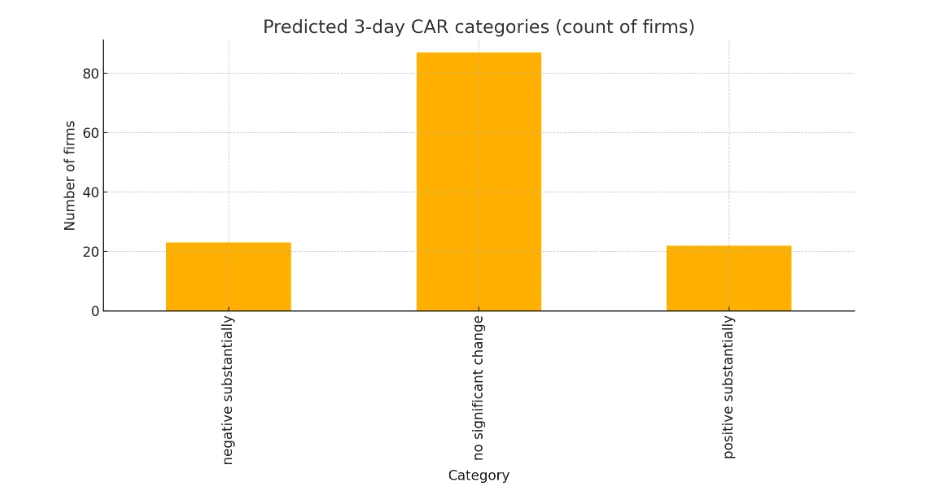
I tested 20 generative AI models on a single, hard forecasting task: predict the 3-day cumulative abnormal return (CAR) of 132 stocks after an unexpected event, using only the firm-level information supplied in the prompt.
- ChatGPT 5 Thinking (74%) model and the Gemini 2.5 Pro (71%) model delivered the best performance.
- More information does not help to increase the performance.
Performance of AI-powered tools
For further details on the benchmark, read the stock trading benchmark methodology section.
How the models reasoned
Every model converged on the same two-force account of what happens when a family manager dies:
- Human-capital loss: If the deceased was generating the returns, the death destroys something the firm cannot replace quickly. Negative CAR.
- Entrenchment relief: If the firm was underperforming under a manager whom family control made unremovable, the death does what the market for corporate control could not. Positive CAR.
The framework is not what separates the models. What separates them is where they set the cutoffs, which variable breaks a tie, and how readily they leave a case in the neutral bucket. The sections below record only those differences.
Current versions
GPT 5.5 Instant
Ranks the role of the deceased first (CEO above chairman above honorary titles), then reads ownership concentration, ROE/ROA, leverage, and general governance-transition implications.
It is the only model in the set that published no thresholds, weights, or arbitration order.
DeepSeek V3.2 (Instant & Deep Think)
Identical scores with and without extended reasoning.
DeepSeek reads family ownership in the opposite direction from most of the field: high ownership signals commitment to a smooth transition and pushes toward positive or neutral, where other models read the same concentration as succession risk.
It treats firm scale and a non-sudden death as evidence that transition machinery already exists, which routes those cases to 0.
Claude Fable 5.1
The model weighed two opposing effects from the executive-death literature:
- losing a key decision-maker (negative)
- removing an entrenched controller (positive).
It assigned −1 to active CEOs and chairmen of profitable firms with concentrated family control, +1 to leaders of loss-making or stagnant firms where the family stake was high, and 0 to retired executives, peripheral roles, very large firms, and cases with missing financials.
Claude Opus 5 High
Takes profitability as the primary axis and then applies multiplicative modulators: role (sitting CEO ×1.20 down to emeritus ×0.30), leverage above 55% (−0.80), headcount above 100,000 (×0.75), and sector (relationship-intensive ×1.15, commodity ×0.80).
Two features are unique to it:
- Conditions ownership on the local control market: above 75% is +0.40 in jurisdictions where takeovers are feasible and −0.50 where succession is dynastic, and it applies a separate investor-protection adjustment by country.
- Imposes two hard constraints: raw asset, revenue, and debt figures are discarded as non-comparable across 24 currencies, leaving only ratios and headcounts; and a +1 requires below-median profitability, since without underperformance there is nothing for the death to relieve.
Claude Fable 5
Role-first, and explicit about its grounding in the executive-death event-study literature. It zeroes out the 18 ceremonial cases before scoring anything, then treats peripheral roles as 0 with one exception: a family board seat at ownership ≥ 75%, where the death loosens the control block.
Active CEO or president defaults to −1 and flips to +1 on negative net income or ROE, or on very high ownership paired with mediocre returns. The active-chairman branch is the only place in the benchmark where a model explicitly calls two forces as cancelling rather than picking the larger one: average performance in a supervisory role is scored 0 because lost stewardship and governance improvement offset.
Gemini 3.1 Pro
The loosest threshold set among the current models.
A critical role plus ROE > 10% or ROA > 5% yields −1; any prior underperformance, negative net income, ROA, or ROE, yields +1; everything else is 0.
Both directional conditions fire easily, so few cases survive into the neutral category.
Older models
GPT 5 Thinking model
The most accurate model, and the only one that labels by relative rank with a margin requirement rather than by absolute thresholds. It builds two continuous z-score indices:
- Leadership concentration index (LCI), higher = more likely substantially negative:
LCI = 0.40·z(role_importance) + 0.30·z(family_control) + 0.20·z(financial_strength) − 0.10·z(size) - Renewal potential index (RPI), higher = more likely substantially positive:
RPI = 0.40·(−z(financial_strength)) + 0.25·z(leverage) − 0.20·z(family_control) − 0.10·z(size) + 0.05·z(liquidity_stress)
A directional label is issued only when one index sits in the top 30% of the sample and clears the other by at least 0.5 z-units. That margin requirement is what keeps the default at 0, and it is the clearest structural difference between this model and the ones below it.
Gemini 2.5 Pro
The same two-index architecture with a far stricter gate: top 5% of the sample instead of top 30%.
- Vulnerability index (VI):
0.40·z(family_control) + 0.35·(−z(financial_strength)) + 0.20·z(leverage) − 0.05·z(size) - Turnaround catalyst index (TCI):
0.50·(−z(financial_strength)) + 0.25·z(family_control) − 0.15·z(leverage) − 0.10·z(size)
Family control enters both indices with a positive sign, so ownership concentration on its own cannot pick a direction, profitability breaks the tie. The positive label additionally requires TCI to exceed VI by 0.5 z-units.
GPT 5.4 Instant
Uses profitability as the primary signal and publishes no cutoffs. Negative when the deceased held a central operating role at a healthy, tightly held firm; positive when profitability was weaker or leverage higher and family succession depth looked available; neutral when the role was ceremonial or the signals offset.
GPT 5.4 Thinking
Same inputs as 5.4 Instant, one structural difference: centrality of the role is required in both directions, so a peripheral role cannot produce a directional label at all. Firm size also earns a neutral on its own; a firm large enough to absorb the change is scored 0 regardless of performance.
Claude Opus 4.8 Medium
Core logic Two opposing forces drive the reaction:
(+) Entrenchment-relief: Death of an entrenched/underperforming insider can activate the control market and raise turnaround hopes.
(-) Lost human capital: Death of a value-adding owner-manager destroys hard-to-replace skill and creates succession risk.
(0) No surprise: Ceremonial/retired titles, pure board roles, or muted/offsetting cases produce no significant reaction.
Decision rules:
- Emeritus/honorary -> 0 (withdrawn).
- Board member/director, profitable -> 0; loss-making -> +1 (shake-up).
- Active exec + losses/ROA<1 -> +1 (relief/optionality).
- Active exec + strong (ROA>=median & ROE>=10 & NI>0) & ownership>=60% -> -1 (lost steward).
- Active exec + strong but ownership<60% -> 0 (oversight cushion).
- Middling / missing signal / unknown role -> 0.
GPT 5 Pro
Two indices again, but built from ownership and leverage rather than role, which does not appear in either formula.
- Key-person risk index (KPRI):
0.40·z(ownership) + 0.30·z(leverage) − 0.20·z(size) + 0.10·z(profitability) - Turnaround potential index (TPI):
0.40·(−z(profitability)) + 0.20·z(leverage) − 0.20·z(ownership) − 0.10·z(size) + 0.10·z(AP/assets)
Gates are the same as GPT 5 Thinking’s: top 30% plus a 0.5 z-unit margin. Dropping role from the index is the likeliest source of the 18-point gap between the two.
Gemini 3 Flash
States the two forces as competing theories and attaches explicit ROA cutoffs: above 10% the leader is priced as a star and the death is −1; below 3% the death is read as an opening for professional management and scored +1; the 3–10% band and all non-active roles are 0.
Gemini 3 Thinking
The same cutoff design pushed further apart, −1 above ROA 12%, +1 below 2.5%, which widens the neutral band from Flash’s seven points to nearly ten.
Claude Sonnet 4.6
The only additive point system with published weights and absolute cutoffs (≥ +0.90 → +1, ≤ −0.70 → −1).
It scores six dimensions:
- role prominence
- ROA
- net income and EBITDA
- ROE
- family ownership
- leverage
The weighting is deliberately asymmetric. Negative ROA alone is worth +1.2, and a net loss and negative EBITDA add a further +0.6 and +0.5, while the largest role penalty available, an active CEO or chairman, is only −0.6.
Financial distress can therefore override the identity of the deceased, which no other model in the set permits.
GPT 4o
Conditions are listed without an arbitration order, so cases that satisfy two rules have no defined resolution. It also departs from the field on peripheral roles: a board member or VP is scored +1, where nearly every
DeepSeek V3
The three-factor structure that V3.2 later refined, such as role, financial health, and ownership, but without the ownership-as-stabilizer reading. High ownership plus a key role amplifies the negative prediction. Worth noting separately: the model estimated its own accuracy at roughly 65%, more than double its actual score.
Gemini 2.5 Flash
The lowest result, and the only one with a self-inflicted ceiling. The model concluded that the prompt did not contain enough information to identify positive cases and issued no +1 labels at all, collapsing a three-class problem into two and forfeiting every positive case in the sample.
Model accuracy with extensive input
The second round adds ten person-level fields to the same 132 cases: whether the deceased was still working, generation after the founder, founder status, tenure, age at death, sudden death versus illness, and four counts of children and partners.
The aggregate effect is close to nothing. Average accuracy across these 13 models moves from 54.8% to 55.2%. What the average hides is a wide spread of individual responses:
- Claude Fable 5 gains the most, 16 points, and it is the only model whose extra information moves it from near the bottom of the group to the top four. Its round-one logic keyed almost entirely on job title and profitability; the round-two fields supply exactly what that tree was missing, whether the person was still working, and whether the death was sudden.
- Gemini 3.1 Pro (+10) and Gemini 3 Thinking (+9) also improve substantially, as does DeepSeek V3.2 Deep Think (+6).
- GPT 5.4 Instant loses 17 points, the largest move in either direction. Claude Sonnet 4.6 (−7) and GPT 5.4 Thinking (−6) also fall.
- The best round-two score (64%) is lower than the best round-one score in the same group (69%). More information did not raise the ceiling; it compressed the range.
AI-based stock trading benchmark methodology
Prompting
The benchmark evaluates whether generative AI tools can predict stock market reactions to an unexpected event, based on given company fundamentals. The setup relies on data from Tanyeri & Alp (2023)2 and Arslan & Tanyeri-Günsur (2026):3
Each AI tool receives a snapshot of firm-level information for the first round:
Financial information
- Asset size
- Equity size
- Earnings before interest, tax, depreciation, and amortization (EBITDA)
- Net income
- Yearly revenue
- Long- and short-term debt
- Accounts payable
- Return on equity (ROE)
- Return on assets (ROA)
Other information
- Family ownership stake
- Country of headquarters and stock listing
- Number of employees
- Industry/sector
No firm name or other identifiers are provided.
In the second round, the following information is added additionally:
- whether the deceased was working at the time of death
- the deceased’s generation after the founder of the firm
- whether the deceased was the founder
- tenure of the deceased at the firm
- age of the deceased at the time of the death
- whether the deceased died suddenly or after an illness
- the number of children the deceased has
- the number of female children the deceased has
- the number of male children the deceased has
- the number of partners the deceased had
Main question
Given the information above, each AI solution is asked to predict whether the 3-day cumulative abnormal returns (CAR) of 132 firms will be:
- Significantly positive
- Significantly negative
- Not significant
CAR measures how financial markets respond to the event. A positive CAR indicates that stock traders perceive the event as value-enhancing, a negative CAR as value-reducing, and an insignificant CAR as neutral.
Sampling
The dataset includes 132 death events in 109 publicly traded family firms across 24 countries. All firms are ranked among the 500 largest family firms.
Performance measurement
The benchmark builds on prior technical analysis of stock prices. For each firm, the 3-day CAR has been calculated and categorized as:
- Significantly positive
- Significantly negative
- Not significant
The AI predictions are compared with historical CAR values. Accuracy is measured as the percentage of correct predictions made by each generative AI solution.
 Add as preferred source
Further readings
- Agentic AI Finance Benchmark: FinRobot vs FinRL vs FinGPT
- Top AI Financial Research Platforms for Investors
- AI VC Benchmark: AI Agents on Real Venture Capital Tasks
FAQs
While AI stock pickers and AI-powered tools may help identify patterns and reduce emotional bias, stock trading still carries risks. Active traders should combine AI capabilities with their own research, strategy development, and awareness of market conditions to make better-informed decisions.
AI can be useful in stock trading because it can analyze vast amounts of market data, historical data, and real-time insights faster than humans. AI trading bots and AI-powered trading bots use trading algorithms, technical indicators, and fundamental analysis to spot market trends, generate trading signals, and execute trades. They can support stock traders with trade ideas, portfolio analysis, and risk management across multiple asset classes.
AI can help in stock trading by analyzing market data, historical data, and real-time data faster than humans. AI trading bots use trading algorithms, technical analysis, and fundamental analysis to generate trading signals and execute trades. They can spot market trends, react quickly to news, and provide trade ideas. For example, AI trading bots can react to news releases or Fed minutes within seconds, something no human trader can match.4However, AI-based stock trading also comes with risks involved, especially during market volatility, when stock trading bots may trigger herd-like selling. AI-powered tools can offer valuable insights, but making informed decisions still requires one’s own research, risk management, and awareness of market conditions.
Cite this benchmark
Pick the format that matches where you're publishing. Pasting the link version into your CMS preserves the backlink.
@misc{arslan2026,
  author = {Arslan, Ezgi},
  title  = {{AI-Based Stock Trading: Which Gen AI Tool Is Better}},
  year   = {2026},
  month  = sep,
  howpublished    = {\url{https://aimultiple.com/ai-based-stock-trading}},
  note   = {AIMultiple. Retrieved September 3, 2026}
}Results and timestamps of 0 data points. Download the summary data shown in this article's charts and tables as a ZIP file containing 0 CSV files.
Want the granular data behind it? Join Premium
Changelog
4 updatesAdded Claude Fable 5.1 to the tested generative AI models.
Added a "How the models reasoned" section explaining the two-force CAR framework.
Added a Current versions section covering GPT 5.5 Instant, Claude Opus 4.8, DeepSeek V3.2 and Gemini 3.1 Pro.
Added GPT 5.4 Instant and GPT 5.4 Thinking models to the Current versions section.
Reference Links







Be the first to comment
Your email address will not be published. All fields are required. Comments are left in their original language.