


Top 10 AIOps Platforms Compared

AIOps platforms apply machine learning and agentic IT to IT operations tasks such as anomaly detection, event correlation, and root cause analysis. We compared the top 10 AIOps platforms based on their key and differentiating features, pricing plans, and primary use cases.
AIOps platforms core features
Product | ML anomaly detection | Automated remediation | Event correlation / noise reduction | Automated / AI RCA | Predictive analytics |
|---|---|---|---|---|---|
Limited | ✓ | Limited | Limited | Limited | |
BigPanda | Limited | Limited | ✓ | ✓ | Limited |
Datadog | ✓ | ✓ | ✓ | ✓ | Limited |
Dynatrace | ✓ | ✓ | ✓ | ✓ | ✓ |
IBM Instana | ✓ | Limited | ✓ | ✓ | Limited |
LogicMonitor | ✓ | Limited | ✓ | ✓ | ✓ |
New Relic | ✓ | Limited | ✓ | ✓ | Limited |
OpenText OpsBridge | ✓ | ✓ | ✓ | ✓ | ✓ |
Splunk ITSI | ✓ | ✓ | ✓ | ✓ | ✓ |
Zenoss Cloud | ✓ | Limited | ✓ | ✓ | ✓ |
Note: All tables are sorted alphabetically. Our subscribers are listed first.
AIOps tools differentiating features
Top 10 AIOps platforms compared
NinjaOne
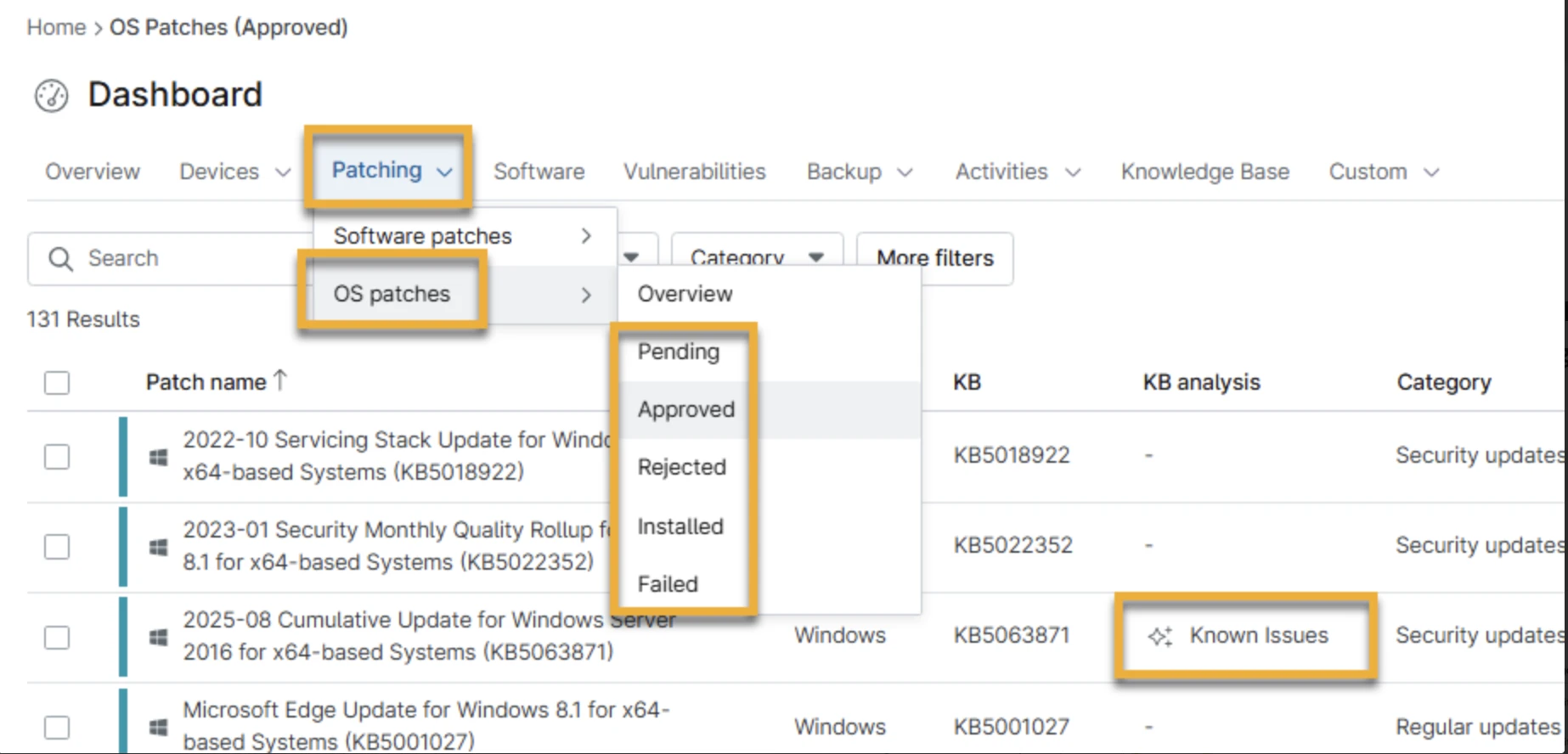
NinjaOne’s Patch Intelligence AI combines generative AI, third-party patch information, and anonymized NinjaOne failure/rollback telemetry. It reevaluates patch status every six hours and can automatically change an otherwise-approved patch to Manual or Reject when it detects known issues or elevated failure/rollback rates.
Katana AI, which is in Early Access, is an in-product agent with RBAC and a kill switch.
Figure 1: Image showing how Patch Intelligence AI data appears in the KB Analysis column under Patching.
BigPanda
BigPanda’s L1 Agent executes predefined customer runbooks through an on-premises containerized worker. The worker makes outbound mTLS connections, keeps no standing credentials, obtains short-lived credentials through a customer-defined service role, and executes pre-registered workflows. Read-only diagnostic steps can run without approval; corrective actions such as restarting a service require explicit approval.
Datadog
Datadog’s Bits Investigation runs an iterative loop: form a root-cause hypothesis, query telemetry, evaluate the evidence, then revise or eliminate hypotheses.
It can inspect metrics, logs, traces, monitor state, RUM, Synthetics, service dependencies, incidents, dashboards, and external sources such as Confluence. The UI records the investigation as both a chronological step log and a hypothesis tree.
Dynatrace
Dynatrace stores its Smartscape topology as nodes and relationships in Grail. DQL can search this topology and follow relationships between services, processes, hosts, cloud resources, and Kubernetes components.
Dynatrace’s Davis correlates events that share an inferred root cause into a single problem and stores the identified root-cause Smartscape entity plus affected entities. Because Grail stores topology alongside logs, spans, metrics, and events, DQL queries can traverse dependencies and enrich telemetry with entity context.
IBM Instana
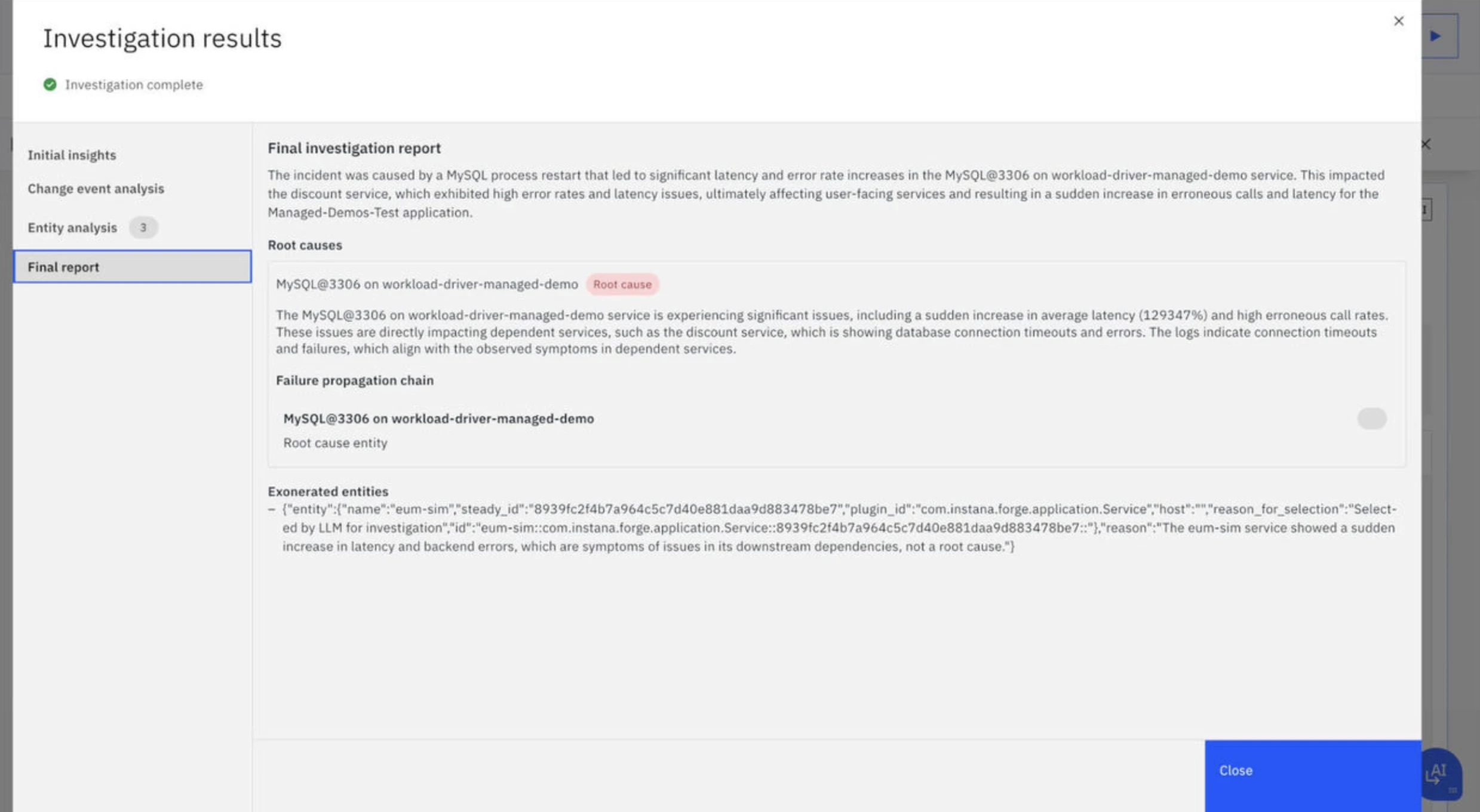
Instana’s Intelligent Incident Investigation creates and tests hypotheses against the monitored environment. The investigation records which hypotheses it tested, what evidence it collected, and which components it inspected.
Once a cause is accepted, Instana can generate a step-by-step remediation runbook and produce a Bash script or Ansible playbook for individual remediation steps, then exports it for review and deployment.
Figure 2: IBM Instana Agentic AI investigation dashboard.1
LogicMonitor
LogicMonitor’s Edwin AI Investigation consumes alerts, metrics, logs, change requests, diagnostic results, and remediation outputs to build an incident timeline, impact analysis, and probable cause.
Edwin correlates alerts into “Insights,” and its agent can operate either globally or within the context of a specific alert/Insight. The investigation system is working over LogicMonitor’s correlated incident objects and associated metadata.
New Relic
New Relic’s MCP server gives external AI agents access to specific observability functions. Available tools include converting natural-language questions into NRQL, generating alert and user-impact reports, analyzing deployment impact, searching traces, detecting anomalous traces, and mapping upstream and downstream service dependencies.
OpenText OpsBridge
For IT operations, OpenText’s Aviator can work with OpenText observability, service-management, automation, CMDB, and asset-management products.
OpenText also provides Aviator Studio for building and deploying custom agents, while Service Management Aviator handles private generative-AI workflows for support and service-management use cases.
Splunk ITSI
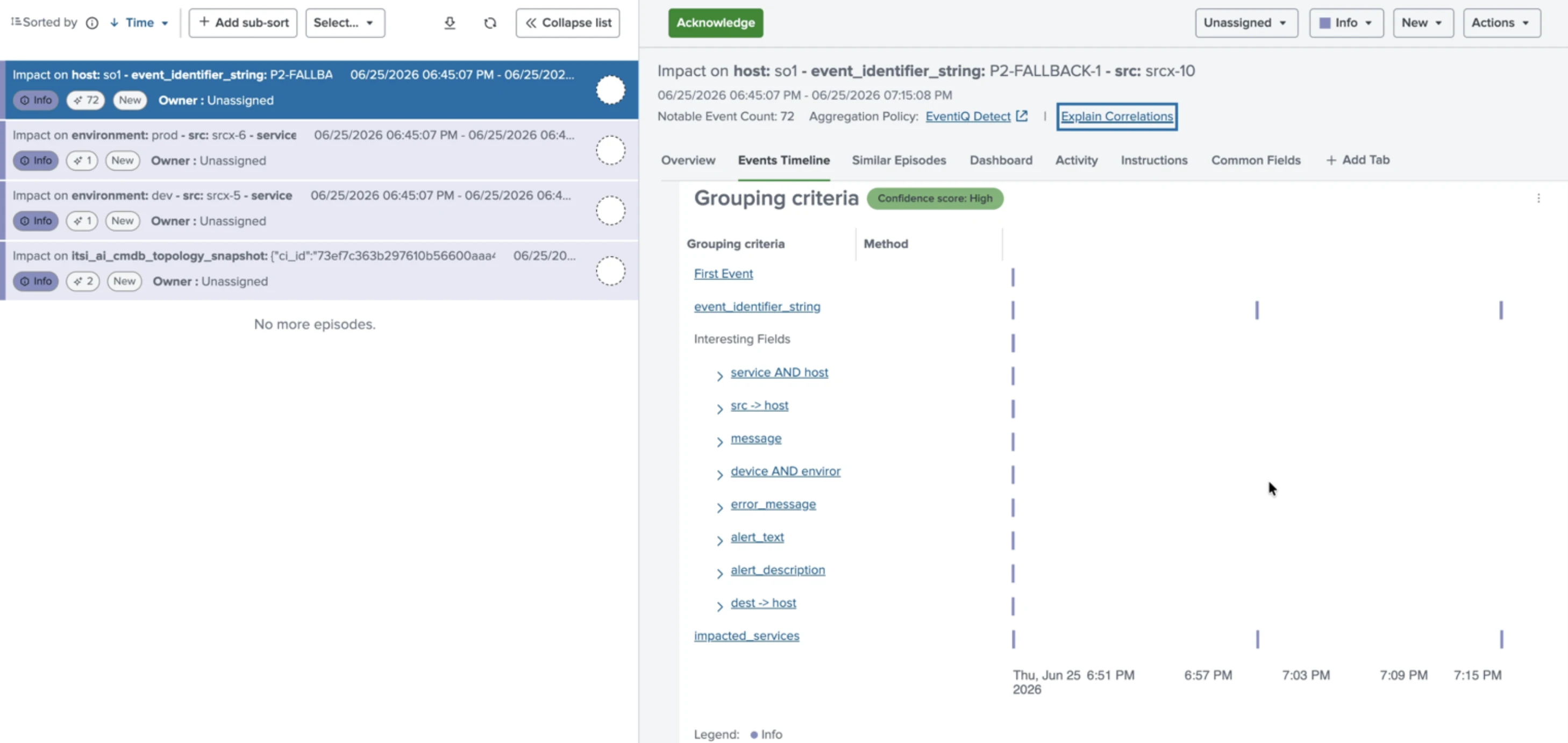
Event iQ Detect analyzes historical notable-event data to recommend which fields should be used to group alerts into episodes.
Current correlation supports exact matching, normalized matching, pattern extraction, fuzzy matching, semantic similarity, shared service topology, and parent/child CMDB relationships. Semantic similarity uses configurable confidence thresholds, while aggregation policies can rank fields and combine them with AND/OR logic.
Figure 3: Alert grouping example from Event iQ Detect in ITSI.2
Zenoss Cloud
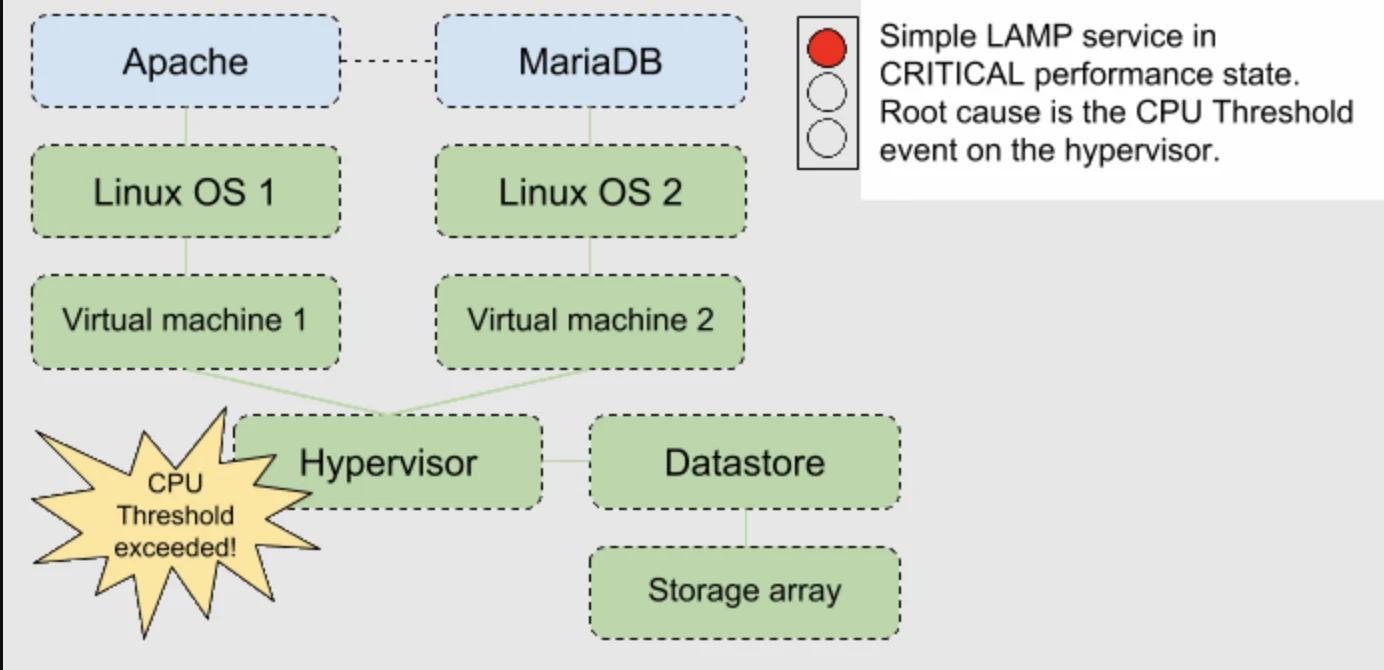
Zenoss Service Impact maintains a dependency model linking services to the infrastructure they depend on: for example, application processes → OS → VM → hypervisor → datastore/storage. The model is updated when monitored infrastructure moves or changes.
When a dependency generates a state or threshold event, Service Impact propagates its effect through the dependency model and can identify the underlying infrastructure event responsible for the service-level state.
Figure 4: Example of a hypervisor event from Zenoss Service Impact.3
AIOps use cases with real-life examples
Anomaly detection
Anomaly detection flags deviations from normal behavior before outages occur. Datadog Watchdog proactively computes a baseline of expected behavior and detects anomalous patterns without manual alert configuration, looking back up to three weeks to account for seasonality.
Watchdog also analyzes ingested logs at intake for anomalous patterns such as sudden increases in warning or error status.4
Automated root cause analysis
Automated root cause analysis traces an incident back to its originating failure across distributed systems. Dynatrace’s Davis AI causation engine collects all distributed traces along the horizontal stack when an event triggers, continuing analysis automatically when a called service is also marked unhealthy.5
Alert noise reduction
Alert noise reduction groups related alerts to reduce operational fatigue. PagerDuty’s Intelligent Alert Grouping consolidates related alerts into a single incident using machine learning.6
BigPanda applies exact, temporal, and pattern-based deduplication mechanisms to merge alerts into incidents.7
Infrastructure health monitoring
Predictive infrastructure health monitoring targets endpoints and devices. NinjaOne provides real-time visibility into device-level metrics including CPU load, memory utilization, and disk health, with threshold-based alerting that triggers before end users report problems.
AI-assisted remediation
Automated or AI-assisted remediation moves from detection to action. Dynatrace Davis CoPilot for Workflows embeds generative AI to auto-summarize problems, propose remediation steps, and autonomously edit Kubernetes manifests for auto-scaling through GitHub automations. 8
 Add as preferred source
Cite this research
Pick the format that matches where you're publishing. Pasting the link version into your CMS preserves the backlink.
@misc{ermut2026,
  author = {Ermut, Sıla},
  title  = {{Top 10 AIOps Platforms Compared}},
  year   = {2026},
  month  = oct,
  howpublished    = {\url{https://aimultiple.com/aiops-platforms}},
  note   = {AIMultiple. Retrieved October 2, 2026}
}Results and timestamps of 30 data points. Download the summary data shown in this article's charts and tables as a ZIP file containing 3 CSV files.
Want the granular data behind it? Join Premium
Reference Links
She previously worked as a recruiter in project management and consulting firms. Sıla holds a Master of Science degree in Social Psychology and a Bachelor of Arts degree in International Relations.




Be the first to comment
Your email address will not be published. All fields are required. Comments are left in their original language.