


Enterprise AI Companies: Landscape Breakdown

Artificial intelligence is revolutionizing every industry with various use cases. Demand for AI products grows as more companies shift their legacy systems to digital products to survive in the competitive business landscape. However, the AI vendor landscape is crowded, and most executives or decision-makers have limited knowledge of the AI landscape.
Check out our comprehensive categorization of enterprise AI companies based on their sizes, technology, industry, business function, geography, business model & services they offer:
Breakdown by size
Tech-giants
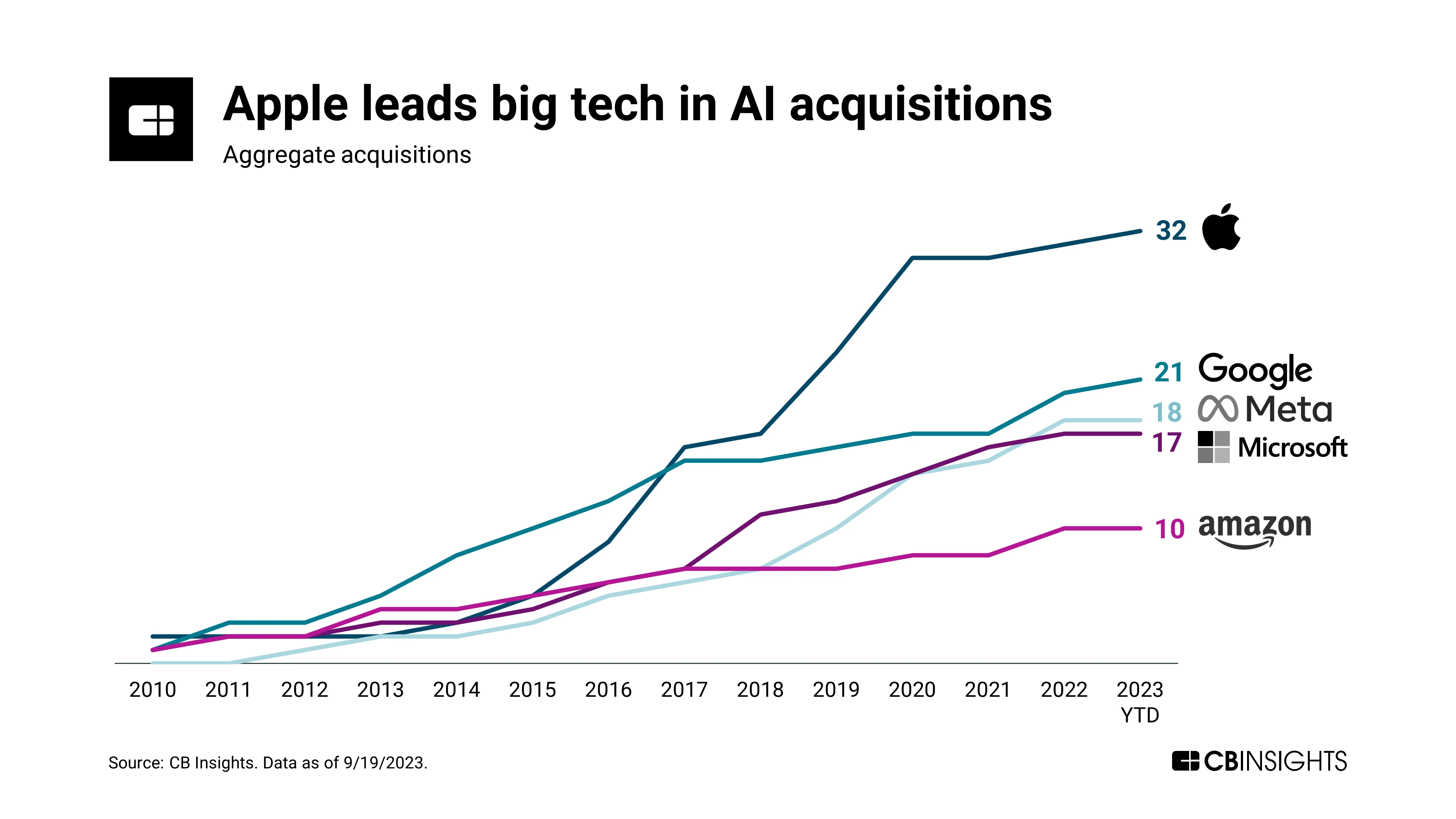
The global AI race is getting fierce, and companies such as Google, Meta, Amazon, Microsoft, Apple OpenAI, Anthropic, and NVIDIA are developing AI products & services and making new AI acquisitions. Apple is leading in the number of AI acquisitions. 1
Recommended reading:
The latest tech giants
Total Funding ≥ $10 Billion
- OpenAI: One of the leader in frontier models (GPT series). It has transitioned into a massive commercial entity with deep ties to Microsoft and Apple.
- Funding: $122B
- Headquarters: United States
- Anthropic: It offers a safety-focused LLMs (Claude) with integrated monitoring and governance, attracting massive cloud-provider investments.
- Funding: $125B equity
- Headquarters: United States
- xAI: The company focused on accelerating human scientific discovery.
- Funding: $20B+
- Headquarters: United States
Scaleup
Total funding ≥ $1 Billion
As of April 2026, these key players maintain massive private or recent post-IPO funding:
- SenseTime: AI company that focuses on computer vision and deep learning technologies. SenseTime remains a leader in Asian computer vision.
- Funding*: $2.82B
- Headquarters: Hong Kong
- UiPath: RPA company that focuses on AI-integrated enterprise automation.
- Funding: $2B
- Headquarters: United States
- Mistral AI: The company delivers open-weight models.
- Funding: $3B+.
- Headquarters: France.
- Nuro: A robotics company that develops autonomous delivery vehicles.
- Funding: $2.3B
- Headquarters: United States.
- DataRobot: The most funded autoML company that enables customers to prepare their data, create and validate machine learning models.
- Funding: $1.1B
- Headquarters: United States
$1 Billion > Total funding ≥ $500 Million
- Hive AI: Heavily expanded into content moderation and AI model training data.
- Funding: ~$600M (Significantly grown from its $20M in 2020).
- Headquarters: United States.
- MEGVII: The company builds AI Engines that power various AI applications.
- Funding: $1.98B
- Headquarters: China
- ThoughtSpot: AI company that develops business-intelligence analytics search software.
- Funding: $743.7M
- Headquarters: United States
$500 Million > Total funding ≥ $100 Million
- Mobvoi: AI company that focuses on speech recognition, natural language processing, and vertical mobile search. They also have a strategic partnership with Google.
- Funding: $260M
- Headquarters: China
- C3: AI software company for building enterprise-scale AI applications for digital transformation.
- Funding: $481M
- Headquarters: United States.
$100 Million > Total funding
- Orion Labs: Developing voice-activated communication and automation solutions for deskless workers.
- Funding: $63M
- Headquarters: United States.
- Hypatos: A process automation startup that applies language processing AI and computer vision tech to speed up financial document processing
- Funding: $12M
- Headquarters: Germany.
he table below summarizes the AI startups listed by size above:
Breakdown by technology
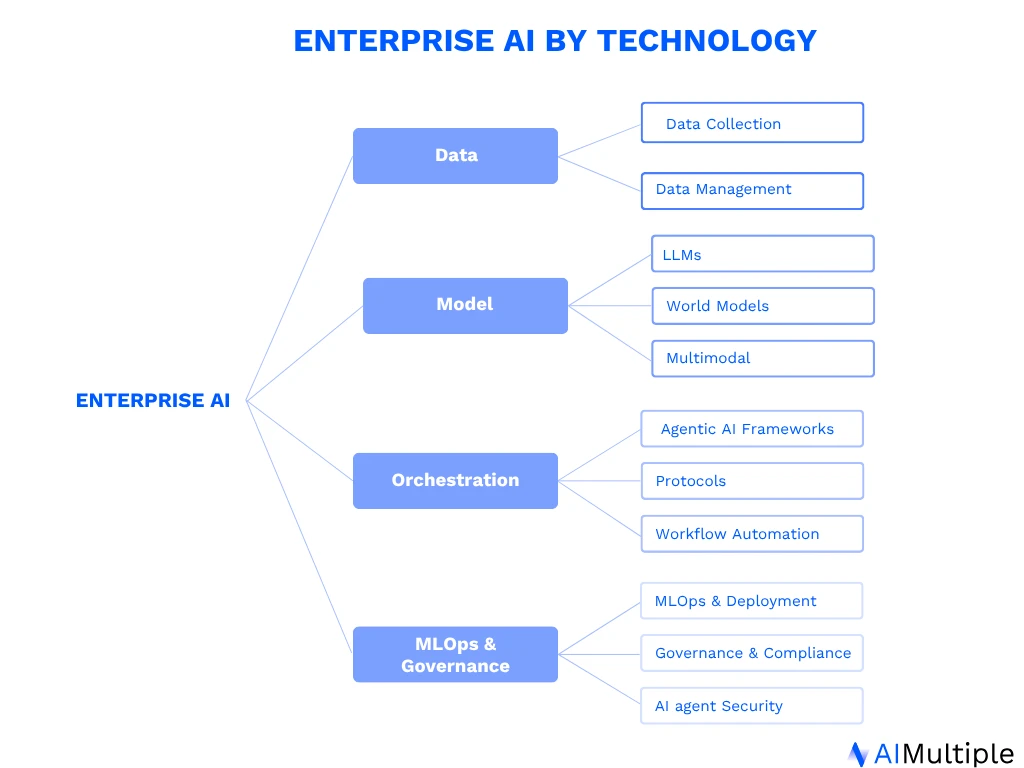
Enterprise AI by data solutions
Platforms and services that source, structure, and prepare the data that powers enterprise AI training pipelines and real-time inference systems.
Data collection vendors
- Bright Data: Web data infrastructure platform offering proxy networks, scraping APIs, datasets, and browser automation tools that enable enterprises and AI agents to access and structure public web data at scale.
- Funding: Private (bootstrapped, $300M revenue in 2025)
- Headquarters: Israel
- Scale AI: Supplies annotated datasets and human feedback services used to train and align large language models, including RLHF pipelines for major model labs.
- Funding: $1.6B+
- Headquarters: United States
- Common Crawl: Nonprofit organization maintaining a freely available open repository of web crawl data used to train many of the world’s leading foundation models.
- Funding: Nonprofit
- Headquarters: United States
Data management vendors
- Databricks: Unifies data engineering, ML lifecycle management, and production‑grade AI workflows on a lakehouse architecture, enabling enterprises to go from raw data to deployed AI in a single platform.
- Funding: ~$43B valuation (private)
- Headquarters: United States
- Snowflake: Enterprise cloud data platform that enables organizations to store, organize, and share structured data across environments, serving as a key data source for AI and analytics pipelines.
- Funding: Publicly listed
- Headquarters: United States
- dbt Labs: Provides data transformation tools that help analytics engineers model, test, and deploy analytics‑ready datasets within cloud data warehouses such as Snowflake, BigQuery, and Databricks.
- Funding: $416M
- Headquarters: United States
Enterprise AI by model
These are the companies that develop the AI models for enterprises to consume, fine‑tune, or deploy. These include standard LLMs emerging world models, and multimodal systems.
LLM providers
- OpenAI: One of the leading developers of large language models for enterprise use, offering GPT‑4o and GPT-5 for workflow automation, summarization, and content generation at scale.
- Funding: $122B
- Headquarters: United States
- Cohere: Provides enterprise‑grade NLP and generative AI models with semantic search, embeddings, and fine‑tuning capabilities tailored for business contexts and private cloud deployments.
- Funding: ~$450M+
- Headquarters: Canada
- Meta (Llama): Develops and open‑sources the Llama family of large language models, widely adopted in enterprise deployments for on‑premise and private cloud environments where data sovereignty is required.
- Funding: Publicly listed
- Headquarters: United States.
Learn more on generative AI applications and tools.
Related articles:
- Enterprise Generative AI: Top Use Cases & Best Practices
- Major Risks of Generative AI & How to Mitigate Them
World models & alternative approaches vendors
For a deeper look at this emerging space, see our articles on AMI Marble and Google DeepMind’s physical AI research.
- AMI Labs: Develops world models designed to reason about physical environments and temporal dynamics, moving beyond token prediction toward causal understanding of how the world works.
- Funding: Undisclosed
- Headquarters: France
- Google DeepMind: Leads research into world models for physical AI, including Genie 2, which generates interactive 3D environments from images, and broader work on models that bridge language, vision, and autonomous action.
- Funding: Publicly listed
- Headquarters: United States
Multimodal model vendors
- Runway: Creative AI platform focused on enterprise video, image, and multimodal content generation, with tools used across media, advertising, and production workflows.
- Funding: Undisclosed (venture backed)
- Headquarters: United States
- Stability AI: Develops open‑source and commercial generative AI models for image, video, audio, and 3D content, with enterprise licensing and API access across media, gaming, and design industries.
- Funding: ~$181M
- Headquarters: United Kingdom
- ElevenLabs: Specializes in AI voice synthesis and audio generation, enabling enterprises to produce realistic, multilingual speech at scale for applications ranging from audiobooks to customer experience platforms.
- Funding: $282M
- Headquarters: US & UK
Enterprise AI by orchestration & Agentic AI
These are the platforms and protocols that chain models together, give them tools, and enable them to act autonomously across enterprise systems in multi‑step workflows.
Agentic AI framework providers
- Microsoft (AutoGen): Open‑source multi‑agent framework that enables enterprises to build, orchestrate, and coordinate networks of AI agents for complex task execution, integrated into the broader Azure AI ecosystem.
- Funding: Publicly listed
- Headquarters: United States
- Harness: AI‑native software delivery platform that automates testing, deployment, security, and governance across the full engineering lifecycle using AI agents and a software delivery knowledge graph to eliminate manual DevOps toil at enterprise scale.
- Funding: $614M
- Headquarters: United States
- LangChain: Provides open‑source frameworks and a commercial platform (LangSmith) for building, testing, and deploying reliable AI agent applications, with a LangGraph runtime that supports stateful, long‑running agents in production.
- Funding: $260M
- Headquarters: United States.
Explore more on Agentic AI:
Connectivity protocol
- Anthropic (MCP): Developer of the Model Context Protocol, an open standard that enables AI agents to connect to external tools, data sources, and APIs through a unified interface, rapidly becoming the connective layer between AI models and enterprise systems.
- Funding: $125B,
- Headquarters: United States.
Enterprise workflow automation vendors
These platforms embed agentic AI directly into existing enterprise software workflows, sitting above raw orchestration frameworks as ready‑to‑deploy automation layers.
- Salesforce (Einstein 1): Embeds agentic AI into CRM workflows, customer support pipelines, and generative insights across enterprise processes, enabling sales, service, and marketing teams to automate decisions at scale.
- Funding: Publicly listed
- Headquarters: United States
- ServiceNow (AI Agents): Automates enterprise IT and operational workflows with embedded agentic AI, enabling organizations to resolve service requests, manage incidents, and orchestrate cross-department processes autonomously.
- Funding: Publicly listed
- Headquarters: United States
You may also like:
Enterprise AI by MLOps & governance solutions
These companies provide the tooling and frameworks to deploy AI into production responsibly. These tools cover experiment tracking, model monitoring, compliance, and risk management at scale.
MLOps vendors
- IBM (watsonx): Enterprise AI suite offering model governance, deployment tooling, and support for hybrid on‑premises and cloud environments, with a strong focus on regulated industries requiring auditability and control.
- Funding: Publicly listed (IBM)
- Headquarters: United States
- HuggingFace: Open‑source model ecosystem and deployment tooling for transformers, RAG systems, and LLM workflows, serving as the central repository and collaboration platform for the global AI community.
- Funding: ~$160M+
- Headquarters: United States
- Fiddler AI: AI observability and safety platform that monitors model performance, detects drift, flags hallucinations, and provides explainability and audit trails for LLM and ML deployments in production.
- Funding: ~$68M
- Headquarters: United States.
- AWS SageMaker & Bedrock: Cloud services for ML lifecycle management, model deployment, and generative AI model access, offering a unified platform from experimentation to production at scale.
- Funding: Publicly listed
- Headquarters: United States
- Palantir AIP: Mission‑critical data and AI infrastructure platform for large enterprises requiring governance, model orchestration, and AI deployment in sensitive and regulated environments.
- Funding: Publicly listed
- Headquarters: United States.
AI governance & compliance vendors
- Holistic AI: Enterprise‑focused AI governance platform offering end‑to‑end visibility, policy enforcement, continuous compliance monitoring, and risk management for models and AI systems at scale.
- Funding: Undisclosed (private)
- Headquarters: United Kingdom
- Zenity: End‑to‑end security and governance platform for AI agents, offering visibility, risk monitoring, and inline controls across agent lifecycles in enterprise deployments.
- Funding: ~$59.5M
- Headquarters: Israel
- Weights & Biases (by CoreWeave): Built MLOps platform for experiment tracking, model versioning, and performance visualization, used by OpenAI, Meta, and Cohere to train and iterate on foundation models.
- Funding: $1.3B
- Headquarters: United States.
- Microsoft (Azure AI & Copilot): Integrates AI models and agentic tools into productivity and cloud workflows, supporting enterprise-scale deployments.
- Funding: Publicly listed
- Headquarters: United States
- Google (Vertex AI & Gemma Models): Cloud-native LLM and agentic AI platform for enterprises to deploy, manage, and scale AI models securely.
- Funding: Publicly listed
- Headquarters: United States
- Salesforce Einstein 1: Embedded AI for CRM workflows, customer support, and generative insights across enterprise processes.
- Funding: Publicly listed
- Headquarters: United States
- H2O.ai: Originally a purely predictive ML platform, now a leader in “Sovereign AI” and Agentic AI for banks.
- Funding: $256M
- Headquarters: United States.
AI agent security vendor
As AI agents gain access to enterprise systems, securing their actions and enforcing identity controls becomes a distinct infrastructure requirement separate from model governance.
- WitnessAI: AI security and governance platform focused on securing AI agents and enforcing policy guardrails, providing enterprises with visibility and control over agent behavior in production environments.
- Funding: $58M
- Headquarters: United States
- Okta (AI Agents): Extends its identity and access management framework to secure and monitor enterprise AI agents, ensuring that agents operate within defined permissions and compliance boundaries.
- Funding: Publicly listed
- Headquarters: United States
The table below lists tools by their technology category:
Breakdown by industry
Enterprise AI in healthcare
Roughly 70% of healthcare tasks could be optimized through automation or AI support. In nursing, 20% of routine, low-complexity duties could be automated, potentially saving $50 billion annually.3 Therefore, 45% of operations leaders in customer care said introducing advanced technologies, including AI, was a key priority.4
The most prominent applications of AI companies in the healthcare industry are early diagnosis, drug discovery, and better treatment along with data-driven administration by analyzing and interpreting the available patient and company data more precisely.
Healthcare AI vendors
- Numerion Labs (Atomwise): A startup using AI to accelerate drug discovery.
- Funding: $174M
- Headquarters: United States
- Nanox AI (formerly Zebra Medical): Imaging Analytics Platform allows healthcare institutions to analyze clinical imaging data in real-time and detect medical indications. It was acquired by the medical imaging tech company Nanox in 2021.
- Funding: $74.1M
- Headquarters: United States
- Owkin: Deploying AI and federated learning for medical research.
- Funding: $304M
- Headquarters: France
Recommended readings:
Enterprise AI in insurance
The insurance industry heavily relies on documents and repetitive processes. AI and Insurtech companies deliver automation in back-office tasks while improving customer service (via chatbots) and enabling fraud detection (via predictive analytics).
Insurance AI vendors
- Lemonade: licensed insurance carrier that offers renters, homeowners, and pet health insurance in the United States and contents and liability insurance in Germany and the Netherlands.
- Funding: Publicly traded
- Headquarters: United States.
- Tractable: The insurtech startup that develops artificial intelligence for accident and disaster recovery.
- Funding: $185M
- Headquarters: United Kingdom.
- Zesty.ai: An AI-powered property analytics and risk platform for insurance.
- Funding: $46M
- Headquarters: United States
Recommended readings:
Enterprise AI in retail
AI products & services can provide retailers various capabilities such as
- Customer intelligence is where businesses leverage customer data to deliver better and more personalized products & services.
- Autonomous stores to serve customers faster.
- Autonomous warehouses to improve the efficiency of supply chain processes.
AI Retail Vendors
- AiFi: Specialized in developing store automation systems with a combination of AI, edge computing, and scalable sensor fusion technology.
- Funding: $80M
- Headquarters: United States
- Heuritech: Specialized in developing store automation systems with a combination of AI, edge computing, and scalable sensor fusion technology.
- Funding: €5.2M
- Headquarters: France
- Osara: Osara is an artificial intelligence company that provides warehouse automation technology through machine learning solutions.
- Funding: $87M
- Headquarters: United States
Related articles:
- Generative AI in Retail: Use Cases, Examples & Benefits
- Compare Top Checkout Free Stores and Solution Providers
- Price Monitoring Tools
Enterprise AI in manufacturing
Most popular AI use cases in manufacturing focus on improving maintenance and quality. Manufacturing includes the orchestration of processes and full of analytical data that suits AI/ ML algorithms; therefore, manufacturers can generate value through AI adoption.
AI Manufacturing Vendors
- Data Prophet: Its AI solution suite improves quality and yield in manufacturing
- Funding: $16M
- Headquarters: South Africa.
- NavVis: The company helps manufacturers drive efficiencies in global factory planning and operations with a digital twin solution that enables fast and accurate 3D mapping and 3D visualization of the shop floors,
- Funding: $68.2M
- Headquarters: Germany.
- Noodle.AI: Noodle AI provides AI-powered analytics to minimize waste in manufacturing and supply chain operations.
- Funding: $72M
- Headquarters: United States.
Related articles:
Enterprise AI in logistics
Capabilities AI technology offers to logistics companies are:
- Supply & Demand Planning
- Backoffice & Warehouse Automation
- Autonomous transportation
- Logistics optimization through analytics
AI Logistics Vendors
- Scale AI: An investment company that funds AI initiatives for supply chain companies.
- Funding: CA$23.4M
- Headquarters: Canada.
- Aquify: Company focuses on scalable 3D computer vision solutions based on commodity hardware for accelerating and improving the accuracy of the manual processes gating logistics and manufacturing throughput.
- Funding: $36.8M
- Headquarters: United States.
- LogiNext: An SaaS company for field service and logistics optimization. LogiNext uses data analytics and machine learning algorithms to optimize movements across the globe.
- Funding: $49.6M
- Headquarters: United States & India.
You may also like:
Enterprise AI in telecom
In the telecommunication industry, AI projects focus on the following technologies:
- Network optimization
- Virtual Assistants
- Robotic process automation (RPA)
AI Telecom Vendors
- Metawave: A wireless technology company that builds intelligent and high-performance automotive radars by leveraging metamaterials and AI.
- Funding: $49.6M
- Headquarters: United States.
- DeepSig: Using ML and AI to learn optimized models directly from data so that communication systems become faster, more cost efficient, more secure, and able to excel in complex environments.
- Funding: $7.7M
- Headquarters: United States.
Enterprise AI in banking
AI helps banks and other financial institutions reduce costs and errors with improved banking processes while ensuring data security and compliance. McKinsey estimated that AI can generate more than $250 billion in value for financial institutions.5
AI Banking Vendors
- Avant: An online lending platform that offers alternatives to its clients by relying upon big data and machine-learning algorithms.
- Funding: $1.6B
- Headquarters: United States
- OakNorth: A credit science platform that leverages machine learning to model a view of a borrower’s financial situation.
- Funding: $1B
- Headquarters: United Kingdom
- ComplyAdvantage: Providing AI-driven financial crime risk data and detection technology for financial institutions.
- Funding: $88.2M
- Headquarters: United Kingdom
You may also like:
- Top Generative AI Finance Use Cases & Case Studies
- ChatGPT Use Cases with Real Life Examples
- Top RPA SAP Use Cases & Examples
- Top RPA Use Cases & Examples in Finance
Check out enterprise AI companies listed by the industry they belong to:
Breakdown by business function/department they serve
Enterprise AI in sales
Most important challenge of sales reps is spending a significant time on unqualified leads due to a lack of lead prioritization and manual processes in lead generation. AI technologies can target these obstacles with its analytics and automation capabilities.
AI Sales Vendors
- SalesDirector.ai: Providing AI based sales coaching and forecasting for enterprise sales teams
- Funding: Not available
- Headquarters: United States
- Zilliant: The company offers price optimization and management software for manufacturing, distribution, high-tech, and industrial service companies.
- Funding: $92.4M
- Headquarters: United States
- People.ai: Using AI to transforms business activity data into recommendations that increase the impact of Sales, Marketing, and Operations.
- Funding: $100M
- Headquarters: United States
Recommended articles:
Enterprise AI in marketing
There are numerous AI products you can purchase to enhance different marketing strategies such as SEO, content marketing, and account based marketing (ABM). Products like recommendation engines or website personalization solutions help businesses improve conversations while AI-powered analytics is enabling better customer targeting.
AI Marketing Vendors
- MarketMuse: Using AI to accelerate content planning, creation, and optimization. Some examples are identifying content quality issues on the site and building blueprints that show how to write to cover a topic comprehensively.
- Funding: $6.7M
- Headquarters: United States
- Writer: An AI writing assistant
- Funding: $5M
- Headquarters: United States
- Seamless.AI: A sales automation software that organizes contacts and makes them universally accessible and useful.
- Funding: $300K
- Headquarters: United States
Related articles:
- Top NLP Use Cases with Real-life Examples
- Top Data Collection Services
- Test Automation Documentation with Best Practices
- Recommendation Systems: Applications and Examples
- Top SEO AI Use Cases with Case Studies
Enterprise AI in customer service
AI can help customer service team enable communication with customers through chatbots while performing analytics on customer responses to enhance call experience.
AI Customer Service Vendors
- Gong.io: A Revenue Intelligence Platform that captures and understands every customer interaction then delivers insights to empower revenue teams for data driven decisions.
- Funding: $333M
- Headquarters: United States
- Observe.AI: A software company that leverages AI, machine learning, and analytics to develop contact center software. The company helps businesses analyze all calls and streamline quality assurance workflows.
- Funding: $88.1M
- Headquarters: United States
- Directly: The company offers AI-powered solutions to help resolve customer issues with a mix of automation and human support.
- Funding: $66.8M
- Headquarters: United States
You may also like:
Enterprise AI in human resources
AI can facilitate recruiting and saves time for recruiters by automating processes such as candidate identification & outreach, resume screening & interview analysis.
AI vendors for HR department
- XOR.ai: Developing technologies for human resource and talent acquisition workflow automation.
- Funding: $8.4M
- Headquarters: United States
- Ideal: The company uses AI to centralize rich candidate data and screen candidates so that recruiting teams make more accurate, fair, and efficient talent decisions.
- Funding: $3M
- Headquarters: Canada
Related articles
Enterprise AI in security
Artificial intelligence’s influence on security systems depends on where you look.
- AI helps enhance security systems.
- AI creates new vulnerable points that businesses need to secure.
- Cyberattackers may use AI for malicious actions.
Regardless of perspective, businesses should rely on AI to secure themselves from cyberattacks. IBM’s 2025 report shows that global breach costs fell 9% to USD 4.44 million, the lowest in five years, as AI defenses cut containment time to 241 days, a nine-year best.6
AI Security Vendors
- Palo Alto Networks: Addressing the security challenges with continuous innovation that seizes the latest breakthroughs in artificial intelligence, analytics, automation, and orchestration.
- Funding: $65M
- Headquarters: United States
- LogRhythm: Delivering security analytics; user and entity behavior analytics (UEBA); network detection and response (NDR); and security orchestration, automation, and response (SOAR) within a single, integrated platform for rapid detection, response, and neutralization of threats.
- Funding: $126.3M
- Headquarters: United States
- Absolute Software: Creating endpoint resiliency solutions that enable organizations to secure their devices, data, and users.
- Funding: Publicly traded company on Toronto Stock exchange
- Headquarters: Canada
Articles you may like:
- Top 10 Privacy Enhancing Technologies (PETs)
- Synthetic Data Use Cases
- Top 5 Endpoint Management Software with Pricing
- Top SOAR Platforms
- Agentic AI for Cybersecurity: Use Cases & Examples.
Here are some of the enterprise AI companies categorized by the business functions:
Breakdown by geography
The top 5 countries by number of AI startups:
- United States: 4000+(approx)
- China: 4000+(approx)
- India: 4,000+
- United Kingdom: 3,000+
- Israel: 1,600+7
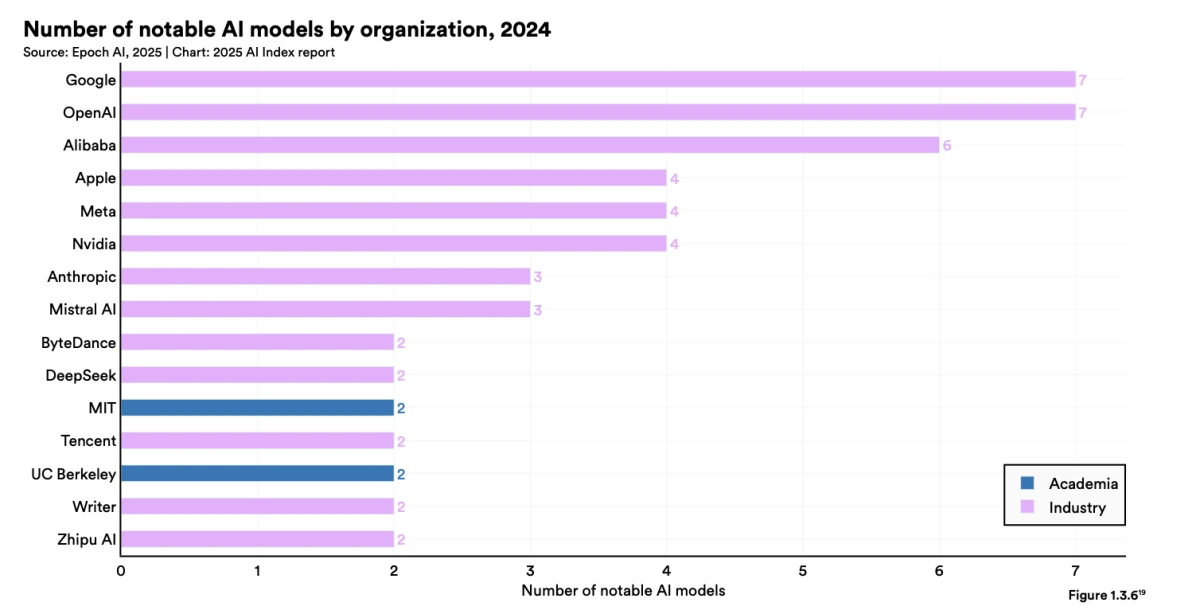
The top Enterprise AI companies that delivered highest notable AI models are listed as:
 Add as preferred source
Breakdown by business model
Like tech companies, AI companies can also be classified by the size of the businesses they target:
- Consumers (B2C)
- B2B
- SMEs
- Mid-market (Companies with hundreds of millions in revenue)
- Enterprise (Forbes 2000 or at least $1 billion in revenue)
Though most AI startups, specifically in industries such as insurance, retail, healthcare, and banking, focus on enhancing customer experience through the guidance of data and analytics, they promote their products for businesses rather than consumers.
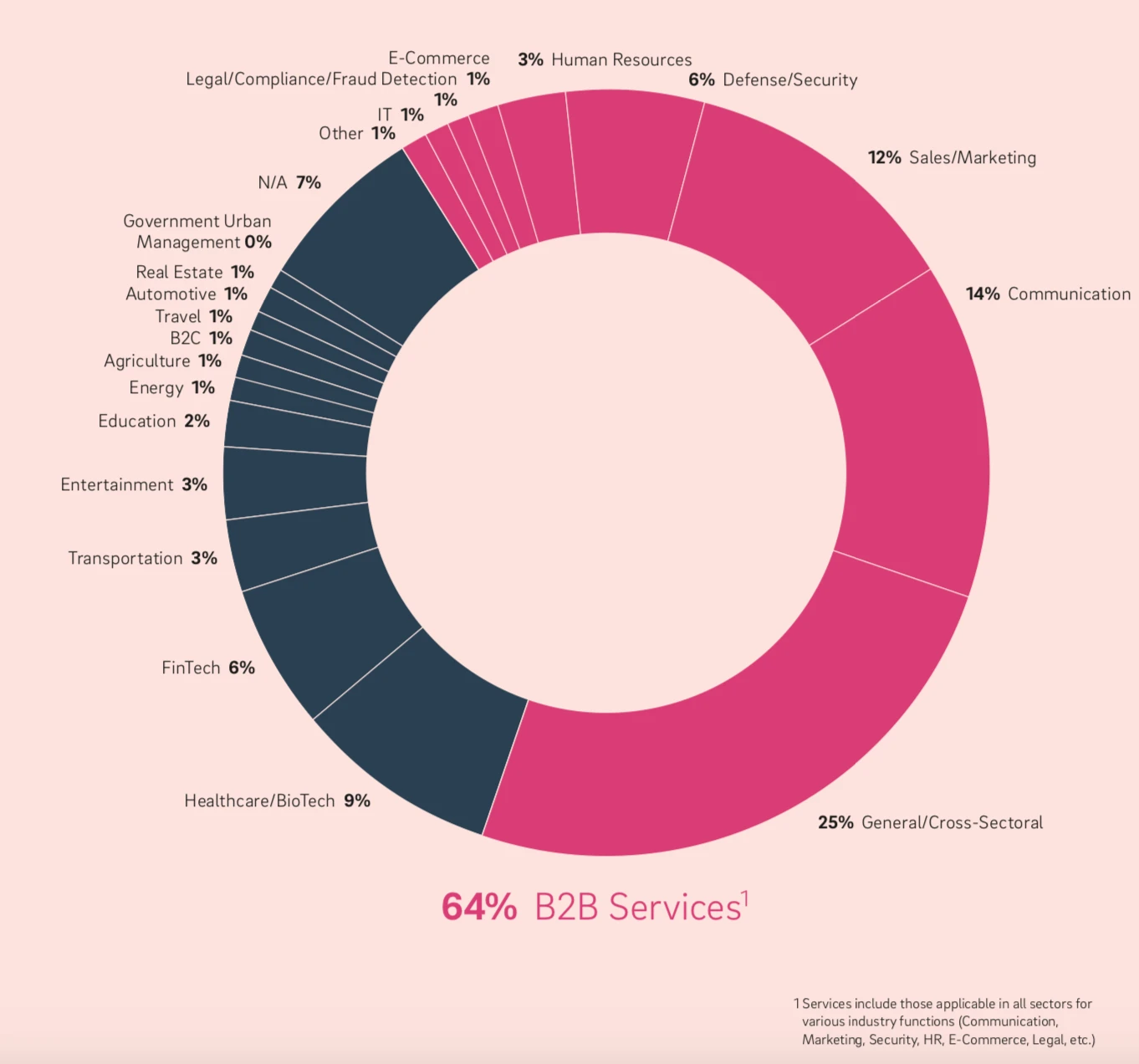
In other words, most AI companies are B2B-focused. According to Asgard’s research, which is a venture fund for AI companies, 64% of AI companies are B2B. However, their calculation methodology doesn’t look 100% accurate since there are numerous B2B companies such as OJO Labs (in real estate) and Personetics Technologies (in Fintech) where the research below included them in the B2C environment. Therefore, we assume the ratio of B2B AI startups is higher than 64% of the AI ecosystem.
Breakdown by service
Product offerings
Hardware
AI chips are specially designed accelerators for artificial neural network(ANN) based applications. ANN is considered a subfield of artificial intelligence and most commercial ANN applications are deep learning applications.
AI Chip Vendors
- Graphcore: A semiconductor company that develops accelerators for AI and machine learning.
- Funding: $460M
- Headquarters: United Kingdom
- Wave Computing: A company that is revolutionizing AI with its dataflow-based chips, systems and software that deliver orders of magnitude performance improvements over legacy architectures.
- Funding: $203.3M
- Headquarters: United States
Articles that may interest you:
AI software options
Most AI products you encounter in the business world are SaaS products where vendors share APIs or deliver a product via an app or web portal.
Service offerings
Some vendors offer specific services based on your business needs. AI services businesses may purchase include
- AI-as-a-Service (AIaaS)
- Custom AI Development
- Services for enabling AI transformation
- Consulting
- Services to support your internal data science teams
- AI talent recruitment
- Data labeling/ Annotation
- Data science competitions
- AI Platforms.
Recommended readings:
Sources:
*Data related to businesses’ funding is taken from Crunchbase
**Data related to businesses’ number of employees is taken from Linkedin
Cite this research
Pick the format that matches where you're publishing. Pasting the link version into your CMS preserves the backlink.
@misc{simsek2026,
  author = {Şimşek, Hazal},
  title  = {{Enterprise AI Companies: Landscape Breakdown}},
  year   = {2026},
  month  = jul,
  howpublished    = {\url{https://aimultiple.com/enterprise-ai-companies}},
  note   = {AIMultiple. Retrieved July 20, 2026}
}Results and timestamps of 79 data points. Download the summary data shown in this article's charts and tables as a ZIP file containing 4 CSV files.
Want the granular data behind it? Join Premium
Changelog
6 updatesRemoved ServiceNow AI Agents from the enterprise AI vendor list.
Removed Figure 2, the AI tech breakdown chart, from the breakdown by technology section.
Added a data solutions section covering Bright Data, Scale AI, Common Crawl, Databricks, Snowflake and dbt Labs.
Added an AI Security, Governance and Risk section and an Infrastructure and MLOps section with their vendors.
Added a "Titan" tier section listing OpenAI, Anthropic and xAI with funding above $10 billion.
Reference Links




Be the first to comment
Your email address will not be published. All fields are required. Comments are left in their original language.