


Top 7 Methods for Audio Sentiment Analysis

As the number of consumers increases and users’ data accumulates daily, a data explosion is no surprise. Companies use data collection and analytics to improve sales, customer insights, or brand reputation. Even though voice data is the most direct feedback businesses receive from customers, they often overlook its importance.
To better understand how customers evaluate products & services, explore how to analyze the sentiment in audio files, and the top eight methods companies can implement:
What is audio sentiment analysis?
Traditional sentiment analysis methods mainly rely on written texts such as reviews, feedback, surveys, etc. However, as human language is complex, nuances such as irony, sarcasm, or intentions are not always easily understood in the written content.
The acoustic tone in audio files carries richer information and gives better insights into the sentiments.1 Sentiment information can be gathered from various voice characteristics, such as2
- pitch
- loudness
- tone of voice
- other frequency-related measures
So, emotions can be better recognized by combining speech tone and written content analysis than by considering written feedback.
In recent years, companies started implementing audio sentiment analysis methods to understand their customers’ sentiments better and provide them with a better experience.
How does audio sentiment analysis work?
Figure 1. A simplified comparison of written content and multimodal (text + audio) sentiment analysis
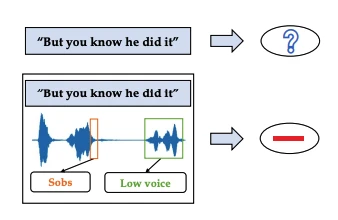
Source: CM-BERT: Cross-Modal BERT for Text-Audio Sentiment Analysis.3
Audio sentiment analysis steps are:
1. Collecting audio
Gathering audio
Start by collecting audio. You can use live recordings, pre-recorded files, or audio from online platforms.
Ensuring quality
Clear audio is essential. Try to reduce background noise and keep the sound crisp. Also, make sure your data is diverse, different voices, tones, and emotions will help your model learn better.
Preprocessing
Once collected, clean the audio. This includes removing noise, adjusting volume, and trimming silence. These steps make the audio ready for the next phases.
2. Transcribing to text
Converting audio to text
Speech recognition tools turn spoken words into text. OpenAI’s Whisper remains a common choice, but the current versions, such as large-v3 and the faster large-v3-turbo, have replaced the 2022 release most guides still cite. Newer options, including OpenAI’s GPT-4o transcription models, add built-in speaker labeling. That removes the need for a separate tool to tell an agent’s voice apart from a customer’s in a recorded call.
Cleaning the text
The transcribed text may need formatting. You might remove extra punctuation, lowercase all words, or clean up special characters.
3. Choosing the model
Pick a model that works well with audio and text. Some models are trained on emotional or spoken language. Choose one with good accuracy and flexibility.
4. Interpreting and using the results
Understanding the results
Use the data to learn how people feel. This is useful in areas like customer service, marketing, and public feedback.
Visualizing results
Show the sentiment scores in charts, tables, or dashboards. This helps people quickly see the emotional tone of the audio.
7 methods of conducting audio sentiment analysis
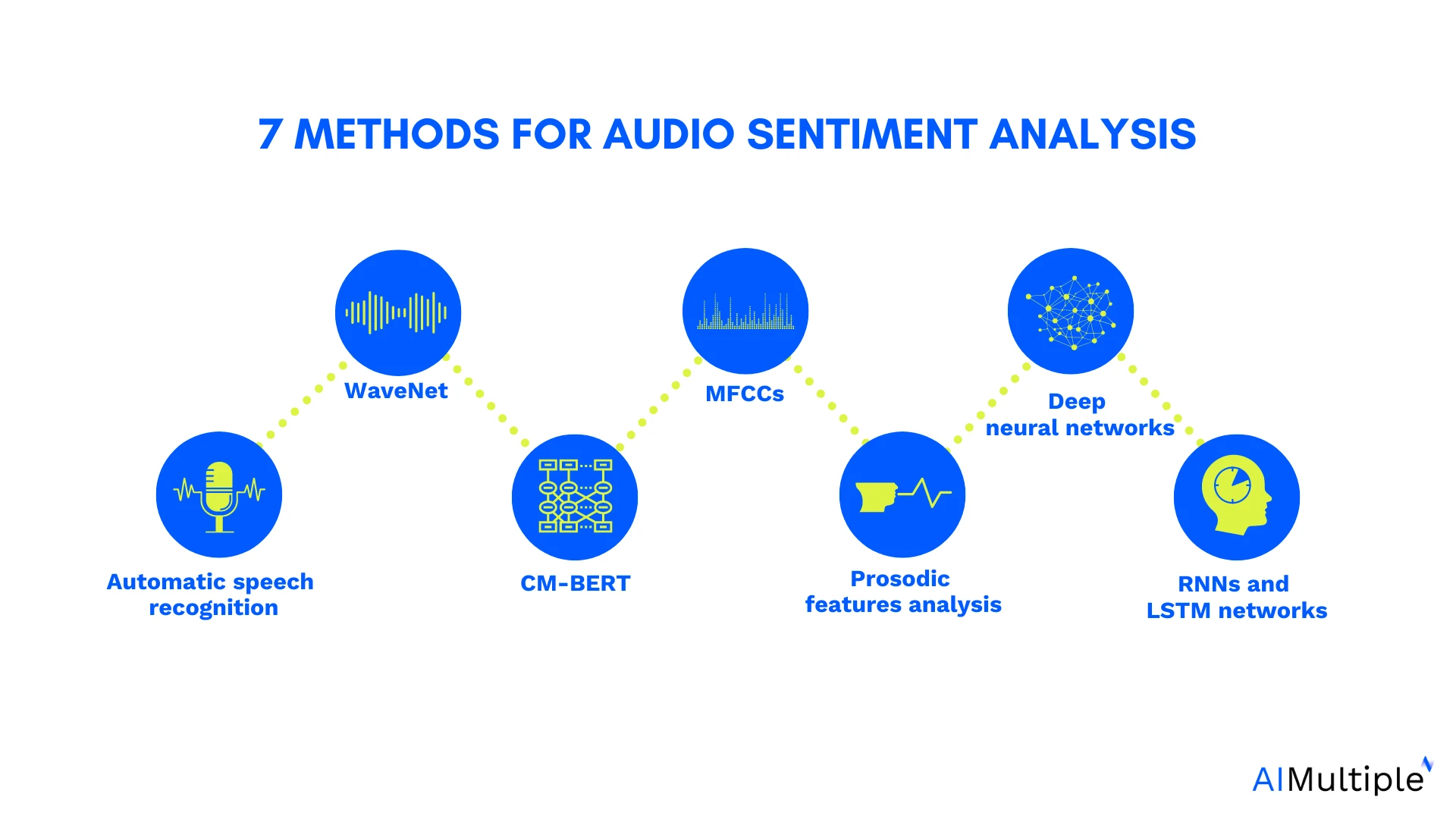
There are seven main methods of conducting audio sentiment analysis.
1- Automatic speech recognition (ASR)
Figure 2. An example of how ASR works
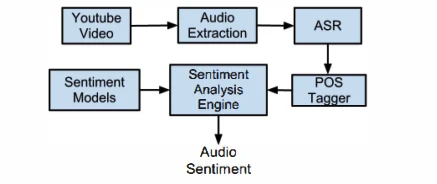
Source: Sentiment extraction from natural audio streams4
Process: ASR transcribes spoken sentences into text using speech recognition. The transcribed text is then analyzed for sentiment using natural language processing (NLP) techniques.
Example: In call centers, ASR can transcribe customer conversations, allowing sentiment analysis models to determine the overall sentiment of the interaction.
2- WaveNet (Raw audio waveform analysis)
Process: WaveNet analyzes raw audio waveforms directly to extract audio features using deep neural networks. This method does not require audio transcription and can capture intricate details in the audio signal. It is a probabilistic method that offers state-of-art results with a multimodal (text+audio) dataset.
Example: WaveNet can detect different emotions from the tone and pitch of the audio, providing a good representation of the speaker’s emotional state.
WaveNet was primarily built for generating speech, not for scoring sentiment. Teams doing raw-waveform sentiment work today more often reach for self-supervised encoders such as Wav2Vec 2.0 or HuBERT, trained specifically to represent both speech content and vocal cues like tone.5 WaveNet’s core idea, learning straight from the waveform instead of hand-built features, still holds. The specific model has mostly been replaced by these newer encoders.
3- Crossmodal bidirectional encoder representations from transformers (CM-BERT)
Figure 3. The architecture of the CM-BERT network
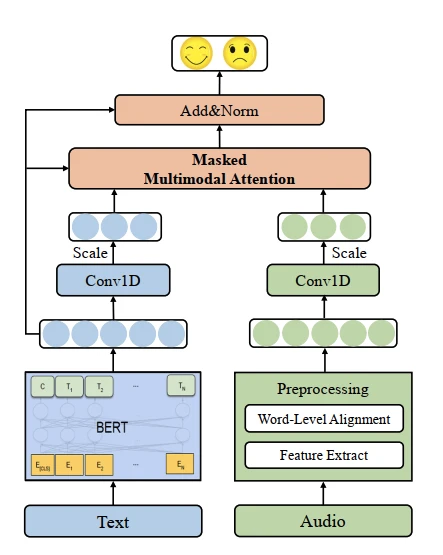
Source: CM-BERT: Cross-Modal BERT for Text-Audio Sentiment Analysis.3
Process: The CM-BERT approach relies on the interaction between text and audio and dynamically adjusts the weight of words by comparing the information from different modalities. It uses machine learning models to analyze both the audio signal and its transcription, leveraging the strengths of both modalities.
Example: In a project analyzing audio recordings from podcasts, CM-BERT can provide insights into the sentiment expressed in both the spoken words and the audio features.
4- Mel-Frequency cepstral coefficients (MFCCs)
Process: MFCCs are used to represent the short-term power spectrum of sound. They are extracted from audio recordings and used as features for sentiment analysis models.
Example: By analyzing MFCCs, machine learning models can recognize different emotional states in audio files, such as happiness, sadness, or anger.
MFCCs still work as a lightweight, fast feature set, and remain a reasonable default for teams with tight compute budgets. Newer self-supervised models, such as Wav2Vec 2.0, HuBERT, and emotion2vec, now beat MFCC-based systems on most published benchmarks, as they learn features directly from raw audio rather than relying on a fixed formula.6 Teams chasing top accuracy tend to pick one of these instead.
5- Prosodic features analysis
Process: This method analyzes prosodic features like intonation, stress, and rhythm in speech. These features are crucial for understanding the emotional tone in audio recordings.
Example: Prosodic features analysis can be used in customer service interactions to identify stress or frustration in a customer’s voice, helping improve the user interface and response strategies.
6- Deep neural networks (DNNs)
Process: DNNs can be trained on large datasets of audio recordings to recognize patterns and classify sentiments. They are capable of learning complex representations of audio data.
Example: DNNs can be employed in sentiment analysis projects where high accuracy is required, such as in social media audio posts to gauge public opinion.
emotion2vec, released in 2024 and actively maintained through 2026, is an open-source model trained specifically to pull emotion signals out of raw audio.7 It runs on a single GPU, is free to use, and has become a common baseline in speech emotion research: the role Whisper plays for transcription.
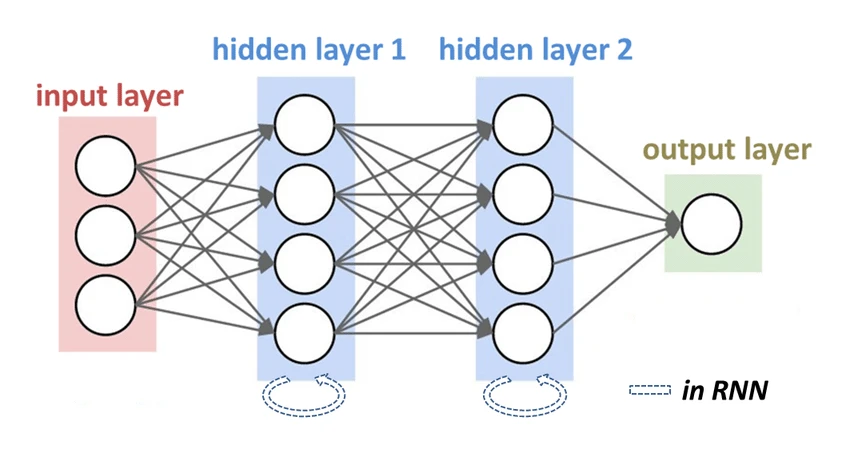
7- Recurrent neural networks (RNNs) and long short-term memory (LSTM) networks
Figure 4. Recurrent neural networks with two hidden layers
Source: Classification and prediction of wave chaotic systems with machine learning techniques.8
Process: RNNs and LSTMs are designed to handle sequential data, making them suitable for analyzing temporal dependencies in audio signals. They can capture the progression of emotions.
Example: In analyzing long audio recordings like interviews or speeches, RNNs and LSTMs can track the changes in sentiment throughout the entire audio file.
8- Large audio-language models (LALMs)
Process: A large audio-language model reads audio and text in one pass, inside a single model. Older methods split the work into two: one model turns speech into text, and a separate model reads that text for sentiment. Splitting the work loses information; a flat, deadpan “That’s great” can read as positive when the words are scored. A large audio-language model keeps tone, pace, and word choice together, so it catches that mismatch.
Examples in production include OpenAI’s GPT-4o Audio, Google’s Gemini 2.5, and Alibaba’s Qwen2.5-Omni. Each accepts an audio clip directly and returns a transcript, an emotion label, or both, without exposing a separate transcription step.
Example: A support platform routes a customer call directly to one of these models. It returns a transcript, a sentiment score, and a note on where the tone shifted during the call, all from a single pass over the audio.
Trade-off: These models cost more to run per minute of audio than smaller, task-built models. Teams handling high call volumes often run a lightweight open-source model, such as emotion2vec, as a first pass, then send flagged calls to a larger model for a closer read.9
Top 8 applications of audio sentiment analysis
Audio sentiment analysis has a wide range of applications in various fields, enhancing processes and providing valuable insights across industries.
1- Call centers
In call centers, audio sentiment analysis is used to analyze customer interactions. By performing sentiment analysis on audio recordings, companies can determine the sentiment expressed during calls, whether positive, negative, or neutral. This information can help improve customer service by:
- Identifying issues: Detecting negative sentiments early allows call center agents to address customer concerns more effectively.
- Training purposes: Understanding the emotional states of customers during calls can be used to train agents, enhancing their ability to handle different emotions.
- Quality Assurance: Sentiment analysis results can be used to monitor and maintain the quality of service, ensuring consistent customer satisfaction.
2- Emotion recognition
Detecting different emotions in audio recordings can significantly enhance user interfaces and create more empathetic AI systems. Emotion recognition through audio sentiment analysis involves:
- Personalized experiences: Tailoring responses based on the detected emotions to provide a more personalized and engaging user experience.
- Mental health applications: Monitoring emotional states can aid in mental health applications by recognizing signs of stress, anxiety, or depression in audio recordings.
- Virtual assistants: Improving virtual assistants’ interactions by enabling them to respond more appropriately to the user’s emotional tone.
3- Market research
In market research, audio sentiment analysis of audio files from focus groups or customer feedback can provide valuable insights. By analyzing sentiments in spoken responses, companies can:
- Understand consumer preferences: Gain insights into customer opinions about products or services, helping businesses make informed decisions.
- Product development: Use sentiment data to guide the development and improvement of products based on customer feedback.
- Brand perception: Monitor and analyze public sentiment towards a brand, enabling companies to adjust their strategies accordingly.
4- Social media monitoring
Audio sentiment analysis can also be applied to audio files from podcasts or video content shared on social media platforms. This application helps in:
- Public opinion analysis: Analyzing sentiments in spoken content to gauge public opinion on various topics.
- Content strategy: Influencing content creation strategies by understanding the audience’s emotional reactions to different types of content.
- Trend analysis: Identifying emerging trends and sentiments in social media conversations, allowing companies to stay ahead in their marketing efforts.
5- Healthcare
In the healthcare sector, audio sentiment analysis can be applied to patient-doctor interactions, telemedicine consultations, and patient feedback. This can lead to:
- Enhanced patient care: Understanding patient emotions can help healthcare providers offer more empathetic and tailored care.
- Early detection of conditions: Recognizing changes in a patient’s emotional state can assist in the early detection of mental health issues or other conditions.
- Patient satisfaction: Analyzing patient feedback to improve the quality of healthcare services and ensure patient satisfaction.
6- Education
In educational settings, audio sentiment analysis can be used to analyze student interactions, teacher feedback, and classroom discussions. This can support:
- Student engagement: Understanding students’ emotional responses can help educators adjust their teaching methods to keep students engaged.
- Performance monitoring: Monitoring sentiment in student feedback can provide insights into the effectiveness of educational programs and teaching strategies.
- Emotional support: Identifying students who may need additional emotional support, enabling timely intervention.
7- Entertainment Industry
The entertainment industry can leverage audio sentiment analysis to analyze audience reactions to movies, music, and other media content. This can lead to:
- Content improvement: Using sentiment analysis results to improve scripts, dialogues, and overall content based on audience reactions.
- Marketing strategies: Tailoring marketing campaigns to resonate better with the audience’s emotional responses.
- Audience engagement: Creating more engaging and emotionally resonant content by understanding audience sentiments.
8- Human Resources
In human resources, audio sentiment analysis can be applied to employee feedback, interviews, and performance reviews. This can enhance:
- Employee satisfaction: Analyzing sentiments in employee feedback to improve workplace conditions and address concerns.
- Recruitment processes: Understanding candidates’ emotional responses during interviews to make better hiring decisions.
- Performance management: Using sentiment data to support performance reviews and provide constructive feedback.
Rules to know before deploying audio sentiment analysis in the EU
The EU AI Act bans one specific use of this technology: inferring an employee’s emotions from their voice at work. That ban, under Article 5(1)(f), is one of the Act’s prohibited-practices provisions, and it has applied since February 2, 2025.10 National regulators, including France’s CNIL, have published guidance on preparing for enforcement as the rest of the Act phases in: general-purpose AI rules arrived in August 2025, and most remaining provisions reach full application on August 2, 2026.
What’s banned
- Reading emotion from an employee’s voice, face, or other biometric signal during work tasks, interviews, or performance reviews.
What’s not covered by the ban
- Systems that transcribe a meeting into text.
- Safety-focused systems, such as tools that catch driver fatigue.
The two exceptions
- Medical use.
- Safety use.
- Scoring a customer service agent’s stress level for coaching purposes qualifies for neither.
Customer-facing use is treated differently: Reading a customer’s mood during a support call is not banned under EU law. Outside the workplace and education ban, though, some emotion-recognition deployments may still qualify as high-risk under a separate part of the Act (Annex III) and may trigger added transparency duties under Article 50. Classification depends on the specific deployment, not the use case as a whole.11
Penalties: Fines for breaking the workplace ban reach €35 million or 7% of a company’s global annual revenue, whichever is higher.12 Even before this ban existed, Hungary’s data protection authority ordered a bank to stop analyzing employee voice tone under separate GDPR rules, in what’s now known as the Budapest Bank case: a sign regulators were treating this as a problem under older privacy law.13
What this means for the methods above
- Scoring customer sentiment in a call center stays workable across the EU, subject to the high-risk and transparency checks noted above.
- Applying the same scoring to an agent’s voice, to track mood or stress during a shift, is prohibited under Article 5(1)(f), unless the medical or safety exception applies.
- Interview and performance-review use cases, mentioned in the human resources section above, are usually prohibited outright rather than merely high-risk. Treat these as off-limits in EU deployments without a confirmed medical or safety justification, not a “review before launch.”
 Add as preferred source
How successful are audio sentiment analysis tools?
A 2025 benchmark, AHELM, tested how large audio-language models handle emotion detection specifically, alongside nine other audio understanding tasks.14 Google’s Gemini 2.5 Pro led the group overall, topping five of the ten categories, including emotion detection. No single model led every category. Picking a model still depends on the specific use case, not one leaderboard rank.
A 2026 benchmarking experiment evaluated how well modern models detect sentiment directly from speech signals.15 The results show that audio-based sentiment analysis can capture emotional cues such as tone, pitch, and speaking speed. These cues are often lost when speech is converted to text.
The study tested several well-known speech models, including HuBERT,16 Wav2Vec,17 and Whisper.18 When the models analyzed short phrases spoken with different emotional tones, performance was relatively strong. Accuracy ranged from 78–91%, indicating that these models can detect clear emotional signals in controlled speech.
However, performance dropped when the models were tested on more complex and varied sentences. In these cases, accuracy fell to around 54–60%. The models struggled because sentence meaning, speaker style, and context varied more widely.
Overall, the results suggest that audio sentiment analysis tools can work well when emotional cues are clear. However, their performance declines in realistic conversations. For this reason, many systems combine audio signals and text analysis to improve reliability.
Further readings
- Open Source Sentiment Analysis Tools
- Sentiment Analysis Benchmark Testing
- Answer Engine Optimization Tools
- Emotion AI Tools Tested
Cite this research
Pick the format that matches where you're publishing. Pasting the link version into your CMS preserves the backlink.
@misc{phd2026,
  author = {PhD., Ezgi Arslan,},
  title  = {{Top 7 Methods for Audio Sentiment Analysis}},
  year   = {2026},
  month  = jul,
  howpublished    = {\url{https://aimultiple.com/audio-sentiment-analysis}},
  note   = {AIMultiple. Retrieved July 3, 2026}
}
Changelog
6 updatesAdded a large audio-language models section as an eighth sentiment analysis method.
Removed a link to a related article in the 'Choosing a Sentiment Analysis Model' section.
Reference Links



Be the first to comment
Your email address will not be published. All fields are required. Comments are left in their original language.