


Top 10+ agents d'IA dans le secteur de la santé avec exemples

Nous répertorions les agents d'IA pour le secteur de la santé qui automatisent les flux de travail des opérations cliniques. Découvrez les agents d'IA dans le secteur de la santé, y compris les outils utilisés pour les tâches générales, les agents natifs EHR, le support orienté patient et l'aide à la décision clinique :
Agents d'IA dans le secteur de la santé
Agents de santé polyvalents
Ces agents automatisent les tâches administratives et opérationnelles (par exemple, la planification, le codage médical et les opérations de bureau). Ils ne fournissent pas de diagnostics.
Agent d'IA | Codage médical | Admission des patients | Automatisation de la facturation | Intégration EHR |
|---|---|---|---|---|
Notable | ⚠️ Examen de documents basé sur le NLP | ✓ Semi-autonome – les patients remplissent les formulaires, l'IA pousse les données vers le EHR | ✓ Automatisation de la facturation de bout en bout | ✓ Intégration étendue |
Beam AI | ✓ L'agent d'IA suggère des codes de facturation | ✓ Très autonome – collecte les informations, met à jour le EHR | ✓ Automatisation de la facturation de bout en bout | ⚠️ Connexion basée sur API (prêt pour l'intégration) |
Sully.ai | ✓ L'agent d'IA suggère des codes de facturation | ✓ Très autonome – collecte les informations, met à jour le EHR | ⚠️ Automatisation partielle de la facturation (n'automatise pas les tâches comme la soumission des demandes de remboursement) | ✓ Intégration étendue (17+) |
Sully.ai
Sully.ai fournit une architecture agentique couvrant l'admission, le codage, la facturation et le triage avec un accent sur les agents d'IA modulaires. Automatise la documentation, l'admission, la planification et les tâches administratives.
Fonctionnalités clés :
- Fonctionnalité voix-à-action : Traduit la parole du médecin en actions EMR à l'aide de la reconnaissance vocale.
- Conforme HIPAA : Garantit que le traitement et la manipulation des données respectent les normes HIPAA.
- Capacités multilingues : Prend en charge 19 langues.
Exemples d'agents d'IA de Sully.ai :
Cas d'utilisation réel : CityHealth automatise les soins de santé avec Sully.ai
CityHealth intègre la plateforme de soins de santé IA de Sully.ai directement avec ses dossiers médicaux électroniques (EMR) pour réduire le temps de documentation.
Sully.ai :
- a rédigé la documentation clinique
- a réduit les modifications manuelles
- a soutenu la saisie de données pendant les consultations.
Résultats :
- ~3 heures/jour économisées par clinicien grâce à la réduction du temps de documentation
- Diminution de 50 % des opérations par patient2
Beam AI
Beam AI propose un système multi-agents pour la gestion des soins de santé afin d'automatiser la tenue des dossiers médicaux, la facturation des soins de santé, la conformité médicale, la planification des rendez-vous des patients, etc.
Exemples d'agents de santé Beam AI :
Cas d'utilisation réel : Avi Medical automatise les soins de santé et le service client avec Beam AI
Avi Medical s'est associé à Beam AI pour déployer des agents d'IA multilingues. Les agents de Beam ont récupéré des données pertinentes à partir de bases de données pour répondre à des questions complexes des clients. Grâce à la capacité des agents à accéder à des données externes via des APIs, les agents d'IA ont traité des demandes routinières à volume élevé (70 % des tickets).
Résultats :
- 80 % des demandes des patients ont été automatisées
- Réduction de 90 % du temps de réponse médian
- Augmentation de 10 % du Net Promoter Score (NPS)3
Notable Health
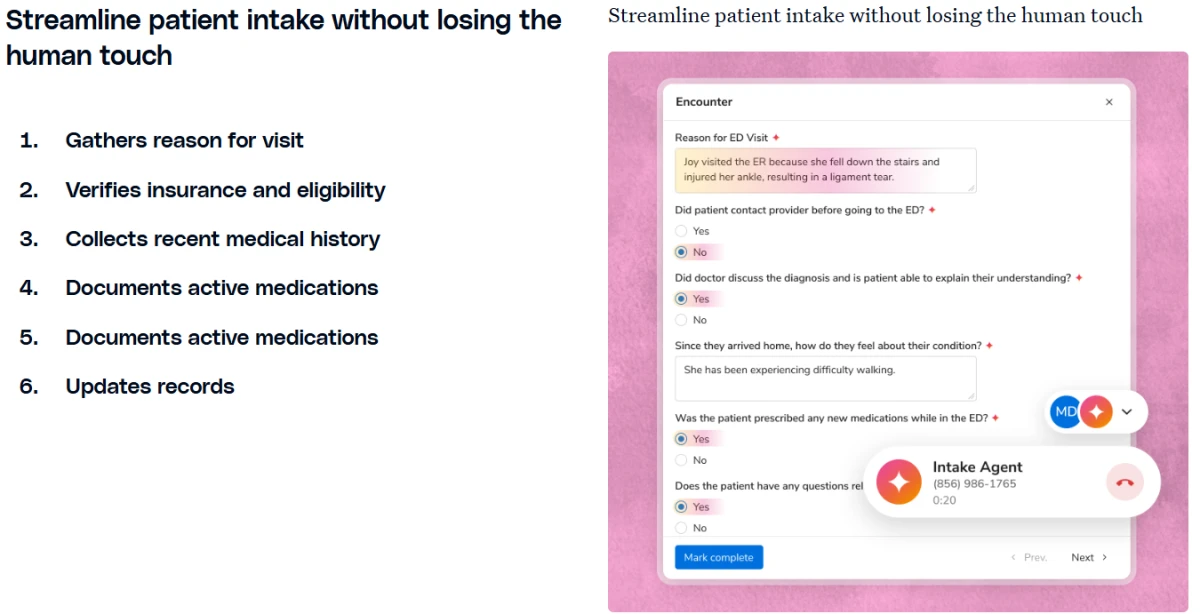
Notable Health utilise des agents d'IA pour automatiser les tâches administratives telles que l'enregistrement des patients, la planification des rendez-vous, les références, l'autorisation des soins et le codage, le tout intégré aux EHR.
Cas d'utilisation réel : North Kansas City Hospital automatise les rendez-vous des patients avec Notable
North Kansas City Hospital (NKCH) faisait face à des inefficacités dans l'enregistrement et l'accueil des patients. NKCH s'est associé à Notable pour automatiser divers flux de travail administratifs tels que la planification des vaccins.
Résultats :
- Plus de 90 % de réduction du temps d'enregistrement des patients (de 4 minutes à 10 secondes).
- 80 % des patients ont été pré-enregistrés, contre 40 % auparavant.4
Agents natifs EHR
Les agents natifs EHR sont des systèmes d'intelligence artificielle intégrés directement dans les plateformes de dossiers de santé électroniques plutôt qu'ajoutés en tant qu'outils externes.
Epic
Epic couvre environ 42 % du marché américain des EHR de soins aigus. Lors de HIMSS26 en mars 2026, Epic a rapporté que plus de 85 % de ses organisations clientes utilisent ses fonctionnalités d'IA.5
Epic propose trois agents nommés :
- Art rédige des notes cliniques, des résumés de parcours hospitalier et des textes de plans de soins infirmiers. Chez Mercy, le temps moyen de rédaction des notes infirmières de fin de quart est passé de 3,5 minutes à environ 32 secondes. Les notes terminées à temps ont augmenté de 225 %.
- Penny gère le codage et les appels de refus. Epic signale une baisse de plus de 20 % des refus liés au codage sur les sites qui l'utilisent le plus, et des lettres d'appel rédigées 23 % plus rapidement.
- Emmie répond aux questions des patients dans MyChart et gère la planification. Au Rush University Medical Center, les messages de service liés à la facturation ont chuté de 58 %.
Oracle Health
L'agent d'IA clinique Oracle Health écoute pendant une visite, rédige la note et rédige les ordonnances de suivi.
Oracle a élargi l'outil sur trois fronts : la rédaction d'ordonnances couvrant les laboratoires, l'imagerie, les prescriptions, les suivis et les références ; la génération de notes pour les contextes d'hospitalisation et d'urgence ; et la couverture de plus de 30 spécialités, avec environ 1 million de notes générées.
Oracle rapporte une réduction de près de 30 % du temps de documentation quotidien des médecins. L'outil fonctionne également au Royaume-Uni et au Canada.6
Assistants cliniques augmentés
Ces systèmes aident les cliniciens dans l'analyse et la priorisation. Ils ne remplacent pas le jugement médical.
Innovaccer
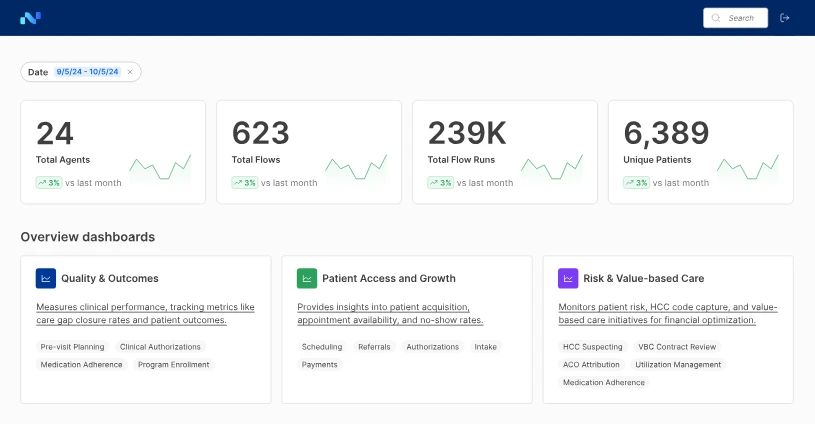
Source : Innovaccer7
Innovaccer propose une suite d'agents d'IA axés sur les soins basés sur la valeur et les opérations. Ses agents soutiennent la prise de décision, pas le diagnostic.
Exemples d'agents de santé Innovaccer :
Cas d'utilisation réel : Franciscan Alliance rationalise le codage avec Innovaccer
Le réseau de médecins multi-spécialités basé dans l'Indiana, Franciscan Alliance, utilise la plateforme d'Innovaccer pour automatiser les processus de codage.
Résultats :
- La solution d'engagement des médecins d'Innovaccer a aidé à rationaliser les processus de codage, entraînant une amélioration d'environ 5 % de la fermeture des lacunes de codage.
- Les protocoles automatisés ont réduit le nombre prévu de cas de patients d'environ 2 600 à environ 1 600.8
Agents de support orientés patient
Ces agents sont spécialisés dans l'interaction directe avec les patients, répondant aux questions, fournissant des instructions, planifiant et offrant un soutien émotionnel.
Hippocratic AI
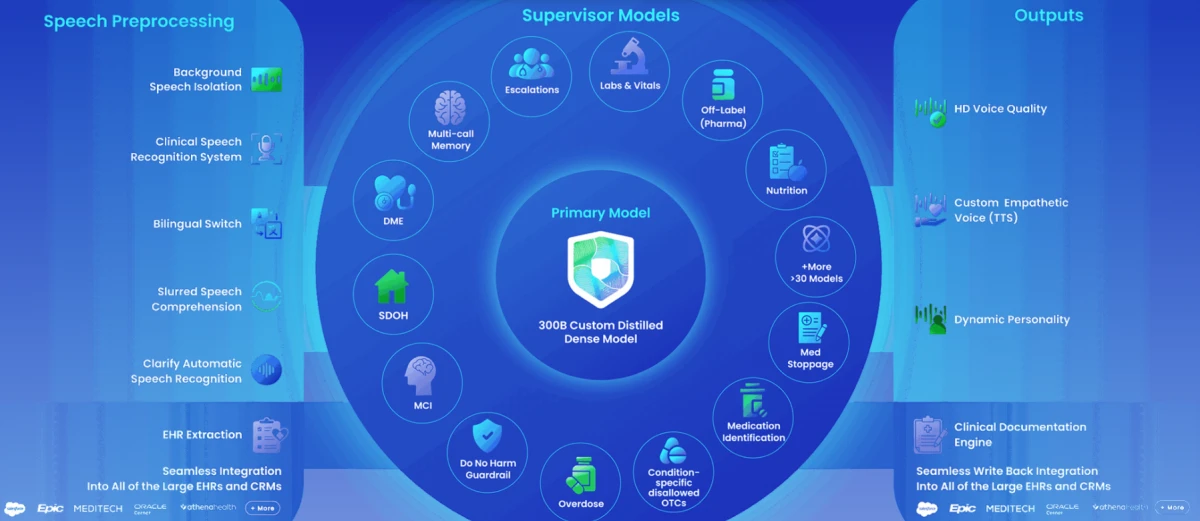
Hippocratic AI est une entreprise d'intelligence artificielle axée sur les soins de santé qui a développé le premier LLM (LLM) spécifiquement pour les tâches cliniques non diagnostiques (par exemple, l'engagement des patients, les suivis, la coordination d'assurance) et les tâches cliniques orientées patient.
L'entreprise a levé 126M$ à une valorisation de 3,5B$, clôturé en novembre 2025, portant le financement total à 404M$.9
Exemples d'agents d'Hippocratic AI :
Cas d'utilisation réel : Partenariat WellSpan Health et Hippocratic AI
WellSpan Health s'est associé à Hippocratic AI pour lancer un agent de soins de santé GenAI qui gère les appels d'engagement des patients. Ces agents peuvent contacter les patients hispanophones et anglophones, répondre à leurs besoins de santé et planifier des dépistages.
Résultat :
- Le système a permis à WellSpan Health de contacter plus de 100 patients, améliorant l'accès aux dépistages critiques du cancer.10
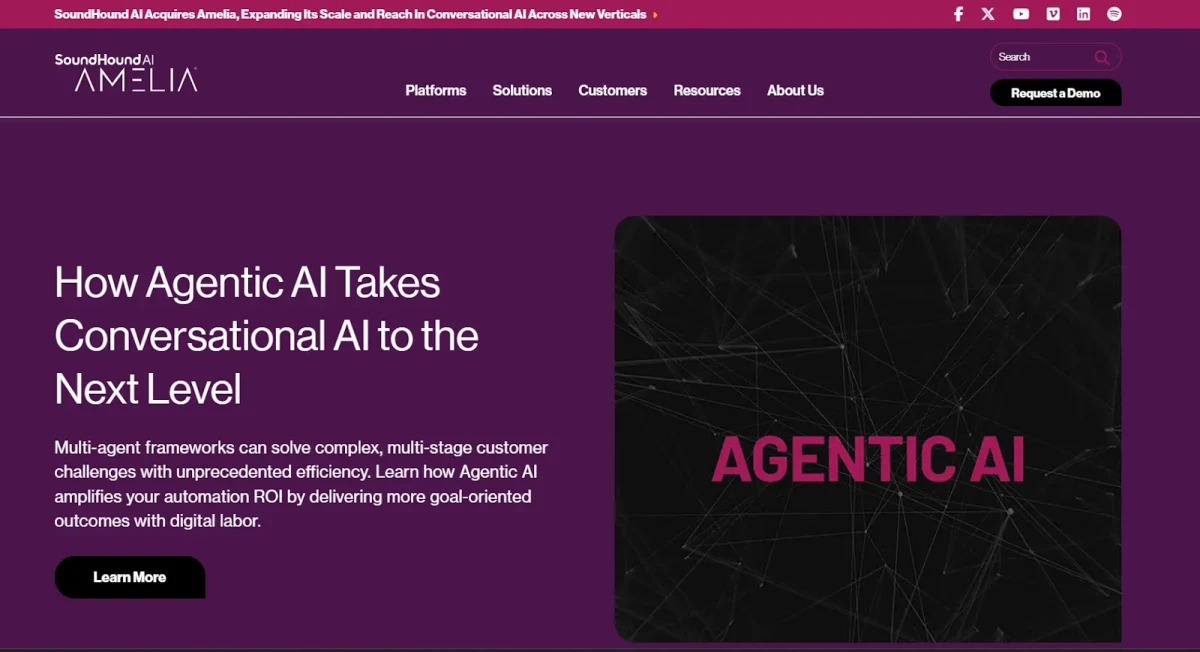
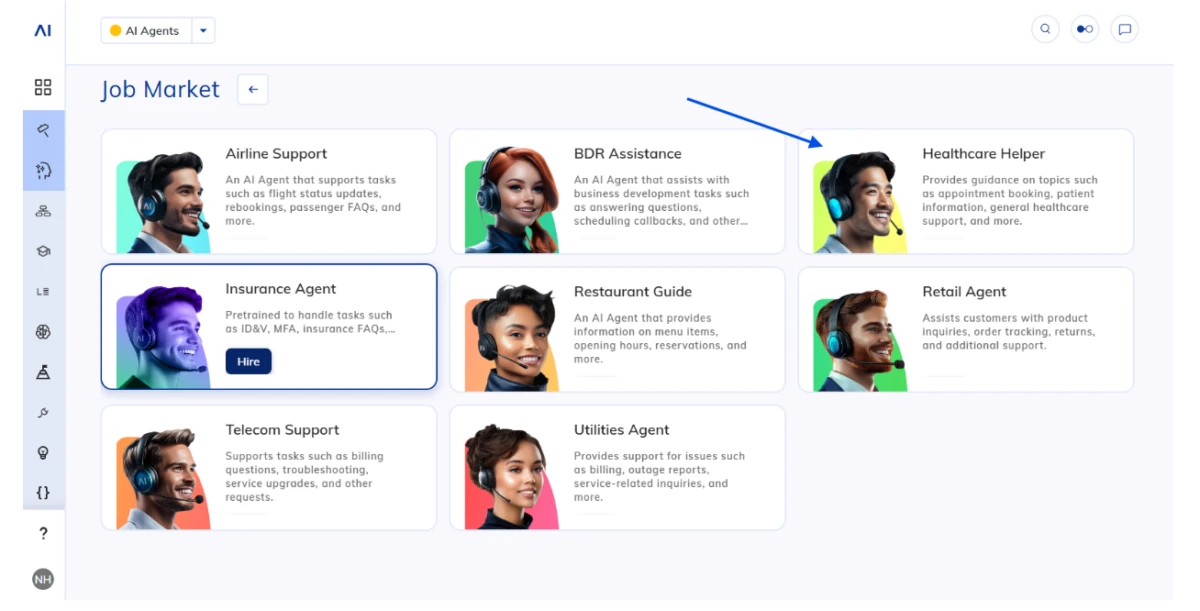
Amelia IA
Les agents Amelia IA peuvent guider les patients tout au long de leur parcours de soins. Ils peuvent planifier des rendez-vous, répondre aux questions des patients et fournir des réponses conversationnelles empathiques.
Cas d'utilisation réel : Aveanna Healthcare utilise les agents Amelia pour le support client
Aveanna utilise l'agent Amelia IA pour gérer les interactions répétitives des employés via Workday et les applications mobiles. L'agent gère désormais les réinitialisations de mots de passe, l'authentification des utilisateurs et d'autres tâches liées aux RH.
Résultats :
- Plus de 560 conversations quotidiennes avec les employés gérées par l'agent d'IA
- 95 % des demandes des employés ont été résolues via le chat Workday.11
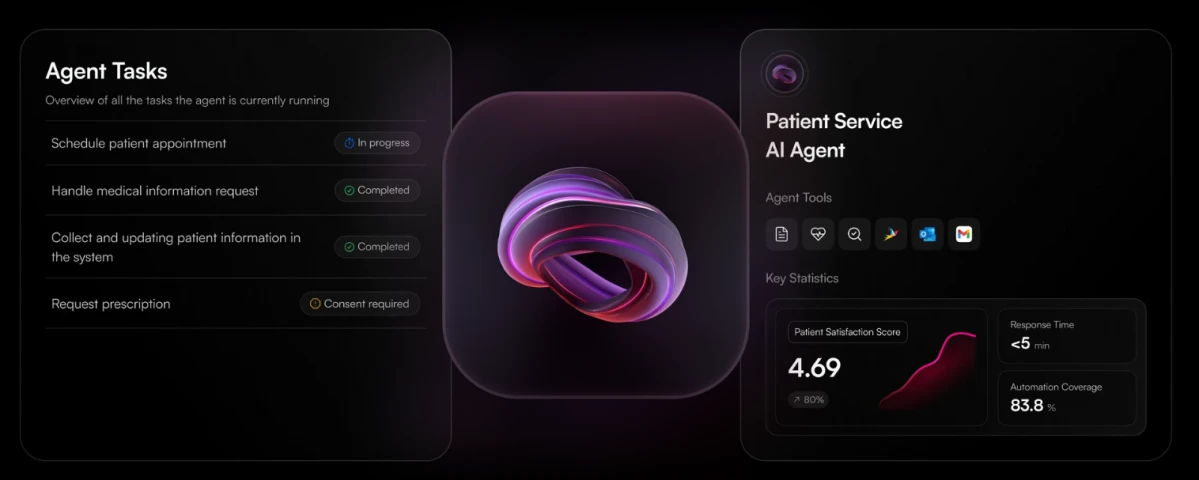
Cognigy
Les agents de Cognigy sont des agents d'IA conversationnels pour les soins de santé, fournissant un support pour les demandes d'assurance, les renouvellements de prescriptions et les instructions de soins post-traitement.
Cognigy propose plus de 30 canaux vocaux et numériques prêts à l'emploi, d'iMessage à WhatsApp et X.
Cas d'utilisation des agents Cognigy IA pour les soins de santé :
- ID&V (Vérification d'identité)
- Prendre et modifier des rendez-vous
- Facturation médicale
- Mettre à jour l'assurance
- Processus d'admission numérique (soumettre les informations personnelles et médicales numériquement)
- Demandes de renouvellement
NiCE a finalisé son acquisition de Cognigy pour 955M$ en septembre 2025. Cognigy fait désormais partie de la plateforme CXone Mpower de NiCE.12
Cas d'utilisation réel : Personify Pulse maintient un taux de confinement de 40 % avec Cognigy
Personify Pulse met en œuvre l'outil de Cognigy et l'intègre à Zendesk LiveChat pour gérer les demandes des clients.
Résultats :
- Taux de confinement : L'agent d'IA de Cognigy a traité 40 % des demandes des clients sans intervention humaine.
- Création automatisée de tickets : Le système a automatiquement créé des tickets de support, rationalisant le processus de suivi.13
Amazon Health IA Assistant
Amazon a lancé un assistant de santé IA pour les membres Prime en mars 2026 qui converse sur les symptômes, trie les demandes, planifie les rendez-vous et se connecte aux dossiers médicaux.14
Il est hautement personnalisable et évolutif au sein de l'écosystème AWS. L'assistant de santé IA nécessite une intégration et une configuration.
Les agents d'IA de santé sont-ils vraiment agentiques ?
Les agents d'IA planifient une tâche, appellent les systèmes dont ils ont besoin et agissent sur le résultat. Dans les soins de santé, la plupart s'arrêtent avant d'agir sans examen.
Pour l'instant, les agents de santé ne sont pas totalement autonomes ; la plupart nécessitent encore des « humains dans la boucle » pour l'exécution des tâches. Pourtant, ces agents possèdent plusieurs capacités agentiques, notamment :
- Récupération autonome de données : Récupérer les données des patients du système, y compris les détails personnels et les antécédents médicaux.
- Validation des données et vérification de l'exactitude : Vérifier les données par rapport aux enregistrements existants pour en garantir l'exactitude.
- Validation autonome des données et signalement des problèmes : Valider les données vérifiées et signaler les écarts pour résolution.
- Mise à jour autonome des données et gestion des dossiers : Mettre à jour le dossier du patient avec les informations validées.
 Ajouter comme source préférée
Les agents d'IA de santé deviendront-ils totalement autonomes ?
Ce que nous observons dans les agents d'IA de santé d'aujourd'hui est une « autonomie supervisée », où l'IA gère le gros du travail de recherche (par exemple, l'extraction de données à partir de rapports de laboratoire) et l'exécution de tâches répétitives (par exemple, l'enregistrement des signes vitaux des patients), mais avec une supervision humaine aux points de décision clés.
Ces agents sont encore loin de fournir des résultats totalement autonomes et prêts pour la production dans des cas d'utilisation médicale complexes, tels que le placement des patients et l'analyse d'images.
À l'avenir, ces systèmes pourraient évoluer vers des réseaux multi-agents, où différents agents d'IA collaborent et interagissent, s'améliorant progressivement vers des solutions plus agentiques.
Par exemple, des entreprises technologiques comme NVIDIA et GE HealthCare collaborent pour construire des systèmes robotiques agentiques comme les rayons X et les ultrasons, qui utilisent l'imagerie médicale pour opérer dans le monde physique.15
Pour aller plus loin
- Cas d'utilisation de l'IA dans les soins de santé avec exemples
- Comparer les 5 meilleurs agents d'IA en service client
Citer cette recherche
Choisissez le format qui correspond à votre lieu de publication. Coller la version avec lien dans votre CMS préserve le lien retour.
@misc{dilmegani2026,
  author = {Dilmegani, Cem and Arslan, Ezgi},
  title  = {{Top 10+ agents d'IA dans le secteur de la santé avec exemples}},
  year   = {2026},
  month  = jul,
  howpublished    = {\url{https://aimultiple.com/ai-agents-in-healthcare}},
  note   = {AIMultiple. Consulté le 27 juillet 2026}
}Résultats et horodatages de 35 points de données. Téléchargez les données de synthèse présentées dans les graphiques et les tableaux de cet article sous forme de fichier ZIP contenant 8 fichiers CSV.
Vous voulez les données détaillées derrière ? Rejoindre Premium
Journal des modifications
8 mises à jourAjout d'une section sur les agents natifs des DSE couvrant Epic et Oracle Health.
Ajouté Amazon Health AI Assistant à la section Cognigy.
Suppression de la section « Exemples d'agents d'IA dans les soins de santé ».
Liens de référence
Le travail de Cem chez AIMultiple a été cité par des publications mondiales de premier plan, notamment Business Insider, Forbes, Morning Brew et Washington Post, par des entreprises mondiales comme Deloitte et HPE, par des ONG comme World Economic Forum et par des organisations supranationales comme European Commission. [1], [2], [3], [4], [5]
Tout au long de sa carrière, Cem a été consultant en technologies, acheteur de technologies et entrepreneur technologique. Il a conseillé des entreprises sur leurs décisions technologiques chez McKinsey & Company et Altman Solon pendant plus de dix ans. Il a également publié un rapport McKinsey sur la digitalisation.
Il a dirigé la stratégie technologique et les achats d'un opérateur télécom, sous la responsabilité du PDG. Il a également dirigé la croissance commerciale de l'entreprise de technologie profonde Hypatos, qui a atteint un revenu récurrent annuel à 7 chiffres et une valorisation à 9 chiffres, passant de 0 à ce résultat en deux ans. Le travail de Cem chez Hypatos a été couvert par des publications technologiques de premier plan comme TechCrunch et Business Insider.
Cem intervient régulièrement lors de conférences technologiques internationales. Il est diplômé de Bogazici University en tant qu'ingénieur informatique et titulaire d'un MBA de la Columbia Business School.

À lire ensuite
Benchmark des plateformes d'agents IA: Claude Managed Agents vs Google Vertex Agent Engine

Recherche agentique: benchmark de 8 API de recherche pour les agents


Créer des agents IA personnels + 18 plateformes et outils d'agents


Soyez le premier à commenter
Votre adresse courriel ne sera pas publiée. Tous les champs sont obligatoires. Les commentaires sont laissés dans leur langue d'origine.