


7 Faydalı AI Dönüşüm Stratejileri

AI'ı dönüştürme yolunu seçmeden önce, liderlerin nereden başlayacağını bilmesi gerekir. Anthropic Economic Index'i (Mart 2026 sürümü)1 analiz ettik; 1 milyondan fazla gerçek dünya Claude etkileşimini 3.260 mesleki görev üzerinde standart APQC Process Classification Framework (PCF) ile eşledik.2
Gerçek dünyadaki AI maruziyeti ve insan doğrulama sürelerine göre yüksek, orta ve ayrıntılı düzey süreçleri, gerçek hayattan AI dönüşümü kullanım örnekleriyle desteklenmiş olarak inceleyin:
| Name | Verification Time (minutes per task) | AI Exposure (%) | Node size |
|---|---|---|---|
| Vision and Strategy | 321.94 | 3.21 | 54 |
| Products and Service Management | 104.55 | 0.64 | 29 |
| Marketing & Sales | 52.99 | 3.17 | 107 |
| Supply Chain | 35.22 | 0.16 | 32 |
| Deliver Services | 61.19 | 0.13 | 21 |
| Customer Service | 13.95 | 0.47 | 44 |
| Product Development | 56.02 | 0.3 | 43 |
| IT | 69.93 | 9.74 | 151 |
| Finance | 18.73 | 0.93 | 74 |
| Assets | 73.64 | 0.04 | 11 |
| Risk & Compliance | 120 | 0.02 | 11 |
| External Relationships | 96.82 | 0.03 | 11 |
| Business Capabilities | 70.11 | 1.77 | 91 |
Yukarıdaki grafik, 13 üst düzey kurumsal kategorinin tamamında bir önceliklendirme matrisi sunmaktadır.
- Balon boyutu: Temel L4/L5 görevlerinin sayısı.
- AI maruziyeti (Y ekseni): Bu görevi hedefleyen Claude görüşmelerinin payı. Daha yüksek bir konum, AI'ın pratikte bu tür işler için aktif olarak kullanıldığı anlamına gelir.
- Doğrulama süresi (X ekseni): Bir uzmanın AI çıktısını doğrulamak için ihtiyaç duyduğu dakika sayısı. Daha düşük süre, insan gözetim maliyetinin düşük olduğu anlamına gelir; bu da AI dağıtımını daha ucuz ve ölçeklenmesini daha hızlı hale getirir.
- Altın kadran: Sol üst, yüksek düzeyde AI entegrasyonu ve düşük doğrulama maliyetlerini gösterirken; sağ alt, düşük AI kullanımı ve yavaş doğrulamayı gösterir.
| Name | Series | Verification Time (minutes per task) | AI Exposure (%) | Node size |
|---|---|---|---|---|
| Define the business concept and long-term vision | Vision and Strategy | 316.76 | 1.66 | 17 |
| Develop business strategy | Vision and Strategy | 335.22 | 1.38 | 23 |
| Develop and measure strategic initiatives | Vision and Strategy | 263.33 | 0.15 | 9 |
| Develop and maintain business models | Vision and Strategy | 384 | 0.02 | 5 |
| Govern and manage product/service development program | Products and Service Management | 94.47 | 0.43 | 15 |
| Generate and define new product/service ideas | Products and Service Management | 104.17 | 0.11 | 6 |
| Develop products and services | Products and Service Management | 123.75 | 0.1 | 8 |
| Understand markets, customers, and capabilities | Marketing & Sales | 50 | 0.41 | 10 |
| Develop marketing strategy | Marketing & Sales | 61.85 | 0.93 | 33 |
| Develop and manage marketing plans | Marketing & Sales | 55.92 | 1.01 | 24 |
| Develop sales strategy | Marketing & Sales | 59.38 | 0.16 | 8 |
| Develop and manage sales plans | Marketing & Sales | 41 | 0.66 | 32 |
| Plan for and align supply chain resources | Supply Chain | 36.88 | 0.06 | 8 |
| Procure materials and services | Supply Chain | 37 | 0.08 | 13 |
| Produce/Assemble/Test product | Supply Chain | 26.5 | 0 | 2 |
| Manage logistics and warehousing | Supply Chain | 33.11 | 0.02 | 9 |
| Establish service delivery governance and strategies | Deliver Services | 58.75 | 0.03 | 4 |
| Manage service delivery resources | Deliver Services | 81.43 | 0.03 | 7 |
| Deliver service to customer | Deliver Services | 48 | 0.07 | 10 |
| Plan and manage customer service contacts | Customer Service | 15.79 | 0.17 | 14 |
| Service products after sales | Customer Service | 12.15 | 0.22 | 20 |
| Evaluate customer service operations and customer satisfaction | Customer Service | 15 | 0.08 | 10 |
| Develop and manage human resources (HR) planning, policies, and strategies | Product Development | 64.18 | 0.11 | 17 |
| Recruit, source, and select employees | Product Development | 58 | 0.07 | 9 |
| Manage employee onboarding, training, and development | Product Development | 48.75 | 0.05 | 8 |
| Reward and retain employees | Product Development | 45.11 | 0.07 | 9 |
| Develop and manage IT customer relationships | IT | 79.2 | 1.51 | 25 |
| Develop and manage IT business strategy | IT | 76.62 | 0.17 | 34 |
| Develop and manage IT resilience and risk | IT | 65.94 | 0.23 | 16 |
| Manage information | IT | 52 | 1.3 | 5 |
| Develop and manage services/solutions | IT | 66.47 | 1.87 | 17 |
| Deploy services/solutions | IT | 65.67 | 0.27 | 15 |
| Create and manage support services/solutions | IT | 65.26 | 4.39 | 39 |
| Perform planning and management accounting | Finance | 21.2 | 0.36 | 10 |
| Perform revenue accounting | Finance | 23.33 | 0.08 | 6 |
| Perform general accounting and reporting | Finance | 20.73 | 0.06 | 11 |
| Manage fixed-asset project accounting | Finance | 20.67 | 0.18 | 3 |
| Process payroll | Finance | 18 | 0.01 | 3 |
| Process accounts payable and expense reimbursements | Finance | 15.75 | 0.02 | 8 |
| Manage treasury operations | Finance | 17.92 | 0.15 | 24 |
| Manage internal controls | Finance | 15.5 | 0.06 | 8 |
| Manage taxes | Finance | 10 | 0.01 | 1 |
| Plan and acquire assets | Assets | 80 | 0.03 | 6 |
| Design and construct assets | Assets | 75 | 0 | 2 |
| Maintain assets | Assets | 60 | 0 | 1 |
| Manage asset end-of-life | Assets | 60 | 0.01 | 2 |
| Manage enterprise risk | Risk & Compliance | 120 | 0 | 9 |
| Manage compliance | Risk & Compliance | 120 | 0.02 | 2 |
| Manage government and industry relationships | External Relationships | 93.75 | 0.02 | 8 |
| Manage legal and ethical issues | External Relationships | 105 | 0.01 | 3 |
| Manage business processes | Business Capabilities | 62.14 | 0 | 14 |
| Manage portfolio, program, and project | Business Capabilities | 80.63 | 0.03 | 8 |
| Manage enterprise quality | Business Capabilities | 50.83 | 0.08 | 6 |
| Manage change | Business Capabilities | 70 | 0.74 | 19 |
| Develop and manage enterprise-wide knowledge management (KM) capability | Business Capabilities | 86.25 | 0.25 | 8 |
| Manage Content | Business Capabilities | 74.71 | 0.5 | 17 |
| Measure and benchmark | Business Capabilities | 69.58 | 0.14 | 12 |
| Manage Environmental Health and Safety (EHS) | Business Capabilities | 70 | 0.03 | 3 |
| Manage sustainability | Business Capabilities | 56.25 | 0 | 4 |
Yukarıdaki grafik, her kategorideki yüksek kaldıraçlı süreç gruplarını göstermektedir. Veriler, IT veya Pazarlama gibi yüksek öncelikli bir fonksiyon içinde bile belirli iş akışlarının çok farklı uygulama profilleri sunduğunu ortaya koymaktadır.
| Name | Series | Verification Time (minutes per task) | AI Exposure (%) |
|---|---|---|---|
| Identify competitors | Vision and Strategy | 240 | 0.07 |
| Analyze and evaluate competition | Vision and Strategy | 360 | 0.05 |
| Identify potential product or service alternatives | Vision and Strategy | 240 | 0.05 |
| Identify economic trends | Vision and Strategy | 480 | 0.03 |
| Identify political and regulatory factors | Vision and Strategy | 315 | 0.05 |
| Identify social and cultural changes | Vision and Strategy | 315 | 0.01 |
| Analyze demographics | Vision and Strategy | 315 | 0.01 |
| Conduct qualitative/quantitative research and assessments | Vision and Strategy | 315 | 0.09 |
| Analyze organizational characteristics | Vision and Strategy | 315 | 0.05 |
| Analyze internal operations | Vision and Strategy | 315 | 0.29 |
| Create baselines for current processes | Vision and Strategy | 360 | 0.02 |
| Analyze systems and technology | Vision and Strategy | 315 | 0.07 |
| Evaluate merger options | Vision and Strategy | 180 | 0.29 |
| Analyze deal options | Vision and Strategy | 180 | 0.29 |
| Evaluate divesture options | Vision and Strategy | 180 | 0.29 |
| Assess and analyze impact of each option | Vision and Strategy | 315 | 0.29 |
| Evaluate shared services options | Vision and Strategy | 315 | 0.04 |
| Evaluate lean/continuous improvement options | Vision and Strategy | 315 | 0.29 |
| Develop global support strategy | Vision and Strategy | 480 | 0.11 |
| Monitor performance against objective | Vision and Strategy | 120 | 0.29 |
| Analyze business unit strategies | Vision and Strategy | 315 | 0.29 |
| Refine business unit strategies in support of organizational strategy | Vision and Strategy | 480 | 0.01 |
| Design customer experience | Vision and Strategy | 360 | 0.01 |
| Define and manage personas | Vision and Strategy | 210 | 0.01 |
| Develop content strategy | Vision and Strategy | 285 | 0.04 |
| Develop strategic initiatives based on business/customer value | Vision and Strategy | 360 | 0.01 |
| Review with stakeholders | Vision and Strategy | 165 | 0.01 |
| Determine the customer value for each strategic priority | Vision and Strategy | 240 | 0.09 |
| Establish baselines for business value drivers | Vision and Strategy | 240 | 0.02 |
| Monitor performance against baselines | Vision and Strategy | 240 | 0.02 |
| Secure appropriate approvals | Vision and Strategy | 240 | 0.01 |
| Adopt the business model | Vision and Strategy | 480 | 0.01 |
| Evaluate performance of existing products/services against market opportunities | Products and Service Management | 120 | 0.01 |
| Confirm alignment of product/service concepts with business strategy | Products and Service Management | 180 | 0.05 |
| Plan for product/service offering modifications | Products and Service Management | 135 | 0.01 |
| Develop plan for new product/service development and introduction/launch | Products and Service Management | 135 | 0.01 |
| Introduce new products/services | Products and Service Management | 90 | 0.01 |
| Identify and refine performance indicators | Products and Service Management | 90 | 0.29 |
| Conduct post launch review | Products and Service Management | 40 | 0.05 |
| Assess feasibility of integrating new leading technologies into product/service concepts | Products and Service Management | 135 | 0.01 |
| Identify potential improvements to existing products and services | Products and Service Management | 90 | 0.01 |
| Define product/service requirements | Products and Service Management | 55 | 0.01 |
| Define post launch support model | Products and Service Management | 120 | 0.07 |
| Identify product/service bundling opportunities | Products and Service Management | 90 | 0.01 |
| Design products/services | Products and Service Management | 75 | 0.01 |
| Identify design/development performance indicators | Products and Service Management | 135 | 0.07 |
| Collaborate on design with suppliers and external partners | Products and Service Management | 135 | 0.01 |
| Communicate warranty policies and offerings | Products and Service Management | 105 | 0.01 |
| Conduct customer and market research | Marketing & Sales | 27 | 0.09 |
| Identify market segments | Marketing & Sales | 75 | 0.06 |
| Determine market share gain/loss | Marketing & Sales | 55 | 0.07 |
| Evaluate existing products/services | Marketing & Sales | 60 | 0.06 |
| Assess internal and external business environment | Marketing & Sales | 60 | 0.01 |
| Determine target segments | Marketing & Sales | 45 | 0.06 |
| Validate opportunities | Marketing & Sales | 27 | 0.01 |
| Confirm internal capabilities | Marketing & Sales | 16 | 0.05 |
| Define offering and positioning | Marketing & Sales | 45 | 0.05 |
| Validate value proposition with target segments | Marketing & Sales | 60 | 0.06 |
| Develop marketing strategy for new and existing brands | Marketing & Sales | 90 | 0.05 |
| Define brand equity position | Marketing & Sales | 45 | 0.05 |
| Assess brand performance management | Marketing & Sales | 60 | 0.05 |
| Conduct pricing analysis | Marketing & Sales | 45 | 0.02 |
| Establish pricing targets | Marketing & Sales | 90 | 0.02 |
| Approve pricing strategies/policies and targets | Marketing & Sales | 90 | 0.02 |
| Identify required channel capabilities | Marketing & Sales | 45 | 0.04 |
| Orchestrate seamless customer experience across supported channels | Marketing & Sales | 27 | 0.04 |
| Define and manage channel/store format strategy | Marketing & Sales | 90 | 0.05 |
| Analyze channel performance | Marketing & Sales | 60 | 0.01 |
| Develop plan for channel improvements | Marketing & Sales | 75 | 0.3 |
| Define public relations (PR) strategy | Marketing & Sales | 90 | 0.04 |
| Define point of sale (POS) communication strategy | Marketing & Sales | 90 | 0.05 |
| Build engagement and relationship with members | Marketing & Sales | 75 | 0.06 |
| Optimize loyalty program value to both the enterprise and the customer | Marketing & Sales | 45 | 0.02 |
| Confirm marketing alignment to business strategy | Marketing & Sales | 90 | 0.05 |
| Create marketing budget | Marketing & Sales | 75 | 0.3 |
| Understand resource requirements for each product/service and delivery channel/method | Marketing & Sales | 45 | 0.04 |
| Execute pricing plan | Marketing & Sales | 45 | 0.02 |
| Determine customer segment specific pricing | Marketing & Sales | 45 | 0.02 |
| Evaluate promotional performance metrics | Marketing & Sales | 60 | 0.12 |
| Refine promotional performance metrics | Marketing & Sales | 45 | 0.12 |
| Analyze customer revenue trend | Marketing & Sales | 60 | 0.02 |
| Revise customer strategies, objectives, and plans based on metrics | Marketing & Sales | 45 | 0.02 |
| Monitor and respond to social media activity | Marketing & Sales | 22 | 0.01 |
| Analyze customer website activity | Marketing & Sales | 60 | 0.01 |
| Analyze customer purchase patterns | Marketing & Sales | 60 | 0.09 |
| Develop business rules to provide personalized offers | Marketing & Sales | 75 | 0.03 |
| Monitor effectiveness of personalized offers and adjust offers accordingly | Marketing & Sales | 30 | 0.12 |
| Test packaging options | Marketing & Sales | 75 | 0.01 |
| Manage product images | Marketing & Sales | 45 | 0.03 |
| Analyze sales trends and patterns | Marketing & Sales | 75 | 0.02 |
| Analyze historical and planned promotions and events | Marketing & Sales | 60 | 0.12 |
| Identify alliance opportunities | Marketing & Sales | 45 | 0.01 |
| Communicate planning information to customer teams | Marketing & Sales | 55 | 0.01 |
| Identify potential customers | Marketing & Sales | 60 | 0.06 |
| Manage customer sales calls | Marketing & Sales | 19 | 0.01 |
| Perform pre-sales activities | Marketing & Sales | 40 | 0.3 |
| Select key customers/accounts | Marketing & Sales | 45 | 0.01 |
| Manage customer master data | Marketing & Sales | 45 | 0.01 |
| De-duplicate customer data | Marketing & Sales | 27 | 0.01 |
| Refine customer requirements | Marketing & Sales | 45 | 0.02 |
| Understand customer business and requirements | Marketing & Sales | 45 | 0.13 |
| Develop solution and delivery approach | Marketing & Sales | 75 | 0.03 |
| Submit/present bid/proposal/quote to customer | Marketing & Sales | 30 | 0.02 |
| Manage notification outcome | Marketing & Sales | 45 | 0.02 |
| Collect and maintain account information | Marketing & Sales | 27 | 0.01 |
| Record key customer communication profile details | Marketing & Sales | 19 | 0.01 |
| Provide sales and product/service training to sales partners/alliances | Marketing & Sales | 27 | 0.01 |
| Manage sales partner/alliance master data | Marketing & Sales | 45 | 0.01 |
| Determine available to promise | Supply Chain | 40 | 0.02 |
| Calculate requirements at destination | Supply Chain | 30 | 0.01 |
| Calculate and optimize destination load plans | Supply Chain | 45 | 0.03 |
| Analyze organization’s spend profile | Supply Chain | 40 | 0.01 |
| Seek opportunities to improve efficiency and value | Supply Chain | 30 | 0.01 |
| Analyze category/product positioning and performance | Supply Chain | 40 | 0.01 |
| Assign revenue and margin targets to each category | Supply Chain | 60 | 0.01 |
| Select suppliers | Supply Chain | 30 | 0.01 |
| Certify and validate suppliers | Supply Chain | 18 | 0.01 |
| Negotiate and establish contracts | Supply Chain | 35 | 0.01 |
| Monitor/Manage supplier information | Supply Chain | 45 | 0.01 |
| Develop and maintain delivery service policy | Supply Chain | 45 | 0.01 |
| Manage disposition of returned products | Supply Chain | 18 | 0.01 |
| Define service delivery goals | Deliver Services | 60 | 0.01 |
| Define labor policies | Deliver Services | 60 | 0.01 |
| Evaluate resource availability | Deliver Services | 75 | 0.01 |
| Create resource plan | Deliver Services | 90 | 0.01 |
| Develop service delivery training plan | Deliver Services | 90 | 0.01 |
| Develop training materials | Deliver Services | 90 | 0.01 |
| Review contract and agreed terms | Deliver Services | 30 | 0.01 |
| Understand customer requirements and define refine approach | Deliver Services | 60 | 0.01 |
| Review customer business objectives | Deliver Services | 30 | 0.02 |
| Identify, select, and assign resources | Deliver Services | 35 | 0.01 |
| Plan for service delivery | Deliver Services | 60 | 0.01 |
| Analyze environment and customer needs | Deliver Services | 75 | 0.01 |
| Monitor and evaluate quality of customer interactions with customer service representatives | Customer Service | 20 | 0.03 |
| Receive customer problems, requests, and inquiries | Customer Service | 9 | 0.03 |
| Analyze problems, requests, and inquiries | Customer Service | 20 | 0.04 |
| Resolve customer problems, requests, and inquiries | Customer Service | 15 | 0.03 |
| Respond to customer problems, requests, and inquiries | Customer Service | 10 | 0.03 |
| Deliver opportunity to sales team | Customer Service | 15 | 0.01 |
| Receive warranty claim | Customer Service | 15 | 0.01 |
| Determine responsible party | Customer Service | 20 | 0.01 |
| Manage pre-authorizations | Customer Service | 15 | 0.01 |
| Authorize payment | Customer Service | 9 | 0.01 |
| Confirm specific service requirements for individual customer | Customer Service | 22 | 0.04 |
| Process customer request | Customer Service | 9 | 0.04 |
| Create customer profile | Customer Service | 14 | 0.04 |
| Provide service to specific customers | Customer Service | 4 | 0.03 |
| Ensure quality of service | Customer Service | 9 | 0.03 |
| Provide customer feedback to product management on customer service experience | Customer Service | 20 | 0.03 |
| Solicit customer feedback on cross-channel experience | Customer Service | 15 | 0.04 |
| Provide feedback and insights to appropriate teams (product design/development, marketing, manufacturing) | Customer Service | 22 | 0.01 |
| Define HR and business function roles and accountability | Product Development | 90 | 0.01 |
| Determine HR delivery model | Product Development | 60 | 0.01 |
| Determine HR costs | Product Development | 45 | 0.01 |
| Establish HR measures | Product Development | 75 | 0.01 |
| Develop strategy for HR systems/technologies/tools | Product Development | 90 | 0.01 |
| Develop HR policies | Product Development | 75 | 0.01 |
| Administer HR policies | Product Development | 45 | 0.01 |
| Measure realization of HR objectives | Product Development | 60 | 0.01 |
| Measure contribution of HR to business strategy | Product Development | 90 | 0.01 |
| Communicate HR plans and provide updates to stakeholders | Product Development | 90 | 0.01 |
| Review and revise HR plans | Product Development | 22 | 0.01 |
| Approve job requisition | Product Development | 27 | 0.02 |
| Notify hiring manager | Product Development | 30 | 0.02 |
| Develop and maintain candidate pool | Product Development | 75 | 0.01 |
| Manage employee referral programs | Product Development | 90 | 0.01 |
| Select and reject candidates | Product Development | 60 | 0.01 |
| Implement employee onboarding program | Product Development | 75 | 0.01 |
| Establish succession plans | Product Development | 40 | 0.02 |
| Establish training needs by analysis of required and available skills | Product Development | 75 | 0.01 |
| Manage examinations and certifications | Product Development | 45 | 0.01 |
| Develop salary/compensation structure and plan | Product Development | 75 | 0.01 |
| Review compensation plan | Product Development | 22 | 0.01 |
| Process benefits claims | Product Development | 30 | 0.01 |
| Perform benefit reconciliation | Product Development | 30 | 0.01 |
| Deliver programs to support work/life balance for employees | Product Development | 45 | 0.01 |
| Manage flexible working | Product Development | 27 | 0.01 |
| Manage transportation programs and services | Product Development | 27 | 0.01 |
| Understand IT customer communities | IT | 60 | 0.01 |
| Understand business requirements for IT capabilities | IT | 60 | 0.07 |
| Develop IT visioning | IT | 120 | 0.01 |
| Determine IT performance indicators | IT | 75 | 0.03 |
| Analyze IT customer requirements | IT | 75 | 0.09 |
| Develop business cases | IT | 90 | 0.09 |
| Maintain IT customer contracts | IT | 60 | 1.17 |
| Establish relationship management mechanisms | IT | 90 | 0.01 |
| Synthesize and distribute IT performance information | IT | 60 | 0.03 |
| Develop IT strategic alignment | IT | 90 | 0.01 |
| Maintain IT strategic alignment | IT | 60 | 0.01 |
| Evaluate proposed IT investment projects | IT | 75 | 0.01 |
| Prioritize IT projects | IT | 60 | 0.01 |
| Establish and operate enterprise architecture governance | IT | 120 | 0.01 |
| Define and deploy support service management process tools and methods | IT | 60 | 0.01 |
| Determine IT performance measures | IT | 60 | 0.03 |
| Assess performance against IT service and project value criteria | IT | 75 | 0.03 |
| Communicate business technology value contribution | IT | 75 | 0.01 |
| Analyze emerging technology concepts | IT | 120 | 0.01 |
| Execute IT research projects | IT | 75 | 0.01 |
| Evaluate IT research project outcomes | IT | 75 | 0.01 |
| Develop and plan IT investment projects | IT | 120 | 0.01 |
| Establish compliance objectives | IT | 60 | 0.01 |
| Review and monitor application security controls | IT | 75 | 0.01 |
| Support integration of identity and authorization policies | IT | 90 | 0.07 |
| Manage IT user authorization | IT | 40 | 0.02 |
| Manage IT user authentication mechanisms | IT | 90 | 0.02 |
| Implement multi-factor authentication (MFA) | IT | 35 | 0.02 |
| Implement identity federation and single sign-on (SSO) | IT | 35 | 0.02 |
| Respond to IT information security and network breaches | IT | 60 | 0.06 |
| Establish data, information, and analytic objectives | IT | 90 | 0.03 |
| Maintain and evolve enterprise data and information architecture | IT | 40 | 0.07 |
| Implement and execute data administration responsibilities | IT | 40 | 0.03 |
| Maintain business information feeds and repositories | IT | 60 | 1.17 |
| Determine IT service/solution development | IT | 75 | 0.05 |
| Identify, deploy, and support development methodologies and tools | IT | 60 | 1.59 |
| Monitor and track emerging technology capabilities | IT | 40 | 0.03 |
| Develop IT service/solution \"sunset\" plans | IT | 90 | 0.03 |
| Determine IT component integration requirements | IT | 60 | 0.07 |
| Develop and maintain service/solution architectures | IT | 90 | 0.05 |
| Execute IT service/solution development lifecycle | IT | 35 | 0.05 |
| Establish IT deployment policies | IT | 60 | 0.07 |
| Create implementation communications | IT | 90 | 0.01 |
| Assess IT change/release risk | IT | 75 | 0.03 |
| Execute internal IT implementation plan | IT | 40 | 0.07 |
| Execute roll-back plan | IT | 40 | 0.07 |
| Provide rollout support | IT | 60 | 0.01 |
| Monitor and record rollout issues | IT | 60 | 0.01 |
| Define IT service support portfolio | IT | 60 | 0.01 |
| Create and maintain IT support model | IT | 90 | 0.01 |
| Develop IT support service sourcing strategy | IT | 120 | 0.01 |
| Provide service support tools and technology | IT | 75 | 0.01 |
| Plan operational activities for IT service delivery | IT | 60 | 0.07 |
| Schedule service delivery resources | IT | 55 | 0.07 |
| Maintain/optimize batch job schedule | IT | 35 | 1.17 |
| Schedule change/release windows | IT | 35 | 0.01 |
| Schedule/optimize backup and archive activities | IT | 35 | 1.17 |
| Determine specific problem support procedures | IT | 35 | 0.08 |
| Determine ongoing IT infrastructure capabilities | IT | 60 | 0.19 |
| Determine required support resource levels, responsibilities, and capabilities | IT | 75 | 0.01 |
| Maintain service support knowledge repository | IT | 90 | 0.01 |
| Maintain service support learning | IT | 60 | 0.01 |
| Communicate service support needs | IT | 75 | 0.01 |
| Respond to unplanned operational issues | IT | 40 | 0.08 |
| Monitor IT infrastructure security | IT | 30 | 0.01 |
| Manage infrastructure configuration | IT | 60 | 0.19 |
| Maintain IT asset records | IT | 40 | 1.17 |
| Provide IT resolution capabilities | IT | 60 | 0.09 |
| Manage IT user requests | IT | 60 | 0.01 |
| Perform inventory accounting | Finance | 14 | 0.01 |
| Report on profitability | Finance | 30 | 0.01 |
| Evaluate new products | Finance | 26 | 0.04 |
| Optimize customer and product mix | Finance | 20 | 0.01 |
| Prepare activity-based performance measures | Finance | 20 | 0.29 |
| Analyze credit scoring history | Finance | 26 | 0.01 |
| Produce credit/collection reports | Finance | 20 | 0.01 |
| Correspond/Negotiate with delinquent accounts | Finance | 24 | 0.02 |
| Analyze adjustments | Finance | 26 | 0.01 |
| Correspond/Negotiate with customer | Finance | 24 | 0.01 |
| Discuss resolution with internal parties | Finance | 20 | 0.02 |
| Prepare and post management adjustments | Finance | 20 | 0.03 |
| Prepare business unit financial statements | Finance | 20 | 0.01 |
| Prepare consolidated financial statements | Finance | 20 | 0.01 |
| Prepare statements for board review | Finance | 30 | 0.01 |
| Develop capital investment policies and procedures | Finance | 30 | 0.02 |
| Conduct financial justification for project approval | Finance | 12 | 0.05 |
| Measure financial returns on completed capital projects | Finance | 20 | 0.11 |
| Respond to employee payroll inquiries | Finance | 20 | 0.01 |
| Adjust accounting records | Finance | 20 | 0.01 |
| Capture and report relevant tax data | Finance | 10 | 0.01 |
| Establish and publish treasury policies | Finance | 30 | 0.02 |
| Analyze, negotiate, resolve, and confirm bank fees | Finance | 26 | 0.01 |
| Calculate interest and fees for in-house bank accounts | Finance | 14 | 0.01 |
| Establish investment policy | Finance | 20 | 0.02 |
| Manage interest rate risk | Finance | 12 | 0.05 |
| Manage exposure risk | Finance | 12 | 0.02 |
| Execute hedging transactions | Finance | 6 | 0.02 |
| Define and communicate code of ethics | Finance | 24 | 0.04 |
| Define business process objectives and risks | Finance | 20 | 0.02 |
| Address tax inquiries | Finance | 10 | 0.01 |
| Determine build, buy, or lease decision | Assets | 90 | 0.01 |
| Manage construction or modification to building | Assets | 60 | 0.01 |
| Acquire workspace and facilities | Assets | 60 | 0.01 |
| Manage disposition, disposal, reprocessing activities | Assets | 60 | 0.01 |
| Maintain controls-related technologies and tools | Risk & Compliance | 120 | 0.01 |
| Maintain relationships with regulators as appropriate | Risk & Compliance | 120 | 0.01 |
| Receive input from internal advisors | External Relationships | 90 | 0.01 |
| Receive input from external advisors | External Relationships | 90 | 0.01 |
| Track legal activity/performance | External Relationships | 45 | 0.01 |
| Identify appropriate project management methodologies | Business Capabilities | 75 | 0.01 |
| Develop project plans | Business Capabilities | 55 | 0.01 |
| Execute projects | Business Capabilities | 25 | 0.01 |
| Plan and deploy the EQMS scope, targets, and goals | Business Capabilities | 60 | 0.01 |
| Create environment and capability for EQMS improvement(s) | Business Capabilities | 25 | 0.07 |
| Determine stakeholders | Business Capabilities | 60 | 0.01 |
| Assess readiness for change | Business Capabilities | 75 | 0.11 |
| Identify change champion(s) | Business Capabilities | 60 | 0.11 |
| Define future state | Business Capabilities | 60 | 0.11 |
| Identify impacted groups | Business Capabilities | 60 | 0.02 |
| Identify barriers to change | Business Capabilities | 60 | 0.11 |
| Develop training plan | Business Capabilities | 90 | 0.01 |
| Establish change adoption measures | Business Capabilities | 60 | 0.11 |
| Identify budget/roles | Business Capabilities | 60 | 0.01 |
| Monitor change | Business Capabilities | 75 | 0.03 |
| Capture and reuse lessons learned from change process | Business Capabilities | 90 | 0.11 |
| Develop funding models | Business Capabilities | 90 | 0.01 |
| Develop training and communication plans | Business Capabilities | 120 | 0.02 |
| Develop change management approaches | Business Capabilities | 90 | 0.11 |
| Leverage and enhance IT for KM approaches | Business Capabilities | 90 | 0.11 |
| Establish content management objectives | Business Capabilities | 90 | 0.04 |
| Develop content management governance model | Business Capabilities | 120 | 0.04 |
| Develop core content management methodologies | Business Capabilities | 90 | 0.04 |
| Assess content management IT needs and engage IT function | Business Capabilities | 75 | 0.04 |
| Develop strategic measures and indicators for content management | Business Capabilities | 90 | 0.04 |
| Determine content management requirements | Business Capabilities | 60 | 0.04 |
| Define content taxonomies | Business Capabilities | 60 | 0.04 |
| Identify new and existing content | Business Capabilities | 60 | 0.04 |
| Identify content control requirements | Business Capabilities | 60 | 0.01 |
| Refine content | Business Capabilities | 60 | 0.04 |
| Enhance and adapt content | Business Capabilities | 60 | 0.04 |
| Perform content branding | Business Capabilities | 40 | 0.04 |
| Evaluate content | Business Capabilities | 75 | 0.01 |
| Delete content | Business Capabilities | 60 | 0.04 |
| Establish need for change | Business Capabilities | 60 | 0.11 |
| Identify performance trends | Business Capabilities | 75 | 0.01 |
| Prepare performance reports | Business Capabilities | 90 | 0.01 |
| Develop performance improvement plan | Business Capabilities | 90 | 0.01 |
| Identify regulatory and stakeholder requirements | Business Capabilities | 60 | 0.01 |
| Record and manage EHS events | Business Capabilities | 90 | 0.02 |
Yukarıdaki grafik, bu süreç gruplarını her kurumsal fonksiyondaki bireysel temel görev ve faaliyetlere ayırmaktadır. Bu mikro ayrıntılı görünüm, otomasyon dağıtımı sırasında hangi belirli iş akışlarına öncelik verileceğini net bir şekilde ortaya koymaktadır.
AI dönüşümü için hangi süreçler seçilmeli?
- Bilgi Teknolojisi (IT): Yüksek AI kullanımı ve yönetilebilir ~60 dakikalık doğrulama döngüsü ile en net önceliktir.
- Seviye 2'de: Otomatik testler insan incelemesini 30 dakikanın altında tuttuğu için uygulama geliştirme ve kod yeniden düzenleme öne çıkar.
- Seviye 3'te: Sözdizimi hata ayıklama ve birim testi oluşturma, neredeyse sıfır doğrulama yüküyle altın kadranda yer alır.
- Pazarlama, satış ve müşteri hizmetleri: 45 dakikanın altında doğrulama süreleriyle yüksek ölçeklenebilir hedeflerdir.
- Seviye 2'de: Düşük doğrulama yükleri sayesinde içerik oluşturma ve pazar araştırması sentezi hızlı dağıtım sunar.
- Seviye 3'te: Ayrıntılı görev analizi, SEO meta etiketleme ve ilk taslak metin oluşturmanın en az insan gözetimi gerektirdiğini ortaya koyar.
- Vizyon ve Strateji: AI'ın yoğun olarak kullanıldığı, ancak insanların işi iki kez kontrol etmek için hâlâ en uzun süreyi harcadığı yüksek maruziyetli bir darboğazdır.
- Seviye 2'de: LLM'ler stratejik iş planlaması için sık sık model taslakları oluşturur. Ancak, uygulamadan önce kritik varsayımları doğrulamak için insan doğrulaması birkaç saat (180+ dakika) gerektirir.
- Seviye 3'te: Rekabet ortamı modellemesi, bu doğrulama darboğazının birincil nedenidir.
- Risk, uyumluluk, dış ilişkiler ve varlık yönetimi: Düşük AI maruziyeti ve uzun doğrulama kuyrukları nedeniyle öncelik sırası düşürülmüş iş akışlarıdır.
- Seviye 2'de: Mevzuat denetimi takibi, yüksek hata maliyetleri nedeniyle geniş otonom dağıtımlar yerine hedeflenmiş nokta çözümlere dayanmalıdır.
- Seviye 3'te: Yasal sözleşme risk ayrıştırmayı içeren görevler, gereken yüksek riskli insan incelemesi nedeniyle matrisin en altında düzleşir.
Metodoloji hakkında daha fazla bilgi edinin.
AI Dönüşümü Nedir?
AI dönüşümü, dijital dönüşümden sonraki adımdır. Bir şirket dijital süreçleri benimsedikten sonra, bir sonraki adım bu süreçlerin zekasını geliştirmektir. Bu, söz konusu süreçlerin otomasyon seviyesini ve etkinliğini artıracaktır.
Dönüştürücü yapay zeka, ticari ve operasyonel faaliyetler dahil olmak üzere modern işletmenin tüm yönlerine dokunur. Teknoloji devleri, süreçlerine ve ürünlerine AI'yı entegre ediyor. Örneğin, Google kendisini "AI-öncelikli" bir organizasyon olarak adlandırıyor.
Şirketinizin dijital dönüşüm yolculuğunda henüz ilerlemediğini düşünüyorsanız, kendinizi ücretsiz hissederek dijital sürdürülebilirlik çözümlerimizi okuyun.
AI dönüşümünün adımları nelerdir?
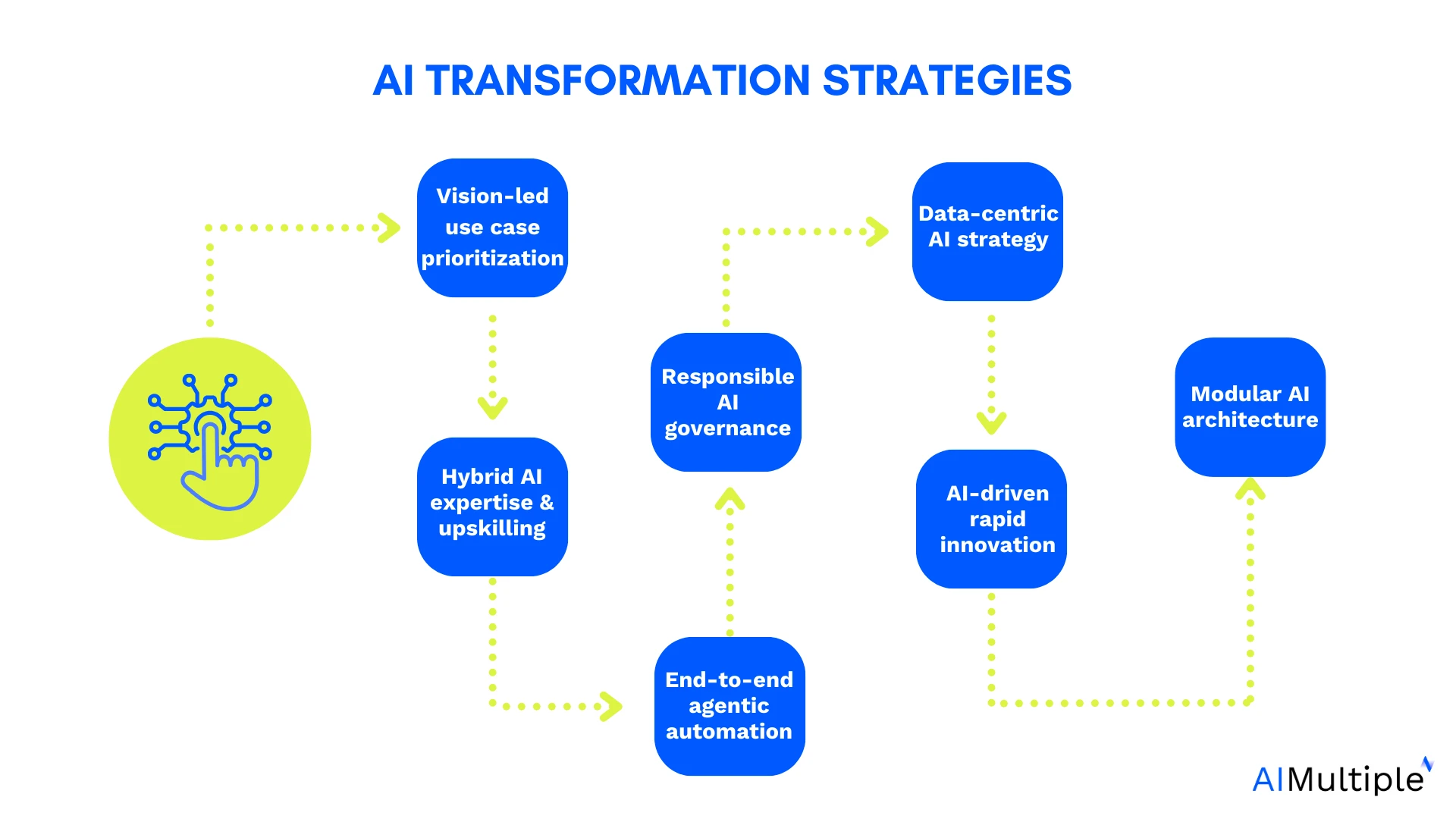
Aşağıda Fortune 500 şirketleri için en önemli adımları listeledik. Daha küçük şirketler, kurum içi ekipleri atlayıp hedefli projeler için danışmanlara güvenmek gibi daha az riskli ve daha az yatırım gerektiren yaklaşımları benimseyebilir.
İşte her stratejinin ilgili gerçek hayattan örnek ayrıntılarıyla kısa bir özeti:
Vaka çalışması kaynakları ilgili her bölümde bulunabilir.
1. AI benimsemesi için net bir vizyon ve stratejik yol haritası tanımlama
Başarılı bir AI dönüşümü, tahmine dayalı analitikten üretken AI'ya (GenAI), büyük dil model'lerine (LLM'ler) ve ajansal AI'ya kadar, AI'ın iş sonuçlarını en önemli ölçüde etkileyebileceği kullanım örneklerini belirleyip önceliklendirmekle başlar. Kuruluşlar, hangi operasyonel iş akışlarının otomasyona en uygun olduğunu ve insan uzmanlığının AI ile hangi noktalarda etkili bir şekilde geliştirilebileceğini değerlendirerek başlamalıdır.
Bu, tekrarlayan görevlerin otomatikleştirilmesini, veri analizinin kolaylaştırılmasını veya büyük, yapılandırılmamış veri kümelerinden içgörü sentezlenmesini içerebilir. Önemli olan, bu kullanım örneklerini genel stratejik hedeflerle uyumlu hale getirerek her AI girişiminin somut sonuçlar üretmesini ve daha yüksek yatırım getirisine katkıda bulunmasını sağlamaktır.
Vaka çalışması:Unilever'in bir AI satın alma ajanı dağıtımı, otonom sistemlerin tedarik zinciri yönetimini nasıl devrim niteliğinde değiştirebileceğini göstermektedir. AI ajanı, tedarikçilerle pazarlık yapabilir ve yıllık $250 milyona varan tasarruf sağlar. Bu vaka çalışması, AI ajanlarının çeşitli fonksiyonlarda operasyonları kolaylaştırma ve maliyet verimliliklerini optimize etme konusundaki muazzam potansiyelini vurgulamaktadır. 3
2. Hibrit bir AI uzmanlık ağı oluşturun
2025'te AI dönüşümünü yönlendirmek isteyen kuruluşlar, son teknoloji teknik yeteneklere ve alana özgü bilgiye erişimleri olduğundan emin olmalıdır. Hibrit bir AI ağı oluşturmak, OpenAI gibi harici AI laboratuvarlarının ve tedarikçilerinin uzmanlığını, iç ekiplerin beceri geliştirmesiyle birleştirmek anlamına gelir. Bu kombinasyon, organizasyona en gelişmiş AI yeteneklerini kazandırdığı ve bu teknolojilerin benzersiz iş zorluklarına nasıl uyarlanabileceğine dair derin bir anlayış geliştirdiği için esastır.
Vaka çalışması: Airbus, yalnızca dışarıdan işe alımlara güvenmek yerine şirket içinde AI becerileri geliştirmeyi seçti. Yaklaşık 2.000 çalışan, yani iş gücünün kabaca %3'ü, yapılandırılmış veri analitiği ve veri bilimi yollarını tamamladı ve personelin üretken AI araçlarını kullanmadan önce zorunlu eğitimi geçmesi gerekiyor. Benzer büyüklükte bir grupla yapılan ayrı bir AI asistanı pilotunda Airbus, ortalama kullanıcının haftada 4 saate kadar tasarruf ettiğini bildirdi.4
Şirketler, yöneticilerden genç mühendislere kadar çeşitli rollere göre uyarlanmış kapsamlı eğitim programlarına yatırım yaparak sürekli öğrenme ve inovasyon kültürünü teşvik edebilir. Ayrıca, süreç madenciliği, müşteri deneyimini otomatikleştirmeye ve iyileştirmeye yardımcı olan, kolay elde edilebilir ve etkili projelerden biridir.
3. Uçtan uca otomasyon için ajansal AI dağıtın
Ajansal AI kavramı, sürekli insan müdahalesi olmadan çok adımlı iş akışlarını yürütebilen otonom sistemlerin dağıtılması etrafında şekillenir. Şirketler, AI ajanlarını iş süreçlerine entegre ederek karmaşık karar alma ve yürütme zincirlerini otomatikleştirebilir. Bu strateji, operasyonel verimliliği optimize eder ve çalışanların yaratıcı ve stratejik düşünme gerektiren daha üst düzey görevlere odaklanmasını sağlar.
Vaka çalışması: Walmart, birçok küçük sözleşme kimsenin yeniden gözden geçirmediği standart şartlarla yürüdüğü için her tedarikçiyle tek müzakere etmekte zorlanıyordu. Pactum'un AI müzakere ajanını devreye aldı. Ajan, tedarikçilerle bir sohbet arayüzü üzerinden konuşur ve her müzakerenin baştan sona, bütçe ve vade sınırları dahilinde yürütür. 89 tedarikçiyle yapılan üç aylık pilotta, ajan %64 ile, %20 hedefe karşılık anlaşmaya vardı ve ortalama 11 günde tamamladı. Aynı anda 2.000 tedarikçiye ölçeklendirildiğinde, ajanlar ortalama %3 civarında tasarruf elde etti.5
4. Sorumlu AI koruma önlemlerini yerleştirin
AI'ın iş operasyonlarının her alanına artan entegrasyonuyla birlikte, etik kullanımı sağlamak ve önyargıyı önlemek hiç olmadığı kadar önemlidir. Sorumlu AI'yı yerleştirmek, AI çıktılarını doğruluk, adalet ve mevzuat uyumu açısından izleyen sağlam gözetim çerçeveleri oluşturmak anlamına gelir. Bu proaktif yaklaşım, kamu güvenini sürdürmek ve AI sistemlerinin şeffaf ve etik bir şekilde çalışmasını sağlamak için hayati öneme sahiptir.
Bir vaka çalışması olarak sorumlu AI uygulamasında, CVS Health'in Amazon Bedrock için AWS Guardrails kullanımı gösterilebilir. Kritik model'leri ve denetim mekanizmalarını entegre ederek CVS Health, eczane chatbot'larının katı FDA yönergelerine tutarlı bir şekilde uymasını sağlarken önyargılı sonuç risklerini de azaltır. Bu tür uygulamalar, risklerin yüksek olduğu ve herhangi bir sapmanın ciddi sonuçları olabileceği sağlık hizmetleri ve diğer hassas sektörlerde kritik öneme sahiptir. 6
5. Veri merkezli AI'da uzmanlaşın
AI girişimlerinin başarısı, veri kalitesi ve yönetimine dayanır. Uzman bir veri merkezli strateji, AI model'lerinin yüksek kaliteli, ilgili ve iyi küratörlü dataset'ler üzerinde eğitilmesini sağlamak için üstün veri yaşam döngüsü yönetimi uygulamalarına yatırım yapmayı içerir. Böyle bir temel olmadan, en gelişmiş AI sistemleri bile düşük performans gösterebilir ve güvenilmez çıktılar üretebilir.
Vaka çalışması:
40 milyon ürünü olan ABD'li bir çevrimiçi ev eşyaları perakendecisi Wayfair, tedarikçi tarafından sağlanan ürün etiketlerinin hatalı ve tutarsız olması ve manuel yeniden etiketlemenin bunları düzeltmek için çok yavaş kalması nedeniyle arama AI'ının düşük performans gösterdiğini tespit etti. Wayfair, veri merkezli bir AI platformu olan Snorkel Flow'u kullanarak ürün kataloğu verilerini temizledi, tekilleştirdi, programatik olarak etiketledi ve sürekli doğruladı; böylece etiketleme model'leri için daha yüksek kaliteli eğitim verileri elde etti.
Sonuçlar:
- Ürün verileri manuel etiketlemeye kıyasla 10x daha hızlı etiketlendi
- Tedarikçi etiketleriyle eğitilen model'lere kıyasla 20 puan daha yüksek model doğruluğu
- Aylar yerine günler içinde oluşturulan 46 etiket model'i
- Tıklama oranında 7 puanlık artış ve sepete ekleme oranında 5 puanlık artış
- Önceki kategori temel çizgilerine kıyasla %98,97 kazanma oranı
- Tahmini olarak altı yıllık çalışan emeğinden tasarruf edildi.7
6. AI odaklı inovasyon
AI alanındaki inovasyon tek seferlik bir çaba değil, yinelemeli testlerden ve hızlı prototiplemeden yararlanan sürekli bir süreçtir. AI odaklı inovasyon sprint'leri, yeni fikirleri kuruluş genelinde ölçeklendirmeden önce hızla test etmek ve doğrulamak için stratejik bir yaklaşım sunar. Bu sprint'ler, şirketlerin pazarlama içerik üretimi, tahmine dayalı bakım ve müşteri hizmetleri iyileştirmeleri genelinde GenAI uygulamalarıyla deneme yapmasını sağlar.
Vaka çalışması: L’Oréal bu stratejinin çarpıcı bir örneğini sunmaktadır. L’Oréal, hedeflenmiş AI inovasyon sprint'leri yürüterek trend analizi ve ürün fikri geliştirme için ChatGPT-4 gibi araçları kullanarak ürün geliştirme döngülerini 18 aydan 4 haftaya indirebilmiştir. Bu yaklaşım, inovasyon sürecini hızlandırır ve yeni ürün ve hizmetlerin pazara sunulma süresini kısaltır. 10
7. Modüler AI ile ölçeklendirin
Modüler bir AI mimarisi, kuruluşların OpenAI'nın araç paketinden açık kaynaklı çözümlere kadar çeşitli AI model'lerini ölçeklenebilir bir sisteme entegre etmesine olanak tanır. Bu, işletmelerin tek bir tedarikçiye bağımlı olmamasını ve yeni gelişmeler ortaya çıktıkça bunları benimsemeye hazır olmasını sağlar.
Vaka çalışması: Samsung'un Gauss LLM'i, modüler bir mimariyi uygulamalı olarak göstermektedir. Samsung, çeşitli AI model'lerini entegre ederek kod üretiminden müşteri desteğine kadar çeşitli görevleri optimize etmiştir. Bu entegre yaklaşım, sistemin genel performansını artırmakla kalmaz, aynı zamanda kuruluşun önemli ölçüde yeniden çalışma olmadan yeni model'lere veya teknolojilere hızla geçebilmesini sağlar. 9
AI dönüşümünün önündeki engeller nelerdir?
AI dönüşümünün karşı karşıya olduğu en önemli engeller şunlardır:
- Organizasyonda yetersiz AI yeteneği ve deneyimi.
- Veri kalitesi sorunları ve yetersiz veri.
- Uygulanabilir iş kullanım örneklerini belirlemede zorluklar.
- Şirket kültürü çoğu zaman AI'ın değerini fark edemez.
En iyi uygulamalar nelerdir?
Mevcut araştırmaları ve görüşmeleri incelememize dayanarak:
- Net hedefler belirleyin: AI'ın çözebileceği belirli iş zorluklarını belirleyin ve bu girişimlerin stratejik hedeflerinizle uyumlu olmasını sağlayın.
- Sağlam bir entegrasyon çerçevesi oluşturun: Veri yönetişimi, model eğitimi, BT entegrasyonu, performans izleme ve mevzuat uyumu için net yönergeler belirleyin.
- Pilot projelerle başlayın: Ölçeklendirmeden önce AI etkinliğini değerlendirmek, içgörü toplamak ve riskleri en aza indirmek için küçük ölçekli pilotlar başlatın.
- Sürekli yineleme uygulayın: AI performansını düzenli olarak değerlendirin, kullanıcı geri bildirimi toplayın ve gelişen iş ihtiyaçlarına uyum sağlamak için model'leri iyileştirin.
- Uzmanlarla ortaklık kurun ve iç beceriler geliştirin: Sürdürülebilir dönüşümü sağlamak için ekibinizi geliştirmeye yatırım yaparken deneyimli LLM tedarikçileriyle iş birliği yapın.
- Güvenlik ve etik uygulamalara öncelik verin: AI yaşam döngüsü boyunca önyargıları ele alın, şeffaflığı sağlayın ve güçlü veri gizliliği önlemleri uygulayın.
- Çapraz fonksiyonel iş birliğini teşvik edin: AI girişimlerini daha geniş iş stratejileriyle uyumlu hale getirmek için departmanlar arası iletişimi ve ekip çalışmasını destekleyin.
- Kullanıcı deneyimine odaklanın: Mevcut iş akışlarıyla kolayca entegre olan sezgisel araçlar tasarlayın ve kullanıcı benimsemesini aktif olarak teşvik edin.
- Geleceğe hazır bir strateji benimseyin: Sürekli öğrenmeyi sağlayan, yeni teknolojilere uyum sağlayan ve tek bir tedarikçiye bağımlılığı azaltan esnek mimariler oluşturun.
 Tercih edilen kaynak olarak ekle
AI süreç dönüşümü metodolojisi
Bu görünümü oluşturmak için üç genel dataset'i birleştirdik.
Üç dataset şunlardır:
- Anthropic Economic Index (AEI): Anthropic'in Claude'un gerçek dünyada nasıl kullanıldığını ölçen araştırma dataset'idir. Mart 2026 sürümü, görev türüne göre etiketlenmiş bir milyondan fazla görüşmeyi kapsar. Bize bugün AI'ın hangi görevlere uygulandığını söyler.
- O*NET: ABD Çalışma Bakanlığı'nın meslekler veritabanıdır. Her iş için, ilgili belirli görevleri listeler (örneğin, bir muhasebeci için "rapor hazırlamak üzere mali kayıtları analiz etmek"). Bize insanların gerçekte hangi işleri yaptığını söyler.
- APQC Process Classification Framework (PCF): "Finansal Kaynakları Yönetme" gibi geniş kategorilerden "Borç hesaplarını işleme" gibi bireysel faaliyetlere kadar beş hiyerarşi seviyesinde (L1'den L5'e) düzenlenmiş standart kurumsal iş süreçleri taksonomisidir. Bize işletmelerin işi nasıl organize ettiğini söyler.
Zorluk: AEI mesleki görevlere göre düzenlenmiştir, oysa işletmeler süreç taksonomileriyle düşünür. Bu ikisini birbirine bağlamamız gerekiyordu.
Adım 1: AEI'yı mesleki görevlere bağlayın
24 Mart 2026 AEI sürümünü aldık ve küresel örneği kullandık. Her görev için önceliklendirmeyle ilgili metrikleri çektik: AI'ın ne sıklıkta kullanıldığı, insanların onunla nasıl iş birliği yaptığı (devretme, yineleme, doğrulama veya öğrenme), AI'ın ne kadar otonom çalıştığı, gereken tipik eğitim seviyesi, insanların görevi yapabilecekleri bir şey olarak bildirip bildirmediği ve AI'ın ne sıklıkta başarılı olduğu.
AEI, her görevi O*NET görev ifadelerindeki tam ifadeleri kullanarak etiketlediği için bağlantı doğrudandır. Görevlerin yaklaşık %7'i birden fazla meslekte görünür. Bu durumlarda ilk listeleneni kullandık.
Adım 2: Mesleki görevleri kurumsal süreçlere bağlayın
Bu adım daha zordur çünkü aynı görev birden fazla iş sürecinde görünebilir ve O*NET ile PCF arasındaki ifadeler nadiren tam olarak eşleşir. Bunu iki katmanda çözdük:
- Aday havuzunu filtreleyin. 13 PCF üst düzey kategorisinin her biri için, makul ölçüde bu tür işi yapan meslekleri tuttuk. Örneğin, "Vizyon ve Strateji Geliştirme" üst düzey yöneticiler, yönetim analistleri ve pazar araştırması analistleri ile sınırlandırıldı. Bu filtreyi, standart ABD mesleki kodlama sistemini kullanarak 13 kategorinin tamamı için manuel olarak oluşturduk.
- Bu havuz içinde en iyi eşleşmeyi bulun. Her O*NET görev tanımının her PCF süreç tanımıyla ne kadar yakından eşleştiğini puanlamak için bir cümle benzerliği model'i (MiniLM adlı yaygın kullanılan bir açık kaynak model) kullandık. Her PCF süreci için en yüksek puanlı eşleşme seçildi.
Eşleşme güveni
Her eşleşme 0 ile 1 arasında bir benzerlik puanı aldı:
- Yüksek güven (puan 0.65 veya üzeri): 306 eşleşme (%20)
- Orta güven (0.50 ile 0.65 arası): 1.037 eşleşme (%66)
- Düşük güven (0.35 ile 0.50 arası): 220 eşleşme (%14)
- Güvenilir eşleşme yok (0.35 altı): 5 eşleşme
1.568 ayrıntılı PCF satırının tamamı (L4 faaliyetleri ve L5 görevleri) bir eşleşme aldı. Daha üst seviyeler (L1'den L3'e) doğrudan eşleştirme için fazla soyuttur ve hiyerarşi ile gruplama için kullanılır.
Yukarıda grafiğini çizdiğimiz veriler aşağıdadır:
Not: Tablo tüm dataset'i gösterirken, grafikler daha iyi okunabilirlik için sıfır AI maruziyeti olan görevleri hariç tutar.
Hariç tuttuklarımız ve nedenleri
- AEI, örneklem haftası boyunca güvenilir sonuçlar çıkaracak kadar çok görüşmede yer alan görevler için kullanım verilerini raporlar.
- Eşleşen süreçlerin %57'i için ilgili O*NET görevi bu eşiğin altına düştü; bu nedenle AI benimsemesinin kesin seviyesini belirleyemiyoruz.
- Bunları tahmin etmek yerine grafiklerden çıkardık. Bunlar mutlaka düşük öncelikli değildir; onları yerleştirecek kanıttan yoksunuz.
- Grafikler, hem AI maruziyeti hem de doğrulama süresinde ölçülebilir bir sinyale sahip olduğumuz 327 süreci göstermektedir.
AI hakkında daha fazlası
AI'ın işinizi nasıl dönüştürebileceği hakkında daha fazla bilgi edinmek için, kendinizi ücretsiz hissederek diğer AI makalelerimize göz atın:
- En İyi AI Kullanım Örnekleri / Uygulamaları
- En İyi 50 Derin Öğrenme Kullanım Örneği ve Vaka Çalışmaları.
Bu araştırmayı kaynak gösterin
Yayınlayacağınız yere uygun formatı seçin. Bağlantılı sürümü CMS'inize yapıştırmak, geri bağlantıyı korur.
@misc{dilmegani2026,
  author = {Dilmegani, Cem and Şimşek, Hazal},
  title  = {{7 Faydalı AI Dönüşüm Stratejileri}},
  year   = {2026},
  month  = nov,
  howpublished    = {\url{https://aimultiple.com/ai-transformation}},
  note   = {AIMultiple. Erişim tarihi: 9 Kasım 2026}
}1.0 bin veri noktasının sonuçları ve zaman damgaları. Bu makaledeki grafik ve tablolarda gösterilen özet verileri, 5 CSV dosyası ve bir README içeren ZIP dosyası olarak indirin.
Arkasındaki ayrıntılı veriyi ister misiniz? Premium'a katılın
Değişiklik günlüğü
4 güncellemeAnthropic Economic Index verilerini APQC süreç kategorileriyle eşleyen, yapay zeka kullanımı ve doğrulama süresi grafikleri içeren bir giriş bölümü eklendi.
AEI, O*NET ve APQC PCF veri kümesi eşleştirme yaklaşımını açıklayan bir yapay zeka süreç dönüşümü metodoloji bölümü eklendi.
Referans Linkleri


Yorumlar 1
Düşüncelerinizi Paylaşın
E-posta adresiniz yayınlanmayacak. Tüm alanlar gereklidir. Yorumlar orijinal dilinde bırakılır.
Great insight on AI and the transformation progression. I found the industries currently impacted interesting also.