


Benchmark des outils de revue de code IA

Avec l'utilisation accrue des outils de codage IA, les bases de code sont devenues plus vulnérables, ce qui a accru le besoin de revues de code efficaces. Pour y répondre, nous présentons RevEval (IA Code Review Eval), qui évalue les quatre principaux outils de revue de code IA sur 309 pull requests issues de dépôts de tailles variées et mesure leurs performances à l'aide des retours de 10 développeurs et d'un LLM-as-a-judge.
Résultats du benchmark
CodeRabbit s'est classé comme l'outil de revue de code le plus performant sur 51 % des 309 PRs :
Pour mesurer le classement, nous avons utilisé les scores du LLM-as-a-judge. Nous avons examiné quel outil de revue de code IA obtenait le score le plus élevé dans chaque PR (noté à l'aide de notre LLM-as-a-judge), puis nous avons calculé le pourcentage de toutes les PRs dans lesquelles chaque outil se classait premier.
CodeRabbit a obtenu les meilleurs scores tant dans les évaluations humaines manuelles que dans les évaluations du LLM-as-a-judge, suivi de Greptile et de GitHub Copilot :
Lors du calcul du score moyen, les trois catégories d'évaluation ont été pondérées de manière égale. Les scores des grands dépôts et des petits dépôts ont été évalués par le LLM-as-a-judge, et les évaluations des développeurs ont été effectuées manuellement pour vérifier les scores du LLM-as-a-judge.
Évaluations humaines
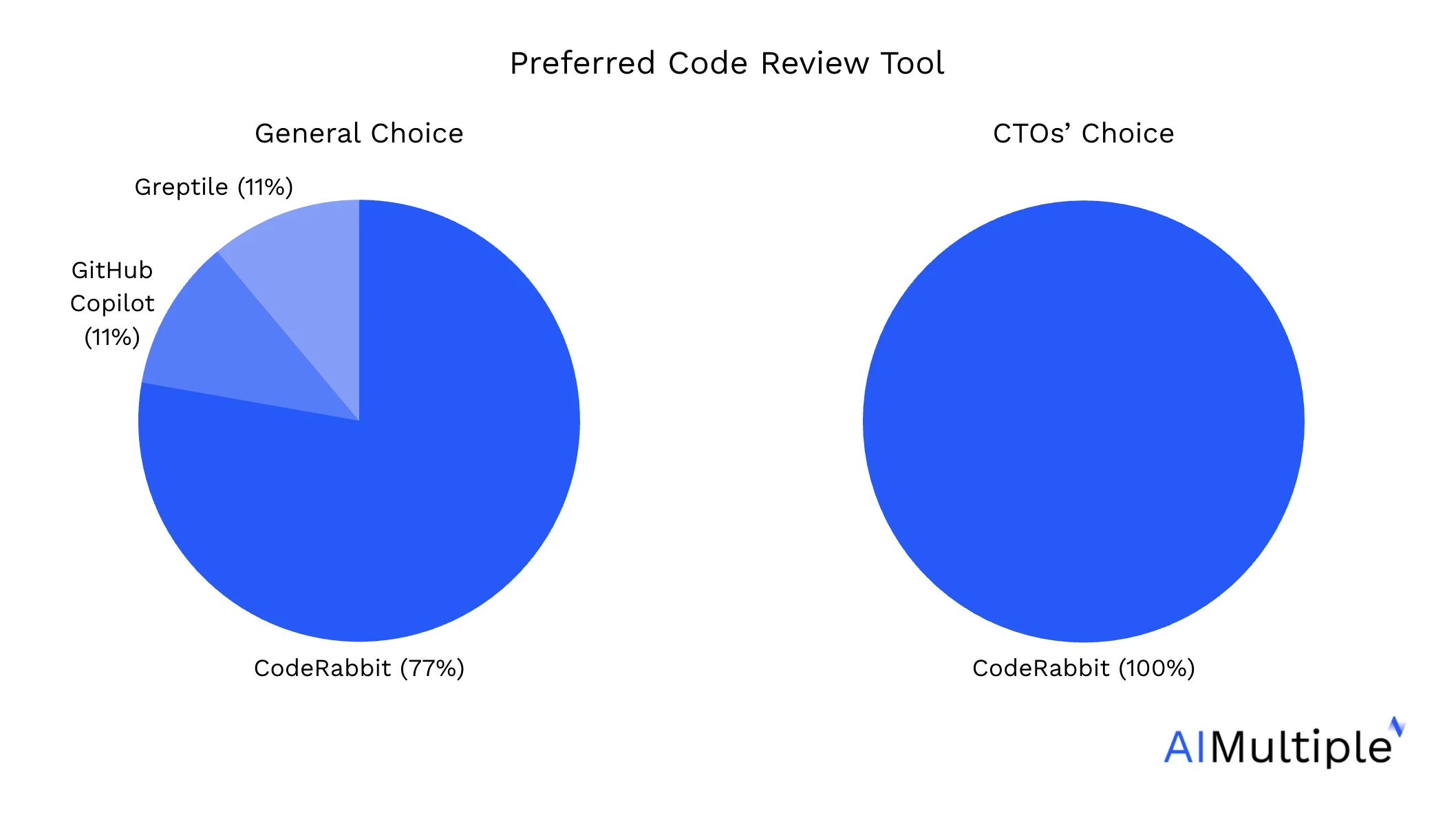
Nous avons demandé aux développeurs ayant participé aux évaluations quel outil de revue de code IA ils préféreraient intégrer à leurs flux de travail. Comme les CTO jouent un rôle décisionnel clé dans le développement logiciel, nous avons mis en évidence leurs réponses dans un graphique distinct :
Comparaison détaillée
Nous avons calculé le nombre moyen de bugs par PR en comptant tous les bugs/problèmes signalés par chaque outil de revue de code et en divisant par le nombre total de PRs (309). Toutes les PRs de notre base de code ne contiennent pas de bugs ou de problèmes. GitHub Copilot ne signale pas explicitement lorsqu'il détecte un bug dans une PR ; il a donc été exclu de cette comparaison.
Vous pouvez consulter notre méthodologie ci-dessous.
Fonctionnalités
* Elle est fournie par la fonctionnalité « agentic pre-merge checks » de CodeRabbit. Elle valide automatiquement les pull requests par rapport aux normes de qualité et aux exigences organisationnelles personnalisées avant la fusion, et renvoie des résultats de réussite/échec avec des explications directement dans la présentation de la PR. Chaque vérification peut être configurée pour avertir les développeurs ou bloquer entièrement les fusions. Bien que GitHub Copilot, Cursor BugBot et Greptile proposent des fonctionnalités de revue de PR, ils fonctionnent comme des systèmes consultatifs qui offrent des retours et des suggestions plutôt que des cadres de validation systématiques.
** Cursor et GitHub Copilot peuvent offrir plus de capacités au-delà de leurs composants de revue de code ; seules les fonctionnalités de Cursor Bugbot et de GitHub Copilot Code Review sont incluses dans notre comparaison.
Les fonctionnalités varient selon les formules d'abonnement ; certaines fonctionnalités indiquées comme disponibles ci-dessus peuvent ne pas l'être dans votre abonnement.
Pour les revues de code automatisées, CodeRabbit, GitHub Copilot et Cursor Bugbot ont été plus faciles à configurer que Greptile, car les revues de code automatisées ne peuvent pas être activées pour un dépôt vide dans Greptile.
Analyse approfondie des fonctionnalités
CodeRabbit
- 40+ linters et scanners de sécurité intégrés.
- Instructions personnalisées basées sur des motifs AST.
- S'adapte aux retours des développeurs au fil du temps.
- Les développeurs peuvent mentionner @coderabbitai pour poser des questions de suivi, demander des corrections ou remettre en question les recommandations.
- Prend en charge les serveurs MCP personnalisés pour du contexte supplémentaire.
GitHub Copilot Code Review
- Le bouton « Implement suggestion » transmet le relais à l'agent de codage Copilot.
- Intégration étroite avec l'écosystème GitHub.
- Instructions personnalisées via copilot-instructions.md.
Greptile
- Apprend les normes de codage de l'équipe à partir de l'historique des commentaires de PR.
- Avec les dépôts modèles, les développeurs peuvent référencer des dépôts liés dans greptile.json afin de fournir du contexte supplémentaire.
- Les développeurs peuvent répondre avec @greptileai pour poser des questions de suivi ou demander des suggestions de correction.
- Greptile apprend à partir des retours pouce vers le haut/pouce vers le bas.
- Diagrammes de séquence auto-générés pour toutes les PRs.
Cursor BugBot
- Après qu'un bug a été identifié par BugBot, les développeurs peuvent utiliser le bouton « Fix in Cursor » pour ouvrir rapidement Cursor afin de corriger le bug.
- Les développeurs peuvent personnaliser leurs règles de revue de code dans les fichiers BUGBOT.md.
Nous avions également l'intention d'évaluer Graphite ; toutefois, en raison d'un bug dans leur tableau de bord, nous n'avons pas pu activer les revues de code automatisées pour les nouveaux dépôts. Nous avons contacté leur équipe d'assistance le 25 octobre 2025, mais la réponse n'a pas résolu le problème. Malgré des e-mails de relance et un message dans leur canal Slack, le problème est resté non résolu.
Composants et intégrations
* Toutes ces solutions prennent en charge GitHub.
Méthodologie
Nous avons créé des dépôts de benchmark distincts pour chaque outil au sein de notre organisation GitHub dédiée.
Après avoir activé les revues de code automatiques pour chaque outil dans son dépôt attribué, nous avons ouvert des pull requests en séquence, attendu que l'outil termine sa revue, puis fermé les PRs pour enregistrer les résultats. Nous n'avons modifié ni réglé aucun paramètre d'outil. Chaque outil a été évalué avec sa configuration par défaut, exactement comme installé.
Notre flux de travail commence par le clonage du dépôt source tel qu'il existait à une date de référence choisie, puis rejoue les pull requests soumises après cette date une par une, en préservant la structure d'origine du dépôt.
Nous avons utilisé les versions de novembre 2025 de tous les produits. Notre benchmark comprenait 2 gammes différentes de dépôts sources :
1. Dépôts bien connus, de taille moyenne à grande
Nous cherchions à voir dans quelle mesure les outils de revue de code IA comprennent les dépôts aux structures vastes et complexes. Nous avons fait examiner 289 PRs au total dans 7 dépôts.
2. Dépôts petits et nouveaux
Nous sommes conscients que nous ne pouvons pas fournir à notre LLM-as-a-judge le
dépôt entier dans les grands dépôts, car leurs fenêtres de contexte ne sont pas suffisantes pour cela. Par conséquent, pour surmonter cela, nous avons également évalué les 3-5 premières PRs de dépôts nouveaux et petits. Les serveurs MCP répondent parfaitement à nos besoins. En conséquence, nous avons choisi 8 serveurs MCP officiels et avons fait examiner 20 PRs sur ceux-ci.
Notre dataset contient du code écrit par des développeurs expérimentés. Nous n'avons pas évalué les performances sur des bases de code entièrement générées par l'IA.
Évaluations des développeurs
Nous avons sélectionné au hasard 35 PRs et les avons attribuées à 10 développeurs, chaque PR étant évaluée 5 fois par des développeurs. Notre objectif en répétant l'évaluation était de minimiser les biais des développeurs. Les développeurs ont évalué les résultats de manière indépendante des fournisseurs.
La plupart d'entre eux sont parvenus aux mêmes conclusions générales :
- Les revues détaillées de CodeRabbit sont utiles, et il réussit bien dans la détection de bugs.
- Greptile a fourni des résumés réussis, mais les diagrammes de séquence qu'il a générés ne sont pas nécessaires pour certaines PRs.
- GitHub Copilot réussit très bien à trouver les fautes de frappe dans le code et fait des suggestions pertinentes ; son analyse est plus courte que celles de CodeRabbit et de Greptile.
- Cursor Bugbot fournit une analyse moins détaillée et moins précise.
Après les évaluations, ils ont également déclaré qu'ils commenceront à les utiliser dans leurs propres dépôts comme outil de soutien pour les développeurs.
LLM-as-a-Judge
Nous avons utilisé GPT-5 pour évaluer les revues. Après l'évaluation, nous avons utilisé GPT-4o pour structurer la sortie au format JSON.
Notre flux de travail d'évaluation comprend :
- Pour les grands dépôts : le corps de la PR d'origine, le diff et les commentaires/revues des outils.
- Pour les petits dépôts : l'ensemble de la base de code, le corps de la PR d'origine, le diff et les commentaires/revues des outils.
Voici le prompt complet que nous avons utilisé :
Évaluez chaque outil sur ces dimensions (échelle de 1 à 5) :
1. Exactitude
Les problèmes identifiés sont-ils réellement de vrais problèmes/bugs/corrections dans le code ?
– 5 (Excellent) : Tous les problèmes identifiés sont de vrais problèmes
– 4 (Bon) : La plupart des problèmes sont réels, quelques erreurs d'identification mineures
– 3 (Acceptable) : Mélange de problèmes réels et discutables
– 2 (Mauvais) : La plupart des problèmes identifiés ne sont pas de vrais problèmes
– 1 (Échec) : Incapable d'identifier les vrais problèmes, toutes les conclusions sont incorrectes
2. Exhaustivité
A-t-il détecté les problèmes importants ? Dans quelle mesure la revue est-elle complète ?
– 5 (Excellent) : Détecte tous les problèmes critiques et la plupart des plus importants.
– 4 (Bon) : Détecte les problèmes majeurs, manque certains problèmes mineurs
– 3 (Acceptable) : Détecte certains problèmes importants mais présente des lacunes notables
– 2 (Mauvais) : Manque plusieurs problèmes critiques
– 1 (Échec) : Manque la totalité ou la quasi-totalité des problèmes critiques
3. Actionnabilité
Les suggestions sont-elles claires et implémentables ? Incluent-elles des correctifs/patchs ? S'il n'y a pas de bugs dans le code, écrivez « null » pour l'actionnabilité pour tous les outils et n'attribuez aucun score à aucun outil pour cette PR.
– 5 (Excellent) : Toutes les suggestions incluent des correctifs/patchs clairs et sont directement implémentables
– 4 (Bon) : La plupart des suggestions fournissent des indications claires, certaines incluent des correctifs
– 3 (Acceptable) : Les suggestions sont assez claires mais manquent de correctifs pour certains problèmes
– 2 (Mauvais) : Les suggestions sont pour la plupart peu claires ou non implémentables
– 1 (Échec) : Aucune suggestion ou indication claire fournie
4. Profondeur
Montre-t-il une compréhension de la logique et de l'objectif du code ?
– 5 (Excellent) : Démontre une compréhension approfondie de la logique du code, de l'architecture et de l'objectif
– 4 (Bon) : Montre une bonne compréhension avec des lacunes mineures
– 3 (Acceptable) : Compréhension superficielle, manque une partie du contexte
– 2 (Mauvais) : Explications superficielles ou incorrectes du comportement du code
– 1 (Échec) : Aucune compréhension de la logique et de l'objectif du code
Format de sortie
Pour chaque outil, fournissez :
1. Raisonnement détaillé : Qu'a-t-il trouvé ? A-t-il manqué des problèmes importants ? Correctifs inclus ? Compréhension approfondie de la base de code ? Exemples spécifiques.
2. Scores individuels (1 à 5 pour chaque dimension, en utilisant l'échelle ci-dessus)
Exemple de sortie
Outil A :
Raisonnement : L'outil A a démontré une excellente exactitude en identifiant une véritable fuite de mémoire dans la logique de groupement de connexions à la ligne 145, fournissant un correctif spécifique à l'aide d'un gestionnaire de contexte. Il a également détecté la gestion d'erreur manquante dans l'endpoint API avec un code actionnable. Le score d'exhaustivité reflète que, bien qu'il ait trouvé des problèmes majeurs, il a manqué la condition de concurrence dans le gestionnaire asynchrone qui pourrait causer des problèmes de production. Les 4 commentaires étaient tous pertinents et directement implémentables. La profondeur était solide, montrant une compréhension des schémas de gestion des ressources et de la propagation des erreurs dans la base de code.
Exactitude : 5
Exhaustivité : 4
Actionnabilité : 5
Profondeur : 4
Outil B :
Raisonnement : L'outil B a correctement identifié la vulnérabilité de validation des entrées à la ligne 89 et a fourni une correction claire utilisant la désinfection des paramètres. Cependant, l'exhaustivité a considérablement souffert car il a manqué la vulnérabilité de sécurité critique dans le flux d'authentification qui permet la réutilisation des tokens. L'actionnabilité était plutôt bonne – les suggestions comprenaient des extraits de code. La profondeur était acceptable mais superficielle, se concentrant sur des vérifications de surface plutôt que sur la compréhension du model de sécurité ou des implications sur le flux de données.
Exactitude : 4
Exhaustivité : 1
Actionnabilité : 4
Profondeur : 2
Outils à évaluer : CodeRabbit, Cursor Bugbot, Github Copilot, Greptile
Soyez objectif et approfondi. Utilisez des exemples spécifiques des revues pour justifier vos scores.
 Ajouter comme source préférée
Qu'est-ce que la revue de code IA ?
La revue de code IA est l'analyse automatisée du code source à l'aide de models de machine learning, principalement de grands models de langage (LLMs), pour identifier les bugs, les inefficacités et les vulnérabilités potentielles. En plus de détecter les problèmes, ces systèmes peuvent fournir des explications contextuelles, suggérer des corrections concrètes et générer des correctifs qui aident les développeurs à améliorer à la fois la qualité du code et sa maintenabilité. De nombreux outils de revue IA aident également à la documentation en résumant les modifications et en produisant des commentaires descriptifs ou des explications pour le code nouvellement ajouté.
Parce que les models d'IA peuvent évaluer le code rapidement et à grande échelle, ils accélèrent considérablement le processus de revue et facilitent la détection précoce des problèmes tout en maintenant des normes de codage cohérentes sur des projets vastes ou en évolution rapide.
Dans les environnements de développement modernes assistés par l'IA, tels que Cursor ou Claude Code, les développeurs peuvent perdre involontairement la trace de l'évolution de leur base de code lorsqu'ils pratiquent le « vibe coding » ou s'appuient fortement sur des suggestions auto-générées. Cela peut introduire des vulnérabilités cachées ou des incohérences logiques. Les outils de revue de code IA contribuent à atténuer ces risques en fournissant une couche supplémentaire d'analyse structurée et systématique pour valider et améliorer le code généré par l'IA.
Avantages de la revue de code IA
Efficacité et rapidité
Les outils de revue de code IA peuvent analyser le code en temps réel, fournissant un retour immédiat et signalant les problèmes potentiels au fur et à mesure que les développeurs travaillent. Ils sont capables de détecter des erreurs et des vulnérabilités de sécurité que les réviseurs humains peuvent négliger, en particulier dans les bases de code vastes ou en évolution rapide. En automatisant les vérifications de routine, ces outils permettent aux développeurs de se concentrer sur le raisonnement de haut niveau, la résolution de problèmes complexes et les décisions architecturales.
Amélioration de la qualité du code
Les outils de revue de code IA contribuent à maintenir des normes de codage cohérentes entre les équipes en identifiant les incohérences stylistiques et les écarts par rapport aux bonnes pratiques. Ils offrent également des retours détaillés et des recommandations sur un large éventail de problèmes de codage, allant d'améliorations mineures à des bugs significatifs. Au fil du temps, les développeurs peuvent apprendre de ces retours, affiner leurs habitudes de codage et adopter de nouvelles techniques qui renforcent la qualité globale de leur travail.
Limites et défis
Dépendance excessive aux outils d'IA
Une préoccupation courante concernant la revue de code IA est la dépendance excessive aux retours automatisés. Bien que l'IA puisse être une source précieuse d'informations, elle ne doit pas être traitée comme un substitut complet à l'expertise humaine. Les revues automatisées peuvent accélérer les flux de travail, mais les réviseurs humains restent essentiels pour garantir l'exactitude, la prise en compte du contexte et l'alignement avec les objectifs du projet. Dans notre benchmark, les développeurs ont systématiquement déclaré qu'ils ne s'appuieraient pas aveuglément sur ces outils. Ils les considéraient comme des assistants qui complètent le jugement humain plutôt que de le remplacer.
Gestion des faux positifs et des faux négatifs
Les faux positifs surviennent lorsque l'outil identifie à tort un code fonctionnel comme problématique, tandis que les faux négatifs surviennent lorsque de véritables problèmes sont manqués. Dans notre évaluation, la préoccupation la plus importante concernait les faux négatifs. Les outils étaient plus susceptibles de négliger des problèmes importants que de déclencher des avertissements incorrects. Cela souligne la nécessité d'une amélioration continue des models et des algorithmes sous-jacents.
Pour relever ces défis, les outils de revue de code IA doivent évoluer grâce à un meilleur entraînement, une meilleure gestion du contexte et des capacités de raisonnement plus précises.
Bonnes pratiques pour l'utilisation des revues de code IA
Conseils d'experts
Associez les revues IA aux observations humaines : utilisez les revues de code IA parallèlement aux revues humaines pour garantir que le code est à la fois techniquement solide et aligné sur les objectifs du projet.
Personnalisez les règles en fonction de votre projet : ajustez les règles de l'outil d'IA pour qu'elles correspondent aux normes de codage de votre projet afin de réduire les alertes inutiles.
Utilisez les retours de l'IA comme outil d'apprentissage : traitez les suggestions de l'IA comme un moyen d'apprendre et de s'améliorer, en discutant avec votre équipe pour comprendre pourquoi et comment éviter des problèmes similaires à l'avenir.
Remerciements
Nous exprimons notre sincère gratitude aux développeurs qui ont consacré leur temps et leur expertise à la réalisation des évaluations manuelles :
Aziz Durmaz (CTO dans une entreprise de transport et de logistique)
Berk Kalelioğlu (cofondateur d'un studio de développement de jeux)
Elif Ece Örnek (ingénieure logicielle sur un site de voyage)
Haydar Külekçi (consultant dans une entreprise de technologies de recherche et d'IA)
Mehmet Şirin Can (responsable du développement chez AIMultiple)
Mehmet Korkmaz (CTO dans une entreprise de médias dans le secteur de l'e-sport et des jeux vidéo)
Murat Orno (ancien CTO d'une plateforme de paiement régionale comptant plus de 500 employés)
Orçun Candan (développeur full-stack chez AIMultiple)
Yalçın Börlü (ingénieur logiciel senior dans une entreprise de santé et de bien-être)
Yiğit Dinç (cofondateur d'une entreprise de technologies juridiques)
Nous remercions également les développeurs et les mainteneurs des dépôts open source inclus dans notre benchmark pour leur travail et leurs précieuses contributions à la communauté.
Anonymisation des identités des développeurs d'origine
Pour mener le benchmark de manière responsable, nous avons anonymisé tous les noms et adresses e-mail des développeurs d'origine lors de la relecture des pull requests provenant de dépôts en amont. Étant donné que les dépôts du benchmark sont publics, la conservation des informations originales sur les auteurs pourrait exposer par inadvertance des données personnelles et créer le risque de notifier les développeurs à chaque ouverture ou mise à jour d'une pull request recréée. Bien que GitHub ne notifie généralement pas les auteurs lorsque leurs commits sont rejoués dans un dépôt séparé, nous avons considéré qu'il était préférable d'éviter toute possibilité de notifications non désirées, de problèmes d'attribution ou de préoccupations en matière de confidentialité.
L'anonymisation garantit que :
- Les développeurs ne sont pas dérangés par des milliers d'événements de PR automatisés.
- Les informations personnelles ne sont pas republiées dans un autre dépôt public.
- Les benchmarks restent impartiaux, empêchant les outils ou les juges LLM d'être influencés par des noms d'auteurs reconnaissables.
- Les normes éthiques et de confidentialité sont respectées lors de l'utilisation de contributions open source.
Seules les métadonnées d'identité ont été modifiées ; tout le code, les diffs, l'ordre des commits et les structures de fichiers ont été préservés exactement pour maintenir l'authenticité et la reproductibilité du benchmark.
Citez ce benchmark
Choisissez le format qui correspond à votre lieu de publication. Coller la version avec lien dans votre CMS préserve le lien retour.
@misc{dilmegani2026,
  author = {Dilmegani, Cem and Alper, Şevval},
  title  = {{Benchmark des outils de revue de code IA}},
  year   = {2026},
  month  = mar,
  howpublished    = {\url{https://aimultiple.com/ai-code-review-tools}},
  note   = {AIMultiple. Consulté le 13 mars 2026}
}Résultats et horodatages de 23 points de données. Téléchargez les données de synthèse présentées dans les graphiques et les tableaux de cet article sous forme de fichier ZIP contenant 4 fichiers CSV.
Vous voulez les données détaillées derrière ? Rejoindre Premium
Journal des modifications
1 mises à jourAjout d'un benchmark de quatre outils de révision de code IA à l'article.
Le travail de Cem chez AIMultiple a été cité par des publications mondiales de premier plan, notamment Business Insider, Forbes, Morning Brew et Washington Post, par des entreprises mondiales comme Deloitte et HPE, par des ONG comme World Economic Forum et par des organisations supranationales comme European Commission. [1], [2], [3], [4], [5]
Tout au long de sa carrière, Cem a été consultant en technologies, acheteur de technologies et entrepreneur technologique. Il a conseillé des entreprises sur leurs décisions technologiques chez McKinsey & Company et Altman Solon pendant plus de dix ans. Il a également publié un rapport McKinsey sur la digitalisation.
Il a dirigé la stratégie technologique et les achats d'un opérateur télécom, sous la responsabilité du PDG. Il a également dirigé la croissance commerciale de l'entreprise de technologie profonde Hypatos, qui a atteint un revenu récurrent annuel à 7 chiffres et une valorisation à 9 chiffres, passant de 0 à ce résultat en deux ans. Le travail de Cem chez Hypatos a été couvert par des publications technologiques de premier plan comme TechCrunch et Business Insider.
Cem intervient régulièrement lors de conférences technologiques internationales. Il est diplômé de Bogazici University en tant qu'ingénieur informatique et titulaire d'un MBA de la Columbia Business School.

Şevval se concentre sur les outils de codage IA, les agents IA et les technologies quantiques.





Soyez le premier à commenter
Votre adresse courriel ne sera pas publiée. Tous les champs sont obligatoires. Les commentaires sont laissés dans leur langue d'origine.